






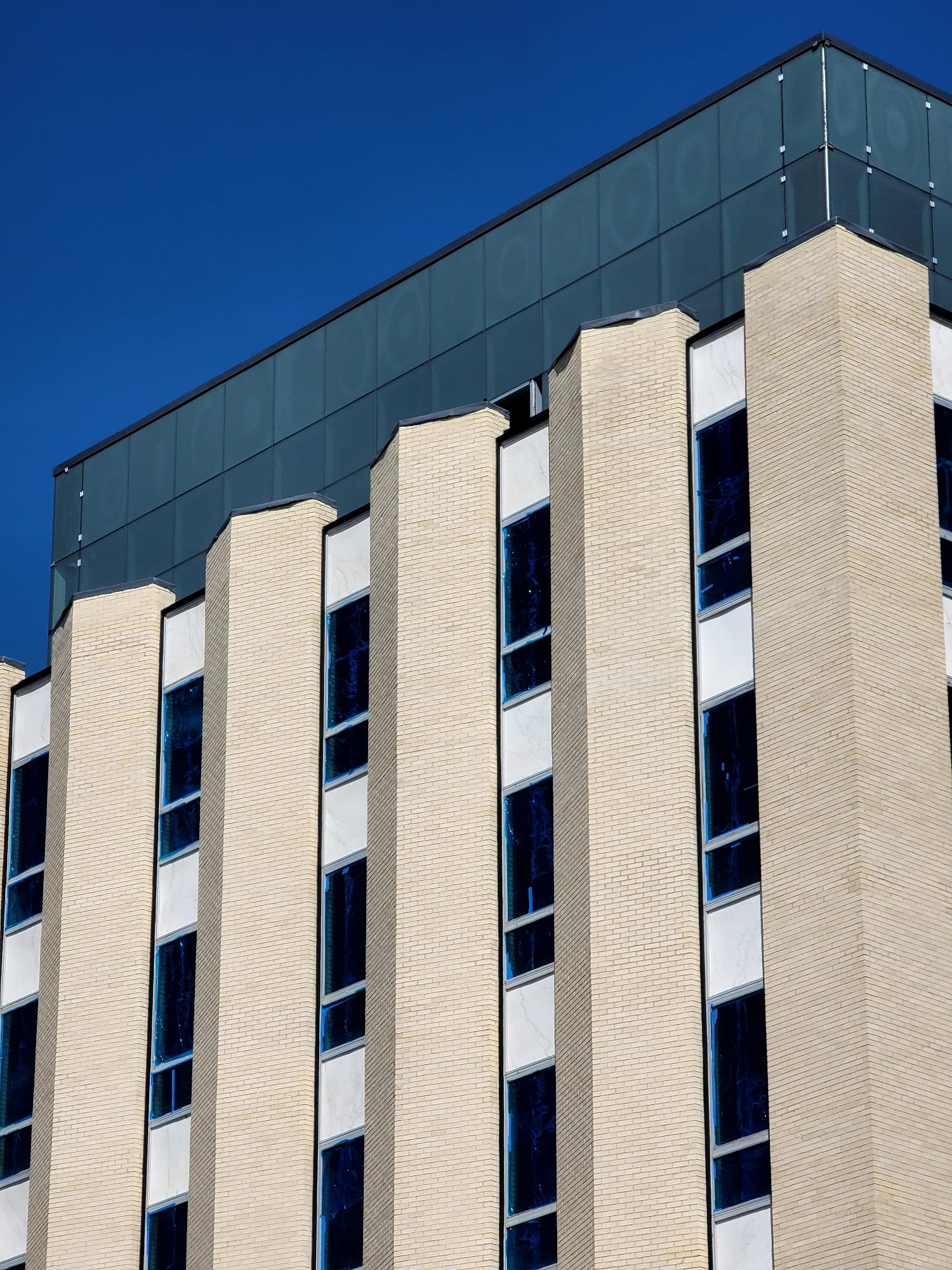
In Durham a great deal of the commercial building stock is a wall that holds the building up. The tobacco warehouses the American Tobacco trust began putting up from 1897, and the districts that grew around them, were built as load-bearing brick exterior walls carrying heavy timber and wood interior framing, the slow burn masonry-and-wood construction documented at the Watts and Yuille Warehouses of 1904 that are now Brightleaf Square. Smith Warehouse runs 850 feet long and 100 feet wide, divided into 12 units of roughly 70 feet each by projecting corbeled firewalls. On a building like that the masonry is not cladding hung off a frame, so a spalling brick face, a joint that has receded or a cracked window head is a structural question and not a cosmetic one. The elevations are also very long, and every projecting firewall and ornamental band along them collects and sheds water in its own way. Where a wall stops shedding water the moisture ends up on interior finishes, and owners are left with interior repairs, tenant complaints and a building losing value while the wall keeps opening.
Presto Restoration runs a full facade restoration, repointing, caulking and coating program built around masonry buildings of this kind. Our crews combine rope access and swing-stage capability at height with restoration products we manufacture ourselves. That lets us take the whole vertical envelope in one scope: repointing eroded joints with a compatible mortar, repairing and replacing spalled brick and cast trim, dealing with the lintels and jambs at very large window openings as the spans they are, refinishing architectural metal and glass, and installing coatings and sealants where the substrate calls for them. The building ends up carrying its load, shedding water, and looking the way it was built to look.
On a load-bearing masonry building the sealed joints are a short list, and they matter out of all proportion to their length: window and door perimeters set into thick brick jambs, joints at panel and trim, and any control joint cut into the wall. Sunlight, movement and repeated wetting take the elasticity out of that material until it tears, shrinks or debonds from one face. Once it has, the joint stops shedding rain and starts delivering it into a jamb or a window head instead. Our technicians cut the spent material out rather than caulking over it, clean and prime the joint faces, and set backer rod to the depth that lets the new bead actually move. Silicone or polyurethane is then chosen for the substrate it has to bond to, which on old brick and cast stone is not the same decision as on metal or glass. Window perimeters, expansion and control joints, panel joints and penetrations are all covered in one coordinated pass over the elevation, because a wall only ends up watertight as a system and never in patches.
The metal on Durham buildings is mostly not curtain wall. It is the framing of very large multi-light industrial window openings, the lintels spanning those openings, storefront and entrance assemblies, canopies and railings, and on downtown’s 1930s work the Art Deco ornament of the sort carried by the Hill Building, 1935 to 1937 and seventeen storeys, by George Watts Carr. Runoff, grit and repeated wetting dull and pit those finishes, and on this construction type crews regularly find that water sitting against embedded steel long enough has corroded it, and the corrosion products expand and begin pushing the surrounding masonry apart. Before budgeting to replace assemblies outright, let our metal team see what can be recovered. Controlled micro-abrasion lifts oxidation, corrosion and embedded contamination, and refinishing brings back the original color and luster. Where corroding steel is the real problem the answer is not cosmetic: the section gets cleaned back to sound metal, protected and reset, so it is no longer levering the brickwork apart from inside the wall. (Refinished metal normally takes a protective clear coat once the work is done: see our Commercial Waterproofing services, which are usually specified in the same package.)
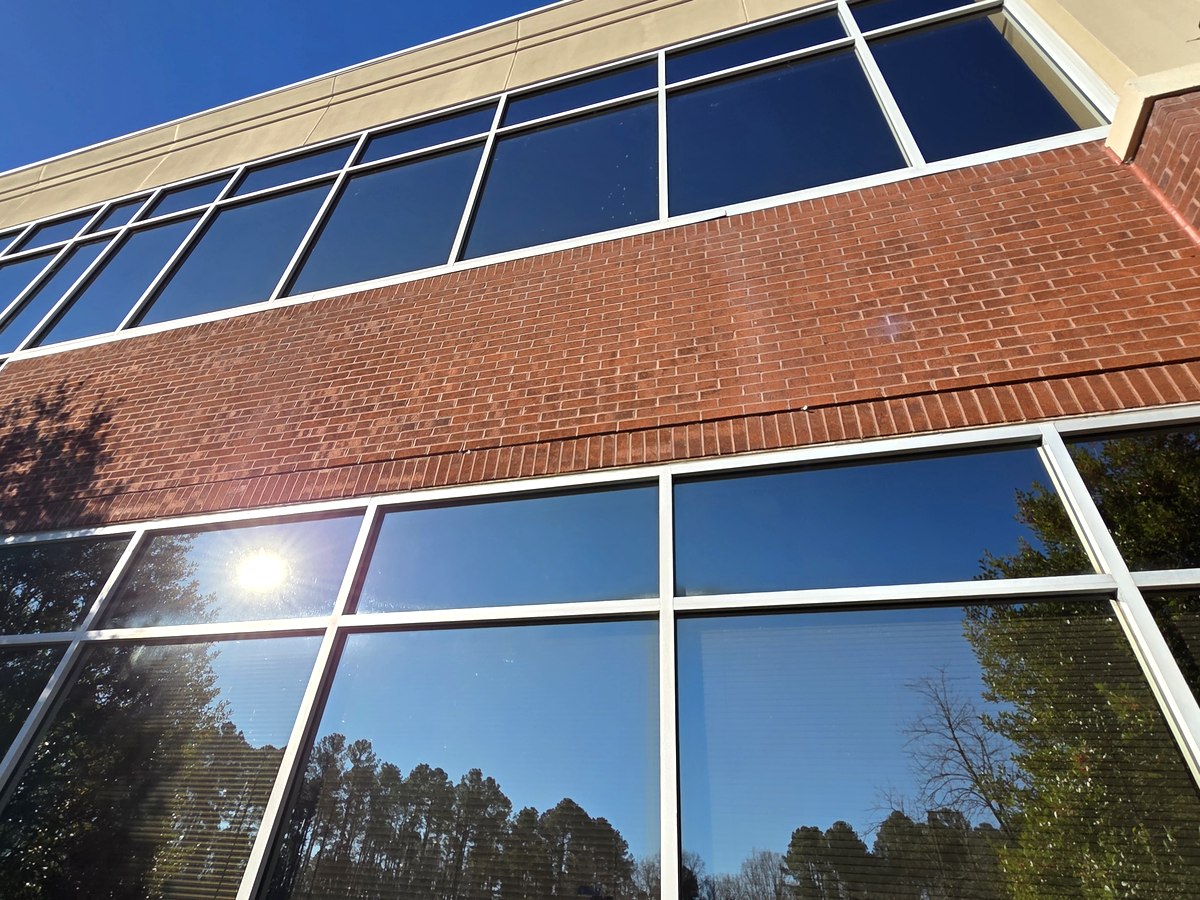
Some glass damage is not dirt, and no cleaning contract will take it off. Water running off brick, mortar and cast trim carries alkaline residue down onto the glass below and etches the surface; sprinkler overspray and hard-water runoff bake mineral deposits into it; and grit dragged across a pane, whether by cleaning or by construction next door, leaves haze and fine scratching. On the very large multi-light openings these warehouse and industrial walls carry, that damage covers a great deal of area at once and it reads from the street. Our chemical restoration process dissolves the staining, lifts the mineral contamination and takes the surface damage back out without sacrificing the glass itself, so the openings read clear again. (To keep it clear once it is back, ask about our proprietary Glass Defender treatment, which is set out on the commercial waterproofing page. Most owners have the two done in one visit.)
Brick, stucco, cast stone and concrete are all porous, and a coating is one way of slowing how much water a wall takes on. It is not the right answer everywhere. On soft historic brick a film that holds vapor behind it can do more damage than the water it keeps out, so on that stock the work is compatible repointing and unit repair first, and a coating only where the substrate and the exposure genuinely call for one. Where one is called for, we install elastomeric systems that cure to a flexible, breathable film. The film moves with the wall as it expands and contracts, bridges hairline cracking up to 1/16 inch, holds bulk water at the face and still lets vapor out of the assembly. The systems come in a full range of factory colors and finishes, so the appearance of the elevation improves along with its performance.
Stone reaches a Durham elevation as sills, lintels, water tables, belt courses and entrance surrounds set into brick walls, as cast stone and precast on downtown buildings, and on Duke’s West Campus as Hillsborough blue stone from the university’s own quarry roughly a dozen miles west, which Duke describes as strong but unpredictably brittle. All of it is porous, so all of it takes on water, stains biologically and pushes salts back out to the face as efflorescence. Every stone scope opens by establishing what the material actually is and then testing the gentlest cleaning that will move the soiling, because the wrong method or the wrong pressure scars the surface permanently and nothing puts it back. Penetrating sealers and breathable coatings follow only where they suit the substrate. Split, spalled and missing pieces are dutchman-repaired or patched, with the repair chosen so it never ends up harder or tighter than the stone it is bonded to.
On a load-bearing brick wall the joints are not a finish detail. They are the part of the structure meant to be given up and renewed, which is why the joint is supposed to be weaker and more permeable than the brick on either side of it: movement and moisture are taken up there instead of in the units. Once the joints have eroded past that point, rain runs through the assembly rather than over it, salts wash out to the face, interior finishes stain, and brick starts working loose.
Our masonry crews cut the failed joints back to sound material at a depth the new mortar can key into, take the old mortar out without chipping the arrises of the brick, fill in lifts, and tool the joint to the profile the wall was given originally, since the profile is what decides where water goes once the joint is closed. The structural repointing and the finer tuckpointing across ornamental brickwork are carried by one crew, and one crew answers for the result.
On this construction type the mix matters as much as the workmanship. Brick laid from the 1870s through to the years before the Second World War, the span the Bright Leaf district buildings were built across, is comparatively soft and was bedded in lime mortar that could absorb movement and let moisture back out through the joint. A hard modern portland mix reverses that relationship. The joint becomes the strongest and tightest thing in the wall, so everything the wall has to accommodate is pushed into the units instead, and the brick faces begin breaking away in a line along the fresh pointing, leaving the elevation worse off than before it was touched. We use lime-based blends kept deliberately weaker and more open than the brick around them, and we arrive at the match by testing the existing mortar rather than by eye.
Presto runs every Durham facade project through the same five phases, arranged so the condition of each elevation is recorded and understood before a price is put against it, so crews and occupants stay safe while the work is under way, and so the building is handed back with a full record of what was done to it.
We survey from grade, then by drone, then from a swing stage or rope with a hand on the wall, because a joint that has receded behind the face or a brick that sounds hollow does not show itself from the sidewalk. Mortar joints, brick faces, stone sills and lintels, ornamental brickwork, corbeled firewalls, window perimeters, coatings, glass and metal are photographed and located on the elevation before anything is priced.
Where the wall may be hiding more than it shows, we test at the wall itself: sounding masonry for delamination behind a face that still looks sound, opening a joint to see what the existing mortar actually is, and checking bearing and anchorage at sills, lintels and copings, so the scope is written for the real condition.
Findings become a line-item scope with measured quantities, named products and a phase order, and on an elevation hundreds of feet long the phasing is most of the planning: where staging sits, how much of the building is affected at once, and in what sequence the bays come down. Your project manager handles access, occupant notice, and permitting through Durham City-County Building & Safety, the single joint department for the city and the county.
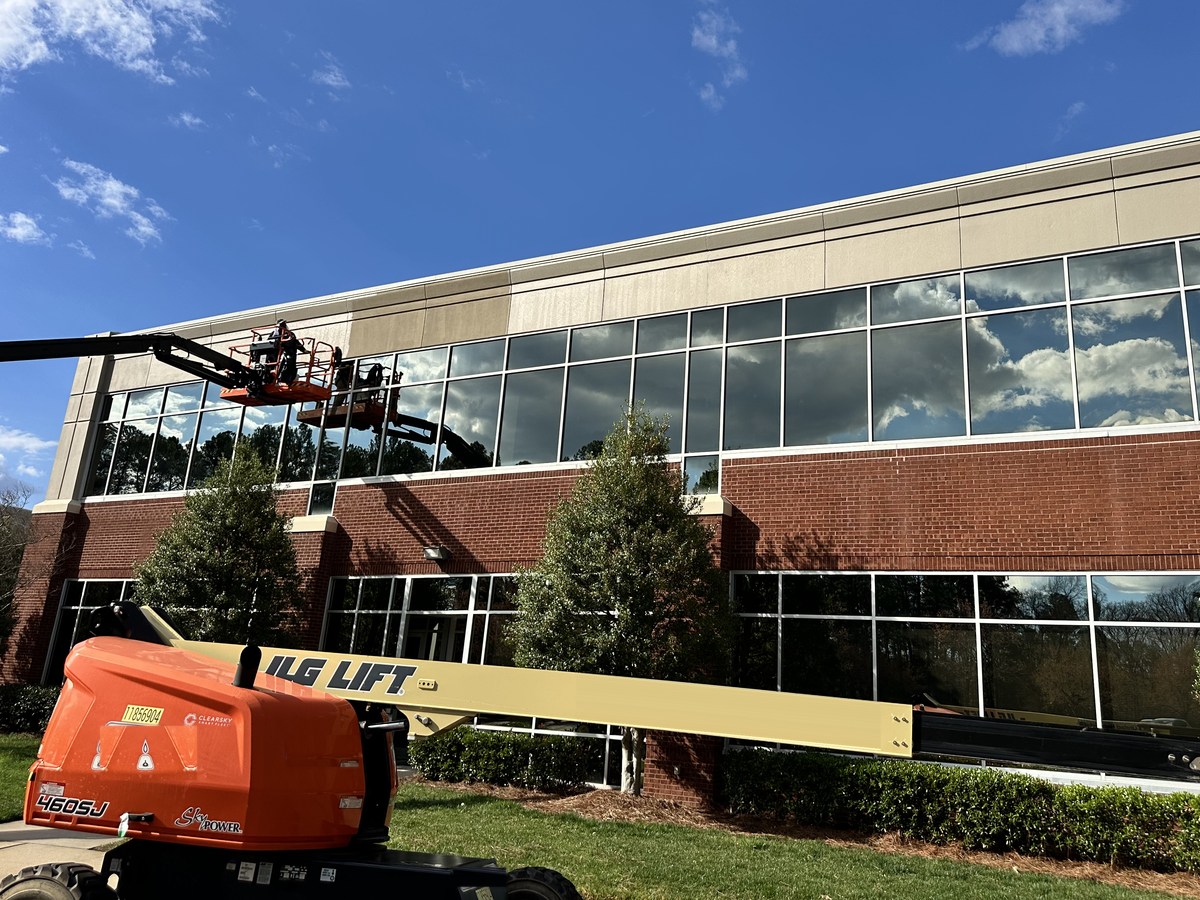
Certified rope-access and swing-stage crews carry out the work to manufacturer specification, and field supervisors hold the standard and log progress daily. On a long elevation divided into bays by projecting firewalls, the units are worked in order, so one stretch is closed and watertight before the next is opened up.
At handover the record goes with the building: warranty documents, product data sheets, before-and-after images bay by bay, and a maintenance schedule naming what to look at on the joints, copings and window heads, and how often to look.
Doing this work properly across downtown Durham, the American Tobacco and Bright Leaf districts, Golden Belt, West Village, Parrish Street, the Duke campuses and Research Triangle Park takes more than a crew passing through for a single job. Presto coordinates a network of specialized divisions so clients get continuous coverage, from a full envelope restoration down to routine facility care.
Property managers who want day-to-day and preventative support can approach our sister divisions directly:
Building Restoration Durham: Targeted structural repair and exterior preservation work at height.
Building Maintenance Durham: The recurring preventative maintenance that keeps a masonry building performing instead of quietly deteriorating between major projects.
Building Services Durham: Day-to-day commercial building support of every kind across Durham and the Triangle.
Presto Restoration has been restoring commercial building exteriors nationwide for more than 25 years. In Durham that experience is aimed at a particular kind of building: load-bearing brick over heavy timber, where the wall is the structure and a masonry defect is a structural one; elevations measured in hundreds of feet, Smith Warehouse being 850 feet long and 100 feet wide in 12 units of roughly 70 feet each divided by projecting corbeled firewalls; ornamental brickwork and corbeling that each collect and shed water differently; very large multi-light industrial window openings whose lintels and jambs have to be treated as spans; and brick soft enough that the mortar specification decides whether repointing helps the wall or ruins it. The work is permitted under the North Carolina State Building Code, 2024 edition, effective 1 July 2025, with its separate Existing Buildings volume, through Durham City-County Building & Safety. Explore our full range of Durham building restoration services.
Not sure how far the wall has actually gone? Tell us what is visible from the ground: mortar you can rake out with a key, brick faces flaking or sounding hollow, cracking stepping up through the joints, rust staining below a window head. We will put the condition on record and lay out the repairs, priced and in the order they need doing.
Call 1-800-785-9927 or Request A Free Quote.
The interval is set by how much water the wall is taking on and how well the joints are still shedding it, not by the age of the building on its own. As planning figures rather than promises: an envelope inspection on a 3-5 year cycle, sealants at 8-12 years, coatings at 10-15 years where one is appropriate, and repointing somewhere in a 20-35 year band on masonry that is otherwise sound. The short end of every one of those ranges belongs to the oldest brick, to parapets and copings, to elevations that never get enough sun to dry out, and to any wall already pointed once with too hard a mix, since that work usually has to come back out before anything else is worth doing.
Look for mortar that has receded behind the face of the brick or comes away as sand when you rake it; brick faces that have flaked, popped or sound hollow when tapped; cracking that steps diagonally through the joints, or runs vertically where a corbeled firewall projects through the elevation; rust staining below a lintel or sill, which usually means embedded steel is corroding and expanding inside the wall; brick displaced or sagging above a wide window head; efflorescence washing down the elevation; sealant torn or debonded at window perimeters; and damp or musty interior finishes against an exterior wall. On a load-bearing wall any one of those is worth having examined properly, because the wall showing the symptom is also the wall holding the floors up.
Yes, and on converted warehouse property it is usually the only workable option, because the tenancies are offices, restaurants, studios and apartments that cannot simply close for a season. Rope access and swing stages put crews on the wall without wrapping the building in scaffolding, which also leaves ground-floor frontages and their entrances open. The loudest operations are scheduled around the hours that matter to those tenants, and on a long building the work advances unit by unit between the firewalls, so only one stretch of elevation is live at a time. Managers and boards get a report as each bay closes out.
Wall area drives the schedule more than height does, which is what tends to surprise owners of long buildings. A defined sealant replacement on a mid-rise can be finished in 2-4 weeks. A full program of repointing, masonry repair, coatings, metal and glass on a tall building generally runs 3-6 months. An elevation 850 feet long and two storeys high carries more square footage of wall than a mid-rise tower does, so it is scoped and phased by the unit rather than by the floor, and the duration follows the total area and the number of access moves. A firm schedule follows the survey, before anything is committed.
Terms follow the systems and methods a particular building actually receives, and on historic masonry that distinction is a real one: repointing in a compatible lime-based mortar, replacing spalled units, a sealant joint, and a coating over brick are four different undertakings carrying four different expectations. Complete warranty documentation is handed over at closeout, and we go through what is covered, and what maintenance keeps it covered, during scoping and before anything is signed.
We do. Permits are filed with Durham City-County Building & Safety, which is one joint department covering the city and the county rather than two separate authorities, under the North Carolina State Building Code and its separate Existing Buildings volume. Where a property sits in a locally designated historic district or is a local landmark, a Certificate of Appropriateness from the Historic Preservation Commission is required for any exterior change, whatever its age or visibility and whether or not a building permit is needed, so that approval is built into the schedule from the start. Our project managers also arrange what work at height needs at ground level, together with the ownership and board approvals and the documentation each of them asks for. Where a general contractor is running other work at the property, permitting is coordinated with them. General liability and workers’ compensation coverage is carried nationwide.
By the time water shows on an interior finish, the wall stopped working some while before. Getting Presto Restoration onto the elevation while the joints are merely open and the brick faces are still sound keeps the scope at repointing rather than rebuilding.
Call us today at 1-800-785-9927 or click Request A Quote.