





Durham’s defining commercial building is the adaptively reused tobacco warehouse: load-bearing brick exterior walls carried over heavy timber and wood interior framing, at a density and a unit scale no other market can claim. The American Tobacco trust began putting up twelve brick tobacco warehouses here in 1897, and the districts that grew around them are still counted building by building: 14 contributing buildings in the American Tobacco Historic District, 1874 into the 1950s, National Register listed in 2000 and redeveloped for offices and mixed use after manufacturing ended in 1987; 22 in Bright Leaf, described in its listing as massive two- to four-storey structures, usually rectangular, with flat or very shallow gable roofs; 116 in Golden Belt. Smith Warehouse alone is 850 feet long and 100 feet wide, divided into 12 units of roughly 70 feet each by projecting corbeled firewalls, which is another way of saying that one building here can carry more continuous parapet, more low-slope roof area and more masonry envelope than a whole block of conventional downtown stock. Brightleaf Square is the Watts and Yuille Warehouses of 1904, two parallel two-storey Romanesque Revival brick warehouses of 75 by 118 feet per floor built as slow burn masonry and wood construction. On this construction type crews routinely meet soft historic brick set against hard modern repointing mortar, corroding original steel lintels, and deflection at large multi-light industrial window openings. None of that stays a small repair once it starts, because on a building of that length the same defect repeats the whole way along the wall.
Presto Restoration is a commercial restoration and waterproofing contractor operating nationwide, with more than 25 years behind it on high-rise buildings, parking structures and historic properties. Working here means working inside a strict review regime: a Certificate of Appropriateness from the Historic Preservation Commission is required for any exterior change to a property in a designated local historic district or to a local landmark, regardless of the building’s age, regardless of whether the change can be seen from the street, and regardless of whether a building permit would be needed at all. Minor work is reviewed by staff in about ten business days and major work waits for a monthly public hearing, which is a scheduling fact worth knowing before a scope is written rather than after. We bring industrial-grade caulking systems, elastomeric waterproof coatings and proprietary glass, metal and stone restoration products, and we specify repointing mortars and sealants to suit soft historic brick rather than to outperform it. From converted warehouse floors at American Tobacco, Brightleaf, Golden Belt and West Village to the seventeen storeys of the 1935-37 Hill Building downtown, we renew a property’s appearance and re-establish the moisture barrier that protects its value.
Presto Restoration delivers a complete lineup of exterior building restoration, waterproofing, and consulting services for commercial properties across Durham, from downtown and the American Tobacco and Brightleaf districts to Golden Belt, West Village, Duke’s East and West Campus, and Research Triangle Park.
Nothing strips value from a commercial building faster than an envelope that has stopped keeping water out. Here the envelope gets treated as one continuous system: parapets, plaza decks, exterior wall assemblies and window perimeters, all carrying high-performance membranes and sealants. That system stops at grade. Presto works above grade only and takes on no foundations and no below-grade waterproofing. On a warehouse conversion the linear footage is the whole problem: parapet, coping, window head and firewall junctions run for hundreds of feet on a single structure, and every foot of that either holds or does not.
A building’s facade does double duty in Durham. It keeps water out of a wall assembly that is frequently the structure itself, and it tells tenants and investors how carefully the asset is being run. Restoring both means complete caulking and sealant replacement, architectural metal refinishing, glass renewal, and elastomeric waterproof coatings. Masonry cleaning and repointing with a mortar softer than the brick it sits between round out the scope, and the wall comes back watertight without looking freshly patched.
View Our Durham Facade Restoration Services →
Durham parking structures take punishment from every direction: constant vehicle traffic, dripped fluids and chlorides, and water that stands on exposed decks and ramps where drainage has stopped working. Once a traffic membrane is worn through or an expansion joint has opened, water gets to the rebar and the concrete begins coming apart. Decks serving converted warehouse floors and downtown offices carry steady weekday turnover rather than a residential cycle, so the wear concentrates at the same drive lanes and ramp turns year after year. The fix is a traffic coating system, concrete repair, expansion joint replacement and structural waterproofing, applied across the whole deck rather than at the visible spalls.
Tearing off a commercial roof in Durham is disruptive, expensive and frequently avoidable. Where the deck and structure are still sound, restoration buys another 10-20 years of service for a fraction of what a tear-off costs. That work means high-performance silicone and elastomeric coating systems, flashings and penetration seals rebuilt, and drainage corrected so nothing is left standing on the membrane. Roof area is the number that governs on this stock: a single warehouse building can hold a low-slope field larger than several ordinary downtown roofs put together, and every lap, curb and drain across that field has to hold.
Durham’s architectural heritage is industrial before it is anything else, from the tobacco districts at American Tobacco, Brightleaf and Golden Belt to the 97 contributing buildings of the Downtown Durham Historic District, listed in 1977 and dating primarily from the first four decades of the 20th century in Colonial Revival, Italianate and Art Deco. Parrish Street, where North Carolina Mutual Life moved its headquarters in 1906 and Mechanics and Farmers Bank followed in 1907, is a four-block corridor whose history deserves accuracy rather than ornament. Buildings like these need period-correct materials, craftsmen who have handled them before, and a Certificate of Appropriateness before any exterior change inside a local historic district. Duke’s West Campus adds the region’s rarest substrate, Hillsborough blue stone from a Duke-owned quarry roughly a dozen miles west, which the university itself calls strong but unpredictably brittle. Owners, architects and the Commission are all in the same conversation before we stabilize a structure or rebuild original detailing. Nothing in the scope is allowed to cost a building the detail that got it listed in the first place.
Chronic leaks in Durham buildings almost never announce themselves where they begin; on a long brick warehouse elevation water can enter at a parapet or a firewall junction and surface a full bay away. Finding the real opening takes controlled water testing, infrared thermography where conditions allow, moisture meter surveys, drone imaging and close hands-on inspection of the facade itself. What comes back is a scope built on what was proven, not on where the stain happened to appear.
For more than 25 years Presto Restoration has been restoring and waterproofing commercial buildings across the United States. That national record is paired with working knowledge of what this market actually asks for: repointing and lintel work on load-bearing brick over heavy timber, parapet and low-slope runs measured in hundreds of feet per building, the North Carolina State Building Code in its 2024 edition effective 1 July 2025 with its separate Existing Buildings Code volume, permitting through one joint department in Durham City-County Building and Safety rather than two authorities, and Certificate of Appropriateness review for any exterior change inside a local historic district.
Serving downtown Durham, the warehouse conversions around it and the Research Triangle Park campuses to the southeast at an elite level takes locally rooted infrastructure. Presto coordinates with specialized support networks across the Triangle so that a client gets complete building care, from major structural restoration down to routine facility upkeep.
Property managers looking for routine upkeep and localized facility work should start with our sister divisions:
Building Restoration Durham: Focused on localized structural repairs and high-rise exterior preservation.
Building Maintenance Durham: Dedicated to the ongoing preventative maintenance that keeps your Durham property performing at its best.
Building Services Durham: Your resource for comprehensive, day-to-day commercial building support across the Durham market.
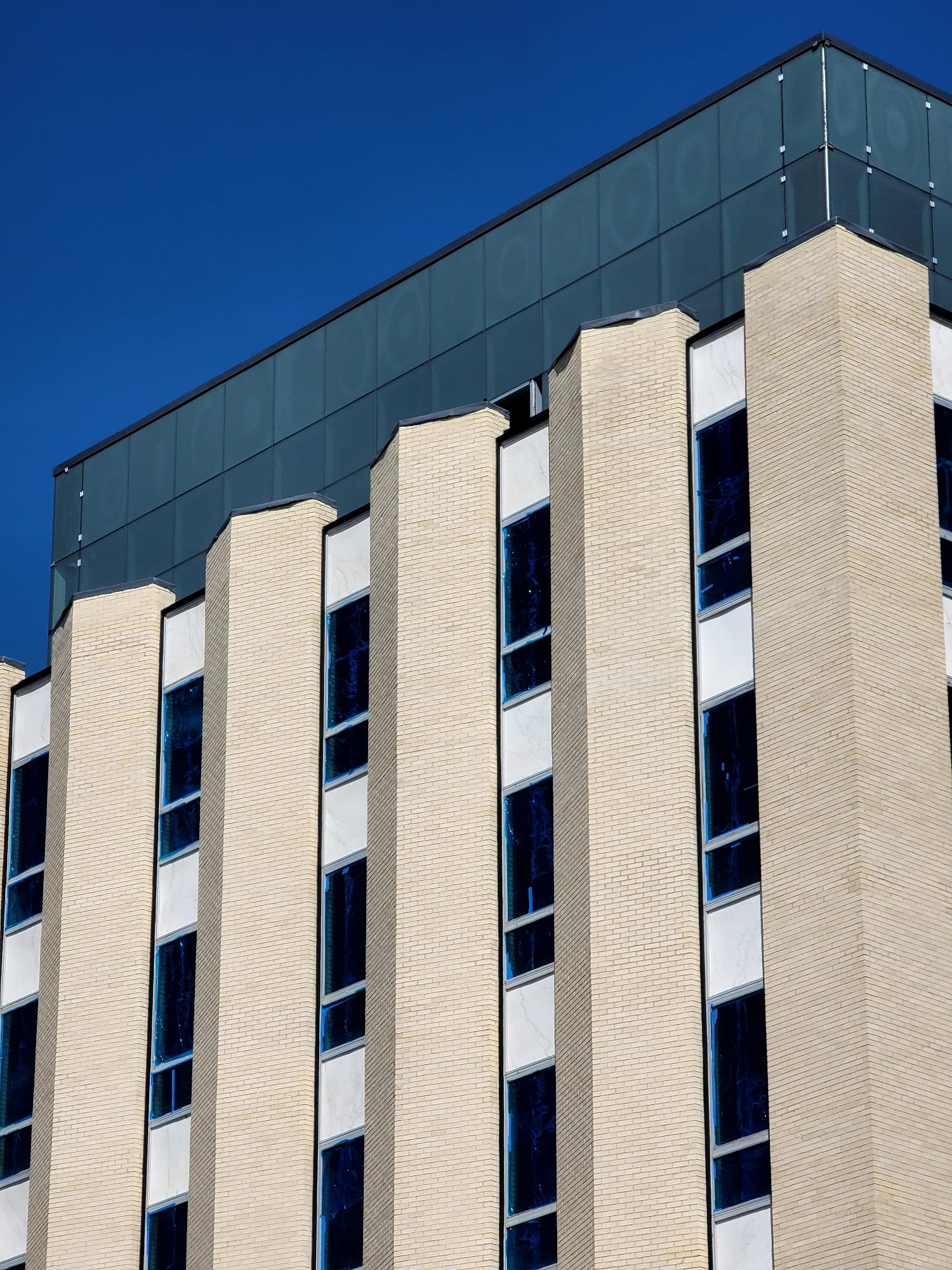
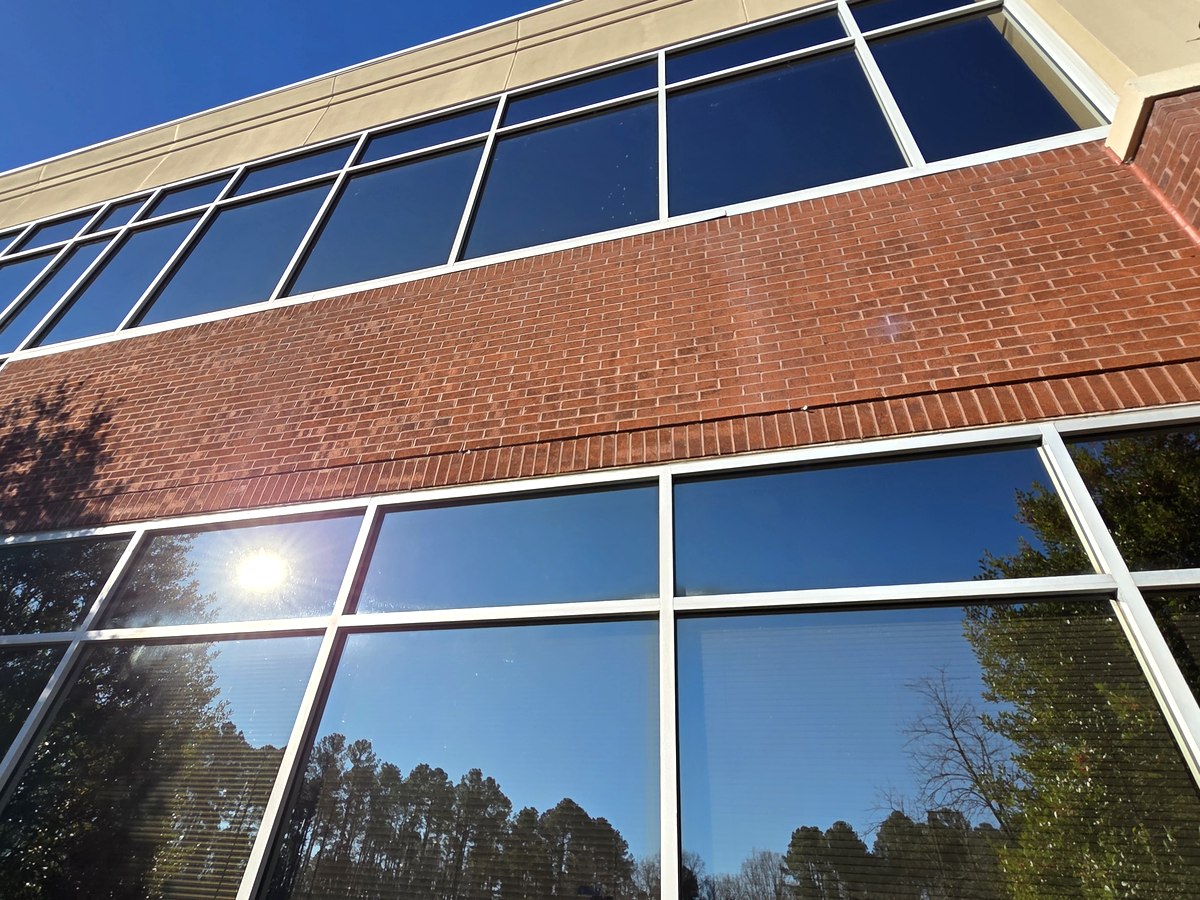
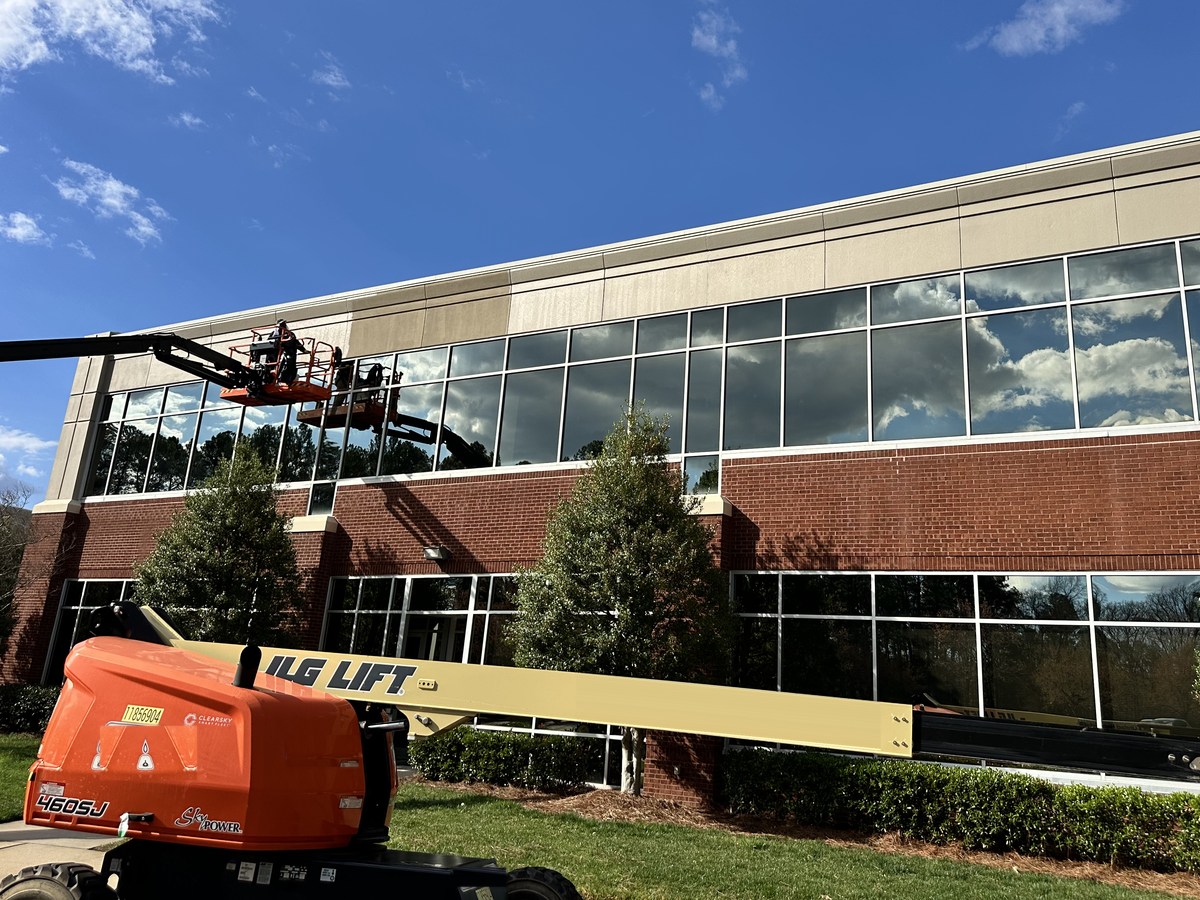
Presto restores nearly every category of commercial and high-rise property in Durham: adaptively reused tobacco warehouses at American Tobacco, Brightleaf, Golden Belt and West Village, downtown offices including 1930s towers, hotels, apartment and condominium buildings, hospitals, government facilities, parking garages, university buildings on Duke’s East and West Campus, and research and office buildings in Research Triangle Park. No exterior surface type is out of scope, from glass curtain walls, metal panels, stone and masonry through stucco, EIFS, concrete and roofing systems. The dominant assembly in this market is load-bearing brick over heavy timber and wood interior framing, frequently with ornamental brickwork and projecting corbeled firewalls, and that assembly wants a different repair approach than a curtain wall does.
Scale and construction type, far more than weather. The commercial core here is brick tobacco warehouse stock adapted to offices, studios and retail: very long two- to four-storey rectangular buildings with flat or very shallow gable roofs, load-bearing brick outside and heavy timber and wood framing inside, subdivided by projecting corbeled firewalls into runs of roughly seventy feet. Brightleaf Square, the Watts and Yuille Warehouses of 1904, is a pair of parallel two-storey Romanesque Revival warehouses of 75 by 118 feet per floor built as slow burn masonry and wood. On that stock the envelope problem is linear rather than dramatic: parapet, coping and window-head runs measured in hundreds of feet per building, soft historic brick that a harder modern repointing mortar damages rather than protects, original steel lintels that corrode and lift the coursing above them, and large multi-light industrial openings that deflect. The season is the ordinary Piedmont set, 64 days a year at or below 32 degrees Fahrenheit, 46.07 inches of precipitation and 6.4 inches of snowfall measured at Raleigh-Durham International Airport, and no defensible freeze-thaw cycle count exists for it, so we quote none. It is the amount of exposed masonry per building, not the severity of the winter, that sets the repair schedule here.
Building size and scope set the duration, and in Durham review sets the start. A focused caulking and sealant replacement on a mid-rise may run two to four weeks, while full facade restoration of a downtown high-rise or of one complete warehouse elevation can span three to six months. Then add review: a minor Certificate of Appropriateness is handled by staff in about ten business days, and a major one waits for the Historic Preservation Commission’s monthly public hearing, so any scope that alters the exterior of a landmark or of a building in a local district is planned around a hearing calendar rather than around a preferred start date. Warehouse conversions with tenants on every floor are phased by elevation and by unit so occupancy is never fully interrupted.
Yes. Permitting in Durham runs through one joint department, Durham City-County Building and Safety, rather than a city authority plus a separate county authority, and the governing code is the North Carolina State Building Code, 2024 edition, effective 1 July 2025, with a separate Existing Buildings Code volume that most restoration scopes are read against. Exterior work on a property in a designated local historic district, or on a local landmark, also needs a Certificate of Appropriateness from the Historic Preservation Commission, and that applies regardless of the building’s age, regardless of whether the change is visible from the public street, and regardless of whether a building permit would otherwise be required. We write our exterior scope so it can be reviewed on that footing, and we support engineers and architects on repair scopes that come out of an envelope condition survey. Where rehabilitation tax credits are in play, the North Carolina State Historic Preservation Office administers the state credit and the federal credit for income-producing properties, and it is worth bringing them in before materials are ordered. If a General Contractor is carrying the broader construction on site, we route permitting through them, and an owner who would rather hold the permits is welcome to. General liability and workers’ compensation are carried nationwide, on every job.
Maintenance is what keeps a property looking presentable on a schedule: window washing, pressure cleaning, touch-ups. Restoration is corrective. It rebuilds failed waterproofing, replaces spent sealants, repoints masonry, repairs spalled concrete and corroded metal, and leaves the envelope able to keep water out again. On brick warehouse stock the difference is easy to miss from the sidewalk, because a wall can look clean and still be taking water at every open head joint along a hundred-foot run. There is a rule difference too: cleaning is maintenance, but changing a mortar, a coating or a sealant on a designated exterior is an alteration, and an alteration inside a local historic district needs a Certificate of Appropriateness whether or not a permit does.
Watch for caulk joints that are cracked, shrinking or pulling free; rust bleed trailing below metal components or below a window lintel; spalled concrete or exposed rebar; open or eroded mortar joints, and brick faces that have started to spall behind a repointing harder than the brick; interior stains that appear after driving rain; efflorescence blooming across masonry; and glass that stays hazy no matter how often it is cleaned. Each of those is evidence that the envelope has failed, not that the building needs washing. On a long warehouse elevation the clearest tell is that the same defect repeats at regular intervals, which points at the lintels or the firewall junctions rather than at one bad spot. Send us photographs and a description of what you are seeing and we will say which of the two it is, and what review the repair is likely to need.
Noticing open mortar joints, rust bleed or spalling brick on your Durham building? Send us the details and we will tell you what the repair actually involves.
Call us today at 1-800-785-9927 or click Request A Quote.