






In a Durham warehouse, water almost never shows itself where it got in. Load-bearing brick exterior walls carried over heavy timber and wood interior framing give it something to travel along, so a member wetted at one end can carry moisture well inside the building and release it at a stain nowhere near the breach. Thick masonry adds a second delay, because a wall that stores water stays wet long after the weather that wetted it, and the stain that shows on Monday may have nothing to do with Monday's rain. Scale makes the guessing expensive. Smith Warehouse runs 850 feet long and 100 feet wide, divided by projecting corbeled firewalls into 12 units of roughly 70 feet each, so on one building the question of where water is getting in has a great many candidate answers. The interfaces are where we look first: window and door perimeters set into thick brick jambs, the junctions where a firewall projects through the wall plane, roof-to-wall connections, and anything that penetrates the masonry. An owner who skips the investigation pays to correct whichever component looked guilty. Because the wall was already holding water, that repair often seems to have worked for a few weeks before the stain comes back in the same place.
Presto Restoration treats leak detection and envelope diagnostics as the first task on a commercial restoration project rather than a formality attached to one. Before a repair scope is written, our team establishes where water is crossing the envelope, what is letting it across, and what will stop it, and it does that with methods that leave the building intact wherever the evidence allows. That order matters more here than in most markets, because in Durham the option of simply opening a wall to look inside is not always on the table. One boundary belongs in plain sight alongside it: Presto works above grade only, so foundations and below-grade waterproofing sit outside our scope, even when our own readings are what point below grade. We also do not sell standalone leak detection as a one-off inspection. Diagnostic and consulting work is bundled into comprehensive commercial restoration projects, typically with a $50,000+ project minimum.
Presto works through a defined set of diagnostic techniques to establish where water is crossing a commercial envelope and why. Which of them a Durham building gets depends on how it is built, what the symptoms are and where they sit, and whether the property is in a designated local historic district or is a local landmark, because that last point decides whether anything may be opened at all.
The only way to prove which point on an envelope is admitting water is to wet one candidate at a time under measured conditions and watch inside while it happens. Nothing is cut to do it, which is why on a Durham building this is usually near the front of the sequence rather than the end of it. We isolate one thing at a time: a single sealant joint, a window or door perimeter set into a deep brick jamb, a junction at a projecting firewall, or one panel of wall, and we either confirm that candidate or strike it off the list before moving to the next. On a wall that stores water, the order and the timing of that testing are part of the method. A mass masonry wall still carrying moisture from earlier in the week will not give a clean answer, so we read the wall first and test when the result will actually mean something.
Where the surface gives nothing conclusive away, infrared thermal imaging measures how heat moves through the assembly instead, and the anomalies it maps mark trapped moisture, wet insulation and details that have been failing quietly for some time. Damp material stores and releases heat at a different rate than dry material, which makes a scan a fast way to read a brick elevation several hundred feet long and narrow it to the two or three bays worth investigating by hand. It carries extra weight in Durham’s historic districts, where the alternative, opening the wall to see for yourself, is an exterior change that has to be reviewed before it can happen. A thermal survey changes nothing on the building and leaves nothing behind.
A moisture meter replaces argument with numbers. We take readings inside drywall, timber and wood substrates, brick and other porous materials, plot them across the affected area, and work out how far water has moved from each candidate entry point and whether that candidate is actively wetting the assembly around it. One set of readings is rarely enough on a thick masonry wall, because a wall that has absorbed water can read wet for days after the event that wetted it. Whether an area dries between visits, stays wet regardless of the weather, or wets only during rain is usually what identifies the mechanism. Repeat readings also settle the competing explanation, condensation on a cold interior surface, which we test for rather than assume.
On Durham’s converted warehouse stock and downtown office buildings, a drone captures close-up, high-resolution imagery of upper walls and roof edges without the cost and scheduling of rigging. Where a suspected defect has to be reached rather than photographed, technicians go to it on rope or on swing stage and put a hand on the detail. Neither method alters the exterior, so neither turns an investigation into a change that has to be reviewed before it can proceed. A dated survey of a full elevation, read against the symptom record, is what tells us which of a long building’s bays earn hands-on investigation before anyone is committed to one.
When thermography, moisture readings and controlled water testing still leave the path unresolved, the assembly has to be opened: one small, carefully placed cut through wall or cladding, made where the evidence already points, so the condition behind the finish can be seen rather than inferred. In Durham that step carries a condition the other methods do not. A Certificate of Appropriateness is required for any exterior change to a property in a designated local historic district or to a local landmark, regardless of visibility and regardless of whether a building permit is needed, and a test opening is an exterior change. Minor requests are handled at staff level and larger ones at a monthly public hearing, so the review calendar, not the crew calendar, decides when a wall can be opened. So an opening here is planned and justified in writing before it is proposed, placed where it answers the most questions per cut, photographed and logged in full, and closed back weathertight. Where the non-destructive work can answer the question instead, that is not simply the tidier route in this city, it is often the only one available without going to review first.
Every engagement ends in a written report about one building and nothing else: the method used at each stage, the readings each conclusion rests on, the entry points confirmed, and the candidates tested and discarded, all with dated photographs. On a Durham building the discarded list often does the most work, because that is where condensation and the wall’s own stored moisture are shown to have been excluded rather than overlooked, and it is also the record that justifies any opening we ask permission to make. Each report is written to the decision in front of its reader, since the owner of a converted warehouse and a managing agent for a multi-tenant office rarely need the same document, and each becomes the basis of the restoration scope and specifications we propose. It is built to hold up later, if an insurer, a board, a reviewer or another contractor questions the finding.
No Presto restoration scope in Durham is priced before the investigation behind it is finished. The reason is local: on a masonry building where the stain can be bays away from the breach, and where checking by opening the wall has to be approved first, a repair quoted off a visible symptom is a guess with a number attached to it.
We log every reported symptom: interior staining, exterior deterioration, tenant complaints, which bay or elevation each one sits on, and whatever repair history the building already carries. On a warehouse elevation, where a symptom appears matters as much as what it looks like.
The pattern in that record points to the methods worth running: controlled water testing one candidate at a time, infrared thermography, moisture meter surveys, drone and rope-access inspection, and a test opening only where the rest leave real doubt and review allows it.
Findings are written up for that building and paired with a line-item restoration scope, so an owner can follow the reasoning from the first reading through to the repair being proposed, including the candidates ruled out on the way.
Our crews then carry out the repairs through whichever Presto service line applies, facade, waterproofing, parking deck, historic preservation or roof restoration, at the entry points the investigation actually established and above grade only.
Where the scope calls for it, we put water back on the points that failed and confirm nothing arrives inside, then hand over the complete record: readings, imagery, and any opening made along with the approval it was made under and the condition it was closed to.
If a Durham building keeps taking on water after repairs that were supposed to end it, tell us which elevations and bays are affected and how long each stain takes to dry out. Our diagnostic and consulting work is included with comprehensive restoration projects (typical minimum project size: $50,000+), and our scope is above grade only.
Call 1-800-785-9927 or Request A Free Quote.
Diagnosing envelope failures across downtown Durham, American Tobacco, Brightleaf, Golden Belt, Parrish Street, West Village, the Duke campuses and out to Research Triangle Park calls for support with real depth in the region. Presto coordinates with our specialized regional divisions so that coverage runs the whole range, from a full envelope restoration down to routine facility work.
Property managers whose needs run to routine upkeep or localized facility work are pointed to our sister divisions:
Building Restoration Durham: Localized structural repair and exterior preservation on a single building, including work carried out at height.
Building Maintenance Durham: Preventative maintenance on a schedule, so small envelope defects are caught long before they become restoration work.
Building Services Durham: Broad day-to-day support for commercial buildings across the Triangle.
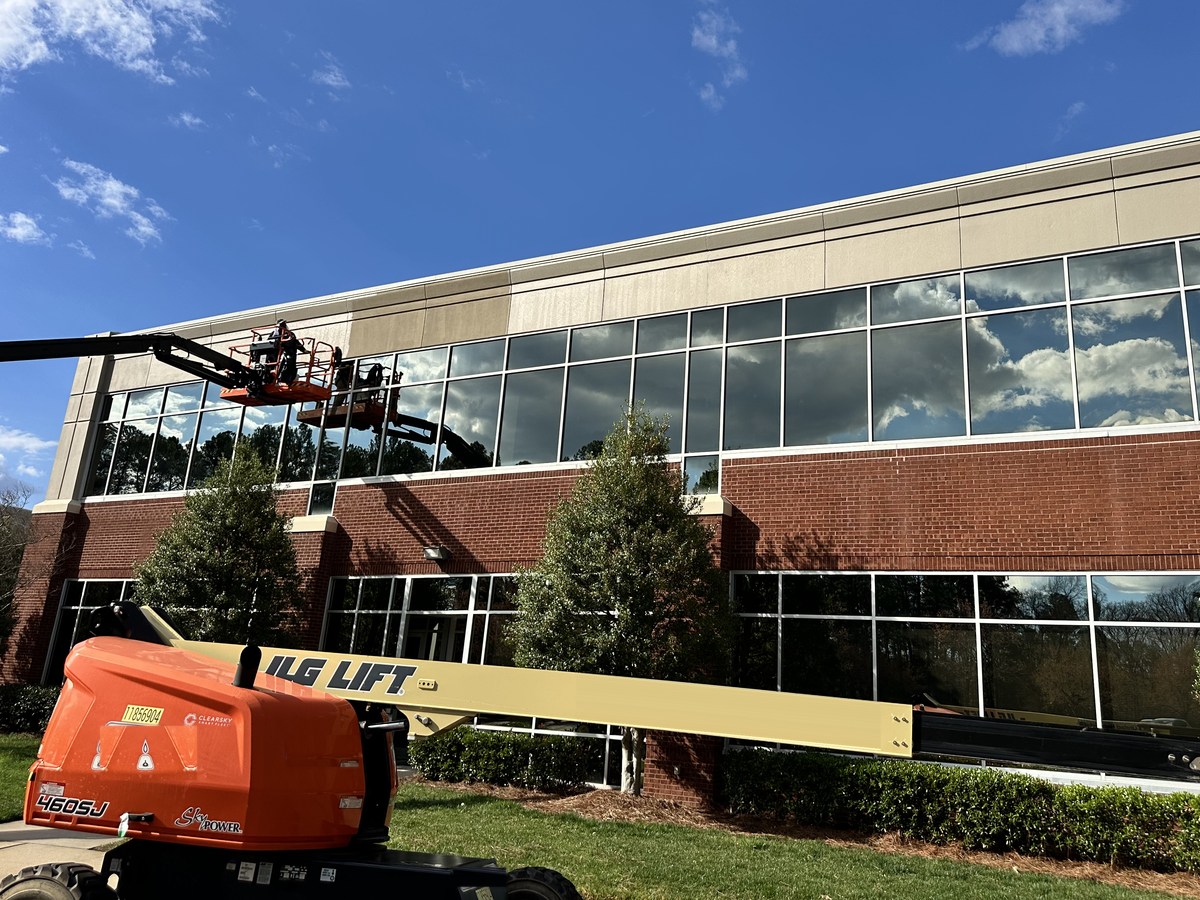
Browse a selection of recent commercial restoration projects across North Carolina, where the investigation established how water was actually entering before any repair was scoped.
No. Diagnostic and envelope consulting work sits inside a comprehensive commercial restoration project rather than being sold on its own, and the typical minimum project size is $50,000. The reason is that the method is built to end in a repair scope. Detached from the work that follows, it produces a finding with nothing attached to it, which in a market where opening a wall may require review first is a particularly poor use of an owner’s money. Two limits are worth stating outright. Presto works above grade only, so foundations and below-grade waterproofing fall outside what we take on, even where our own readings are what point below grade. And a single-building inspection, residential work or a small consulting engagement is a job for a specialty inspection firm rather than for us.
Five, chosen by what the symptom and the building will allow rather than by habit: controlled water testing one candidate at a time, infrared thermography, moisture meter surveys, drone and rope-access inspection, and a test opening where the rest leave real doubt. In Durham the order is largely forced. The non-destructive methods come first because an opening cut into a property in a designated local historic district or into a local landmark is an exterior change requiring a Certificate of Appropriateness, whether or not it would ever be visible and whether or not a building permit is needed. We also leave out any test whose result could not change the restoration scope.
Because on Durham’s characteristic building the stain and the breach are often in different bays. Load-bearing brick over heavy timber and wood framing gives water a member to run along, so it can cross the envelope at one interface and surface a long way from it. Thick masonry compounds it. A wall that has absorbed water gives it back slowly, so a stain can appear days after the rain responsible and sit quietly through rain that has nothing to do with it, and condensation on a cold interior surface is a further candidate to eliminate before anything is called a leak. Then there is scale: an 850-foot building divided into 12 units of roughly 70 feet by projecting corbeled firewalls offers a great many candidate answers. Reseal the wrong bay and an owner has paid to close something that was never open, and paid twice if a review had to be applied for to get at it. Establishing the path first is what makes the repair that follows worth its price.
No. Forensic engineering, expert witness testimony and litigation support sit outside our services, and a project that needs them should retain a specialty forensic engineering firm. Where a dispute or an insurance claim is already open we are often brought in beside such a firm, and what they want from us is usually the file rather than an opinion. A Presto diagnostic file records the method used, the readings and the dates on the photographs, the candidates excluded and the reason each one was excluded, and, where an opening was made, the approval it was made under and the condition the area was closed to. Someone else can follow that reasoning without taking our word for any of it. Interpreting it as a retained expert is not our work.
A report covers one building and the decision its owner is facing. Inside are the inspection findings with dated photographs, each entry point confirmed and its likely mechanism, the candidates tested and set aside, the readings and imagery those calls rest on, and a recommended restoration scope. On a Durham building we state plainly whether a reading reflects water arriving now, water the masonry is still giving back from earlier weather, or condensation on a cold interior surface, because those three lead to different repairs. If a test opening was part of the work, the report carries the justification submitted for it, the approval it was made under and the condition the area was closed to. It then becomes the foundation of the restoration specifications, written to be read later by an insurer, a reviewer or another contractor.
There is no standard duration, only the one produced by the building’s size, the number of plausible entry points and the methods chosen. One suspected point, investigated on its own, is often settled in 1 to 2 days. Several areas, each getting controlled water testing, is more often a 1 to 3 week engagement. Two things stretch that in Durham. A mass masonry wall usually has to be read on more than one visit before a reading carries any weight. And if a test opening proves necessary on a property in a designated local historic district or on a local landmark, a Certificate of Appropriateness has to be in hand first, from staff for minor work or from a monthly public hearing for major work, which is a calendar to plan around rather than push against. A projected timeline is issued during scoping so Durham property managers can sequence the investigation, any review or permitting under the North Carolina State Building Code through Durham City-County Building & Safety, and the restoration phasing that follows.
If a Durham building keeps taking on water after repairs that were meant to stop it, the entry point is probably not where the stain is, and on a long warehouse elevation it can be several bays away. Presto settles that question with methods that leave the wall intact, then restores only the points the investigation confirmed.
Note: our diagnostic and consulting work is included with comprehensive commercial restoration projects (typical $50,000+ minimum), and Presto works above grade only.
Call 1-800-785-9927 or Request A Quote online.