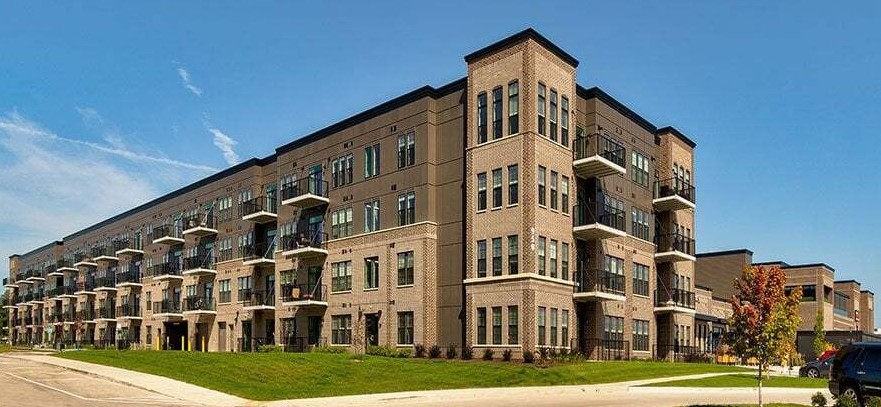
An owner holding a designated building in Des Moines is making an asset decision before a construction one, because the designation narrows what can be done and lengthens how long it takes to get approval to do it. The inventory makes that concrete. Sherman Hill is the city’s oldest residential district and the commercial edges of it carry brick and stone that predate the century. The East Village and Court Avenue are turn-of-the-century warehouse and mercantile blocks converted to office and retail, where the exterior is protected and the interior is not. Downtown holds early high-rise work in glazed terra cotta and Bedford limestone, the same stone that faces the Capitol on the hill opposite. Each of those assemblies has a distinct failure profile, and the central Iowa climate pushes all of them: repeated freeze and thaw opening lime joints, summer hail that becomes an insurance conversation, and in the skywalk-connected core a set of movement joints between old buildings and newer structure that were rarely detailed with a historic wall in mind.
The way to keep that decision from going wrong is to identify the material accurately before specifying anything against it. Presto has carried out landmark and locally designated work across the country, and our scopes track the National Park Service’s Preservation Briefs, the reference the discipline treats as authoritative, applied to the particular style, material palette and review path of the Des Moines property in question. What that produces on paper is lime mortar batched to the original’s strength and color, cleaning specified per substrate rather than per elevation, and repair in kind ahead of replacement. What it produces commercially is a scope that survives review, protects a certificate of appropriateness and does not quietly cost the building its standing. Local designation, a district address, individual National Register listing: each raises the evidentiary bar, and the scope is written to clear whichever applies.
Landmark buildings, locally designated structures and architecturally significant property across Des Moines and Polk County are served by Presto’s complete range of historic preservation work.

Repointing is the decision most likely to be made cheaply and regretted permanently, because the difference between a correct mix and a damaging one is invisible on the day the scaffold comes down and unmistakable three winters later. The original builders used soft lime mortar as a deliberate engineering choice, on the reasoning that the joint should be the part that moves, the part that fails first, and the part that lets water leave the wall as vapor. A hard Portland-cement repoint reverses each of those in turn. Because the new joint is stronger than the brick, stress relocates into the masonry unit. Because it is closed to vapor, water that entered at a sill or a coping has no exit. Then a January freeze expands that water inside the brick and the faces come away, one course at a time, with no repair short of replacement. Our masons cut failed joints by hand rather than running a grinder past the arris, batch to match the original in strength, color and sand, and tool the profile the building was constructed with.
Cleaning a stone elevation is usually framed as a maintenance line item, which is exactly how irreversible damage gets approved. Des Moines commercial stock runs to Bedford limestone at sills, lintels, water tables and belt courses, with glazed terra cotta and cast stone carrying the ornament on the early high-rise buildings downtown. Pressure a granite facade would shrug off will etch limestone, remove a century of weathered surface and leave the building looking falsely new, and on glazed terra cotta the same treatment crazes the glaze and opens the unit to the water that corrodes its anchors from behind. Condition also varies vertically in a way that defeats any single specification: sills and base courses absorbing winter street splash and de-icing salt are routinely decades worse than identical stone at the third floor. We match method to substrate and condition, working across micro-abrasion, preservation-grade chemical cleaners and controlled water, and where stone has spalled we set repairs matched for color, texture and weathering behavior so the patch ages with the elevation.


Window replacement on a designated Des Moines building looks like a straightforward capital upgrade until the two costs that do not appear in the quote are added back. The first is regulatory: substituting vinyl or stock aluminum for original wood sash can put a certificate of appropriateness out of reach and force the work to be undone. The second is arithmetic. The replacement unit carries a service life around twenty years, set against an original that has already delivered a century and can deliver another with maintenance. The case for replacing is normally winter comfort, and it does not survive examination, because the discomfort is air infiltration through a failed perimeter seal and a sash that no longer closes tight rather than conductive loss through glass. So we restore what is failing: hardened glazing compound, rotted sill and rail sections, seized hardware, open perimeter joints. The original glass, frames and hardware stay. With a storm panel where one is wanted, the restored assembly outperforms the replacement on both cost and life.
When stucco fails on an older Des Moines building, the choice is whether to patch it with what a general contractor has on the truck or rebuild it in the system it was originally built as, and the two produce opposite outcomes over a decade. Historic stucco and cement plaster, found on early twentieth century commercial infill, institutional buildings and later remodels applied over older masonry, shares a name with modern acrylic and EIFS products and almost nothing else. It was troweled in successive coats over wood or metal lath, each coat detailed to pass moisture along rather than retain it. A modern cement or acrylic patch closes that path, so water arriving behind the repair stays there through the freeze. The signature is recognizable from the sidewalk: a sound patch surrounded by a widening ring of failed original, a little larger each spring. We rebuild in lime-based formulations, replace lath where it has gone, and finish to the original texture including its irregularity, which is the evidence a person applied it.


Architectural metal is the element most likely to be deferred and the one where deferral is most expensive, because its failure begins on the face nobody inspects. Cast-iron storefront columns and pilasters, pressed sheet metal cornices and window hoods, wrought-iron rail and ornamental grillework carry much of the character on a Des Moines commercial block. A cornice, though, is a horizontal assembly of seamed sheet metal sited high on a wall. Snow rests on it for weeks, meltwater migrates behind the sheet, and corrosion advances outward from the concealed side until the ornament starts to move. Anything visible from the street means the fixings have been loose for some time, and by then the repair has become a removal and rebuild rather than a maintenance call. We remove corrosion that is structurally active, retain patina that is not, re-secure and repair sheet assemblies, and refinish by methods selected for the specific metal. Returning historic metalwork to bare substrate is a last resort and never an opening position.
Specifying waterproofing for a historic building from a modern curtain-wall standard is a common and costly substitution. Lime-set masonry with plaster behind it was engineered as a wall that accepts some water during a storm and returns it to the air afterward, so performance depends on that exchange continuing. Apply a fully impermeable coating and the water still enters, at a joint, a sill, a window opening, and is then held inside the assembly. In central Iowa the consequence arrives on a short timetable, because trapped water freezes and expanding ice disassembles masonry from within. Our historic scopes therefore use vapor-permeable repellents and sealants compatible with lime construction, and place impermeable systems only where the original design intended one. Presto works above grade only, not on foundations or below-grade waterproofing.

Preservation work is sequenced rather than simply scheduled, and in Des Moines the curing requirement sets the outer bound, since lime mortar will not cure below freezing and exterior masonry therefore has to sit inside the open season. Within that, five phases structure every project: establish the condition before mobilization, identify the material accurately, specify period-correct replacements against it, and execute without loss of original fabric that cannot be manufactured again.


We document every area of deterioration on your historic property and separate original fabric (irreplaceable) from later, non-original additions (modifiable). We don't touch anything until we understand the building's history.
We pin down the original materials in detail: specific lime mortar mixes, the terra cotta glaze and body, the limestone and brick in the wall, original plaster composition, window glazing, and metal alloys. Lab analysis is recommended anywhere the material is uncertain.
We translate findings into a detailed scope with quantified line items and period-appropriate product specs. We coordinate directly with property owners, preservation consultants, architects, and local review boards as needed.
Trained crews carry out the work using period-appropriate materials and traditional techniques where called for. Quality control is strict, since historic projects leave no room for rework on substrate that can't be replaced.
We deliver complete project documentation: before-and-after photography, material data sheets, warranty details, and maintenance guidance. For designated properties, this record can support future preservation board reviews.
Whether the deterioration is already visible or the question is how to get ahead of it, tell us what the asset is doing and our specialists will respond with recommendations built on preservation-grade practice rather than on the fastest available repair.
Call 1-800-785-9927 or Request A Free Quote.
Maintaining one standard across Sherman Hill, the East Village, Court Avenue and the downtown core requires infrastructure that is resident rather than mobilized, which is why Presto coordinates a network of specialized regional divisions and holds coverage unbroken from major historic envelope restoration through routine facility upkeep.
For day-to-day and preventative facility needs, property managers are encouraged to contact our sister divisions directly:
Building Restoration Des Moines: localized structural repair and exterior preservation.
Building Maintenance Des Moines: scheduled preventative work, which is the least expensive form this ever takes.
Building Services Des Moines: day-to-day commercial building support across the metro.
Explore recent historic preservation and landmark restoration projects Presto has completed across Iowa.
A standard restoration scope is measured against one outcome, which is a watertight, functioning building, and any material that delivers it is fair game. A preservation scope is measured against two, because the original fabric has to survive the work that restores performance. That second criterion governs every specification underneath it: lime mortar in place of Portland cement, cleaning selected per substrate rather than applied across an elevation, and reversible repairs wherever the condition allows, so that a later generation is not inheriting our decisions as constraints. The schedule is longer and the cost is higher. It is also the only approach under which the building retains its designation and the characteristics that justified it.
Because it determines which component of the wall absorbs stress, and that is not reversible once it has been decided wrongly. Lime mortar is formulated softer than the brick around it, which puts movement, failure and vapor transmission in the joint by design. Every one of those functions matters in central Iowa, where the wall crosses freezing repeatedly through the winter and water that cannot leave as vapor remains in the assembly to expand. A Portland-cement repoint relocates all three. Stress moves into the masonry unit because the joint is now the stronger element, water that entered at a coping or sill has no path out, and the following freeze removes brick faces course by course. No repair short of unit replacement recovers from that. We cut failed joints by hand, batch mortar matched to the original in strength, color and sand, and tool the profile the building was built with.
It can, provided the source of the loss is identified correctly first. In most designated buildings the discomfort attributed to historic windows is air infiltration through a failed perimeter seal and a sash that no longer seats, not conductive loss through the glazing, which means restoring the sash and resealing the perimeter recovers most of the performance without removing anything original. A storm panel, interior or exterior, closes the remainder. Masonry walls of that period also carry substantial thermal mass. And vapor-permeable waterproofing frequently outlasts an impermeable coating in this climate because it is not retaining water in the wall for the freeze to act on. Our scope is the exterior envelope. Interior mechanical and insulation work on a designated property is specialist territory and owners engage a contractor for it separately.
Plan against two constraints rather than one. Hand technique and preservation-grade quality control set the daily pace, and the curing requirement sets the calendar, since lime mortar will not cure below freezing and exterior masonry therefore runs spring through autumn. A scope that starts late in that window carries into the next season rather than being compressed, which is a budgeting fact worth knowing at approval rather than in October. Within the season, facade restoration on a smaller commercial property generally occupies two to four months of field work, while a full preservation scope on a larger landmark property can run six to twelve months or beyond. Local board approval sits ahead of all of it. We issue realistic dates at scoping, identifying which phases must fall inside the open season.
Yes, across the full range of designation, from locally designated sites through buildings individually listed on the National Register, both of which Des Moines holds in quantity. The variable between them is review rather than technique: whether a certificate of appropriateness or an equivalent local approval applies, and which elements of the proposed scope actually trigger it. We determine that during the initial evaluation, before specifications are written, so that the required coordination is a known quantity at the outset instead of a mid-project discovery.
Approval on a designated property is typically led by the owner together with a preservation architect or consultant who knows the reviewing commission, and where National Register listing or tax credits are in play the State Historic Preservation Office participates as well. Our function within that is the technical record the submission depends on: accurate scope, period-appropriate material specifications, and documentation written to withstand that level of examination. We remain in contact with the owner’s preservation team for the duration so the work aligns with what has to be approved, and we satisfy the applicable local and state requirements on every project.
Yes. Scopes track the National Park Service’s Preservation Briefs, which the discipline treats as its standard technical reference. The Briefs address the conditions this inventory actually presents: cleaning masonry without etching the substrate, formulating mortar for a soft wall, restoring wood sash, repairing sheet metal and cast iron, and the behavior of moisture within a historic wall through a freeze cycle. Architectural style and designation level occasionally call for further standards layered above them. Owners retaining a preservation architect are encouraged to review our specifications against the applicable Briefs before mobilization.

There is no replacement market for original fabric. Once it is gone it is gone, and modern materials will not restore what stood there. Each winter spent on open joints and saturated masonry removes a further increment of it, permanently and without notice. Establishing precisely what the building requires, and in what order, is what preserves character, performance and asset value into the next generation of ownership.
Call 1-800-785-9927 or Request A Quote online.




