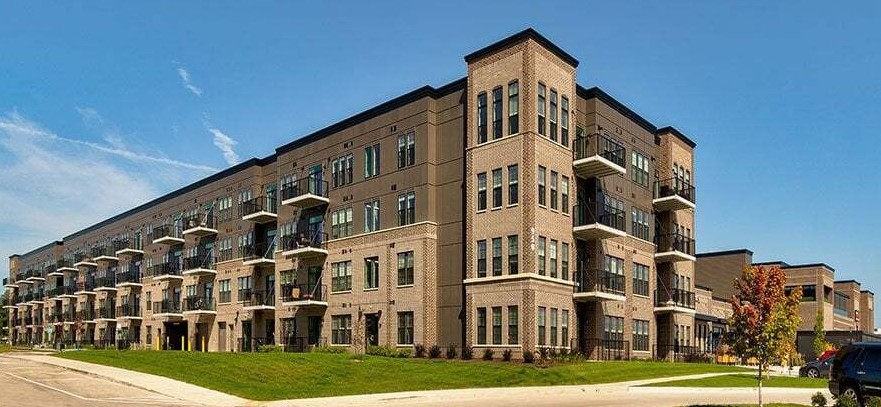
Presto Building Facade Restoration & Waterproofing
Building Facade Waterproofing & Restoration Services 1-800-785-9927

A facade here is never at rest. Glass and aluminum curtain wall on the towers along Grand and Locust expands through a humid ninety-five degree July and contracts through a January below zero, and that hundred-degree annual swing exercises every sealant joint, gasket and panel termination on the building. Sealants past their elastic life split and debond. Water enters the opening, freezes, levers it wider, and repeats that dozens of times in a winter. Road spray and de-icing chemical haze the glazing and attack metal finishes at the lower floors. Brick and precast take on moisture that then expands within them and removes the face. Once the envelope gives way the water reaches the interior, and what follows is repair cost, tenant dissatisfaction and a measurable effect on asset value.
Against that, Presto delivers a facade restoration, caulking and waterproof coating program specified for a hard freeze-thaw climate. Industrial rope access and swing-stage capability are paired with restoration products we manufacture ourselves, which lets a single scope correct each weak point in the exterior envelope: spent sealants replaced with products that stay flexible at low temperature, corroded architectural metals refinished, elastomeric membranes that move with the structure, and masonry repointed with mortar matched to the wall. The outcome is an asset that presents well and performs watertight through the winter.

Where a commercial building leaks, deteriorated caulking is almost always the origin, and in Des Moines the sealant is carrying more load than it would almost anywhere else. A joint on a tower here stretches and compresses through a hundred-degree annual range and has to stay flexible at twenty below. A sealant that stiffens in the cold has already failed in practice, because the movement continues and the bond is what surrenders. Once a joint splits it is a direct channel for water that will then freeze inside the wall. Presto’s high-rise technicians strip out the spent material, prepare each joint, set proper backer rod, and install industrial-grade silicone and polyurethane sealants specified for the low-temperature flexibility this climate requires. Window perimeters, expansion joints, panel joints, penetrations, skywalk connections and control joints are addressed in a single coordinated pass across the facade.
Panel replacement is usually the first number an owner is given on downtown metal, and it is rarely the necessary one. The towers here carry large expanses of aluminum, composite panel, mullion and architectural trim on the weather side, where years of UV fade factory color and chalk the finish, thermal cycling works the panel joints, and street level takes a corrosive film of de-icing chemical each winter that washing never fully lifts. Before that budget is committed, our metal restoration team can attempt to recover what is already on the building: controlled micro-abrasion strips oxidation, corrosion and embedded contamination, and refinishing brings the original color and luster back. What the owner ends up with is like-new metal for a fraction of the replacement figure and with considerably less disruption. (Restored metal is typically sealed with a protective clear coating afterward: see our Commercial Waterproofing services, which pair naturally with this work.)


The reason a window-cleaning contract stops improving the glass on a Des Moines tower is that the problem has stopped being dirt. Irrigation overspray and rain runoff bake minerals into the surface, alkaline runoff off concrete and masonry etches it permanently, and through winter the salt and grit off the street leave haze and micro-scratching on the lower floors that cleaning merely moves around. What our chemical restoration process does instead is dissolve the staining, draw out the mineral contamination and take down the damaged surface layer without harming the glass beneath, which is what returns genuine optical clarity to a curtain wall rather than a short-lived improvement. (To hold that clarity, ask about our proprietary Glass Defender treatment, covered on the commercial waterproofing page. Most clients bundle the two.)
Stucco, EIFS, precast concrete and masonry share a single vulnerability, which is porosity, and in this climate porosity has an arithmetic consequence: water absorbed into the substrate in November is ice in December, and ice occupies about nine percent more volume than the water did. That expansion is what drives spalling, progressive cracking and rebar corrosion in precast panels and concrete. Presto installs elastomeric waterproof coating systems that cure into a flexible, breathable membrane, moving with the structure’s thermal expansion, bridging hairline cracks up to 1/16 inch, and stopping bulk water at the surface while allowing trapped vapor to escape, which matters because a coating that seals moisture in rather than keeping it out makes freeze damage worse rather than better. Systems come in a complete palette of factory colors and finishes, so the waterproofing doubles as a facade facelift.


Stone is where a cleaning decision becomes irreversible, and Des Moines holds a great deal of it: the limestone of the Capitol complex, the cast stone on the older commercial blocks, the precast panels on the downtown towers. Porosity is what makes it vulnerable, drawing in salt contamination, biological staining and efflorescence, with the worst of it concentrated low on the wall where winter street splash lands. So a stone scope opens with substrate evaluation and a cleaning method chosen against that substrate, gentle enough to lift contamination without scarring what is underneath. Sealers that penetrate and coatings that breathe follow, holding liquid water out while leaving the wall free to dry. Where stone has spalled, the repair is matched for color and texture and engineered to weather at the same rate as the material around it.
Repointing is a decision that is easy to defer and expensive to defer twice, because the mortar is engineered to be the weaker, sacrificial component and it is therefore the component consuming itself while the decision waits. In Des Moines it is consumed faster, since every eroded joint holds water that freezes and opens the joint a little further each cycle. Once the joints are gone, rainwater passes directly through the wall assembly, producing interior leaks, efflorescence blooms and eventually loosened, failing brickwork.
The execution matters as much as the timing. Joints are cut back to the correct depth, replacement mortar is batched to match the original on color, compressive strength and composition, and each finished joint is tooled back to the profile the wall was built with, with repointing and decorative tuckpointing delivered by one accountable crew rather than split between trades.
On the historic brick of the East Village, Court Avenue and Sherman Hill we specify lime-based blends consistent with period construction, and schedule the work into temperatures that let mortar cure rather than freeze in the joint.

Each Des Moines facade project runs through five disciplined phases, structured to surface every defect before work begins, keep crews and occupants safe during execution, and hand over fully documented results at completion.


We inspect the full envelope from the ground, by drone, and at arm’s length via suspended access. Sealants, metals, glass, stone, coatings, and masonry are photographed and logged: every defect mapped before pricing.
Where leaks or concealed deterioration are suspected, we run controlled water spray tests, infrared thermography scans, and moisture readings to trace intrusion back to its true source instead of patching symptoms.
Findings become a line-item scope with quantities, specified products, and a phased schedule built around the application temperatures sealants and coatings require. Your project manager handles access logistics, occupant communication, and permitting with the City of Des Moines.
Certified rope-access and swing-stage crews perform the restoration to manufacturer specification, with field supervisors enforcing quality control and documenting progress daily.
At turnover you receive the complete record: warranty documents, product data sheets, before-and-after imagery, and a maintenance roadmap to protect the investment going forward.
Serving the downtown core and the wider metro at this standard depends on permanent local infrastructure rather than visiting crews, so Presto coordinates a network of specialized regional divisions and keeps coverage continuous from major envelope restoration through routine facility care.
Property managers seeking day-to-day and preventative support can contact our sister divisions directly:
Building Restoration Des Moines: localized structural repair and exterior preservation.
Building Maintenance Des Moines: scheduled preventative work across the ownership’s portfolio.
Building Services Des Moines: day-to-day commercial building support across the metro.
For more than 27 years, Presto Restoration has protected commercial properties nationwide. Working in hard-winter markets means we understand what this climate actually does to an envelope: sealants that stiffen and debond in the cold, the freeze-thaw cycling that turns a hairline crack into a spall, de-icing chemical at the base of the wall, and the short application season that decides when exterior work can realistically happen. Explore our full range of Des Moines building restoration services.
Not sure where the facade stands? Describe the condition and our Des Moines specialists will explain what is driving it and lay out the options.
Call 1-800-785-9927 or Request A Free Quote.
Shorter than in a mild-winter city, and unevenly so, because the sealants reach the end first. The working intervals we recommend are a full envelope inspection every 3 to 5 years, sealant replacement every 8 to 12, elastomeric coating renewal every 10 to 15, and masonry repointing every 20 to 35. Exposure then moves a given elevation inside those windows: the faces taking winter wind and the lower floors taking street splash work off the short end, while a sheltered elevation can run longer.
Caulking cracked, shrunk or pulled loose from joints. Rust streaks bleeding from metal fasteners or panels. White efflorescence on masonry and cast stone, which means water is moving through the wall. Brick faces popped or flaked off, which is freeze damage rather than wear. Stucco chalking, cracking or discolored. Interior stains or musty odors near exterior walls, especially appearing during a thaw. Glass that stays hazy after cleaning. Spalling concrete around window openings and slab edges. Any one of those justifies a professional envelope evaluation.
Yes, and occupied offices, hotels and commercial buildings across the metro are most of our work. Rope access avoids the footprint and noise of scaffolding, disruptive tasks are scheduled outside peak hours where the building allows, property managers are updated throughout, and the sequence is phased so lobbies, skywalk connections and parking remain usable.
Building height and scope govern it, and so does the season. A focused sealant replacement on a mid-rise completes in two to four weeks. A full restoration covering caulking, coatings, masonry and metals on a downtown tower typically runs three to six months of field work. Because sealants, coatings and mortar all carry minimum application temperatures, the schedule is built around the open season, and a scope that cannot finish before the cold is phased across two seasons rather than rushed. A firm schedule is issued once the project has been scoped, so ownership can plan the capital against it.
It follows the systems actually installed, so the terms are specific to the coatings, sealants and repair methods specified for that building rather than to a standard schedule. Complete warranty documentation is issued at closeout, and the coverage is walked through with ownership during scoping, before any contract is signed.
Our project managers do, filing permit applications and the related documentation with the City of Des Moines and the surrounding municipal building departments. Where a general contractor is overseeing other work at the property we coordinate with them directly on permitting. Presto carries nationwide general liability and workers’ compensation coverage and complies with all applicable local and state building code requirements.

By the time a leak appears inside, the facade has been open for a while, and in this climate the interval between the first failed joint and the first interior stain is usually one winter. Describe what you are seeing while the remedy is still straightforward.
Call us today at 1-800-785-9927 or click Request A Quote.




