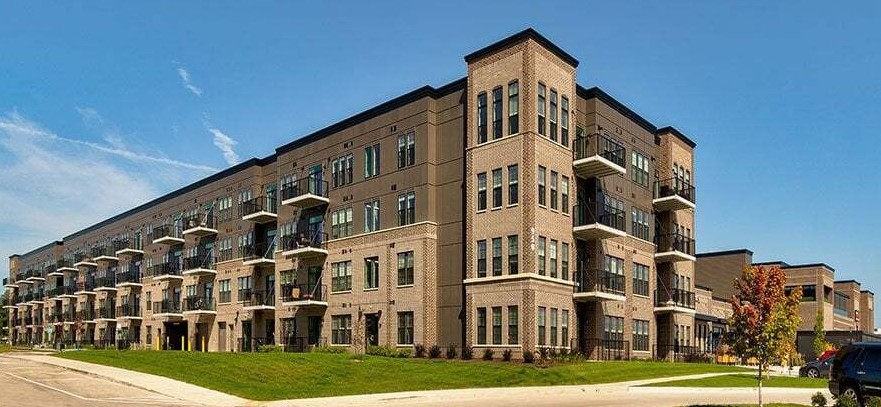
Presto Building Facade Restoration & Waterproofing
Building Facade Waterproofing & Restoration Services 1-800-785-9927

Waterproofing a Des Moines building is, at bottom, a movement problem. The structure expands through a humid ninety-five degree summer and contracts through a January below zero, so every joint, gasket and termination in the envelope has to absorb a hundred-degree swing annually without releasing. Downtown compounds it, because the skywalk system ties together buildings that settle, sway and expand independently, and the joints at those connections must accommodate two structures moving on separate schedules. When a joint does let go, the consequence here is not confined to a leak: water standing in a wall or joint through a cold snap freezes, expands about nine percent, and enlarges the opening it entered by, so the defect grows each winter rather than holding steady.
Against that, Presto covers above-grade commercial work from the downtown towers to the brick and precast stock in the surrounding districts, and does it restoration-first: a surface is cleaned and restored before it is waterproofed rather than caulked over, which is what makes the finished work last. The scope runs to breathable masonry repellents, silicone and elastomeric coatings, expansion joint and crack sealing, and wet glazing and glass sealing carried by products of our own manufacture, Glass Defender among them, together with narrower answers such as Leach Stop Protection for precast. Everything we do is above grade. Foundations and below-grade waterproofing are somebody else’s specialty, and we would rather say so than stretch.
The above-grade scope divides into two categories: core systems that hold the envelope watertight, and restoration-waterproofing services that pair deep cleaning with durable protection.

Concrete and steel-framed buildings are engineered to move, and in Des Moines they move a great deal, since the annual temperature range runs well past a hundred degrees. That movement concentrates at expansion joints, control joints and facade cracks, and downtown it concentrates hardest at the skywalk connections, where two separate structures meet and neither is moving on the other’s schedule. When sealant at a movement joint fails it becomes the fastest available path into the interior, and here the water that follows freezes inside the opening and enlarges it. We repair and reseal these joints with high-movement silicone and polyurethane systems selected to stretch and compress with the structure and to remain flexible at low temperature rather than stiffening and tearing loose in January. On a building in this climate, joint sealing is frequently the highest-value waterproofing expenditure available.
Glass on a Des Moines building is under continuous chemical attack, and the damage is not reversible once it has etched. Mineral-rich runoff from the concrete and masonry above, irrigation overspray, urban pollutants and, through winter, the salt and grit thrown off the street all leave deposits that permanently haze the surface when left. Our proprietary Glass Defender treatment bonds a hydrophobic barrier to the glass so minerals cannot anchor, water sheets away rather than drying in place, and routine cleaning becomes both easier and less frequent. Treated glazing retains optical clarity year after year, including on the lower floors absorbing the worst of the winter road spray.


Horizontal details decide where a coating fails first. Ledges, parapets, copings and sills collect water, and in Des Moines they also hold snow for weeks before it melts. Standing meltwater combined with freeze-thaw cycling is precisely the condition that finishes a conventional coating. For those locations we install high-performance silicone systems: seamless monolithic membranes bonded directly to the substrate, eliminating the laps and terminations at which ordinary products fail. Silicone remains hydrophobic and flexible through both prolonged standing water and cold, which makes it the default specification for the flat and near-flat details holding snow and meltwater on a Des Moines commercial building.
On a commercial tower the perimeter seal between glass and frame fails before almost anything else, and a Des Moines winter locates it early. That small joint absorbs the full differential movement between a cold aluminum frame and the glass unit within it, and once it hardens, splits or releases, water enters the wall cavity and can travel several floors from the breach before appearing indoors, which is what makes the repair bill larger than the defect. Wet glazing addresses it at the source: the spent sealant is removed and new high-performance silicone re-establishes a watertight bond between unit and frame. Presto reglazes storefront, curtain wall, ribbon and punched window systems, delivering documented, warrantied wet glazing across entire buildings.


Hairline cracking in stucco, EIFS and concrete is not a defect to be avoided, it is the normal behavior of the material, and in this climate each crack is an entry point followed by a freeze. An elastomeric coating answers that by remaining flexible for its whole service life: laid at roughly ten times the film thickness of paint, it spans small cracks instead of splitting along them. The elasticity earns most of its keep through the shoulder seasons, when a wall can cross freezing and thaw again inside a single day. Our systems breathe, so interior vapor leaves rather than being held in the wall to freeze, they are stable under UV, and they arrive in a full palette of factory colors and texture profiles.
Porous masonry, meaning brick, block, precast and cast stone, absorbs water, and in Des Moines the water absorbed in autumn is the ice that removes the face in January. Saturated masonry additionally produces efflorescence streaking, accelerated deterioration and damp interior walls, and the damage concentrates on the lower courses where winter street splash carries de-icing salt into the wall. Presto applies clear, breathable penetrating repellents built on silane and siloxane chemistry, which soak into the substrate and render it hydrophobic without altering appearance. After treatment the wall looks untouched, rain beads and rolls off rather than absorbing, and because the treatment breathes the wall can still dry outward instead of holding water through the freeze.

The distinguishing decision is sequencing: surfaces are cleaned and restored before they are sealed, rather than sealed as found. Sealing a deteriorated substrate produces work that fails on the substrate’s schedule rather than the sealant’s. Restoring first yields waterproofing that looks better, performs better and lasts longer, and it makes a set of problems addressable that a conventional waterproofing contractor has no method for.

Recurring window staining below precast is a symptom, which is why cleaning it repeatedly never resolves it. Precast panels contain water-soluble minerals that leach out whenever moisture passes through them, and the runoff deposits on surfaces below as stubborn staining on windows, metal trim and other facade elements that returns within weeks of each cleaning, because the source was never treated. Our Leach Stop Protection service addresses the source: we clean the existing staining and treat the precast to block further mineral migration, so a building that has absorbed that cost annually for years can stop absorbing it.
With architectural metal the choice is usually framed as replace or accept, and there is a third option that costs a fraction of the first. Metal panels, curtain wall framing, mullions and Alucobond composite take continual UV exposure and thermal cycling, and at the lower levels they take the de-icing chemical that winter road spray deposits and leaves in place. Rather than advancing a panel replacement project, we apply protective clear coating systems that seal the metal against corrosion while preserving the original factory finish. The clear coats bond directly to the existing surface and block moisture and chlorides from reaching the substrate beneath, extending the service life of the original material materially. In practice that frequently removes the replacement project from the capital plan altogether and reduces recurring maintenance cost.

Every waterproofing project follows five phases, structured to diagnose the failure accurately, specify systems appropriate to that building, and deliver watertight performance that holds over years rather than seasons.


We inspect every above-grade waterproofing system on your building, from sealed joints and coatings to exposed decks and masonry walls, documenting every failure point with photos and detailed notes.
Water intrusion here often traces back to unexpected sources, and to unexpected seasons. Controlled water testing, moisture readings and visual tracing separate true root causes from surface symptoms, including leaks that only appear during a thaw.
We specify the right products for your substrates, silicones, elastomeric systems, traffic membranes, with clearly quantified line items and a schedule built around the application temperatures they require, while our PM team handles permitting and tenant coordination.
Our trained crews execute using rope access, swing-stage, or lifts as the building requires. All work is installed to manufacturer specifications with strict quality control and full documentation.
We deliver complete documentation, including warranty information, product data sheets, before-and-after photography, and maintenance recommendations to maximize the life of your new waterproofing systems.
Water intrusion, sealant failure or coating deterioration on the building? Describe the condition and our specialists will identify the probable mechanism and the most economical path that actually resolves it.
Call 1-800-785-9927 or Request A Free Quote.
Presto has been restoring and protecting commercial buildings nationwide for over 27 years, and in hard-winter markets that experience shows up in the specification rather than the brochure: sealants chosen on low-temperature movement capability, horizontal details built for standing snow, and an exterior sequence planned around the months in which coatings will actually cure.
Delivering work of this standard across the metro depends on resident infrastructure, so Presto coordinates with specialized regional networks to give clients the full span, major structural restoration through ongoing facility upkeep.
For routine upkeep and localized facility services, property managers are encouraged to contact our sister divisions:
Building Restoration Des Moines: localized structural repair and exterior preservation.
Building Maintenance Des Moines: scheduled preventative work across the ownership’s portfolio.
Building Services Des Moines: day-to-day commercial building support across the metro.
Take a look at a sample of recent commercial waterproofing, caulking, and coating projects Presto has completed across Iowa.
Shorter than the product literature suggests, for a specific reason: the joint absorbs a temperature range well past a hundred degrees annually and has to remain flexible at twenty below while doing it. Many products carry a 15 to 25 year rating, and on exposed elevations here we routinely observe noticeable failure at 10 to 15 years, earlier still on the weather side. Treat the rating as a ceiling rather than an expectation, and inspect the full envelope on a five-year cycle so deterioration is found before it becomes interior water damage.
Waterproofing, which is the preventative side. It keeps water out of the building through sealants, coatings and membranes correctly specified, properly installed and maintained thereafter. Water damage restoration is the after-the-fact discipline, cleaning and repairing what the water reached once inside. Our work is restoring and maintaining the exterior systems that keep the envelope closed, an expenditure that is almost always lower than remediating interior damage repeatedly.
Yes, and most of our projects are on occupied assets, from office towers and hotels through hospitals and institutional facilities. We use industrial rope access in preference to scaffolding wherever the elevation permits, schedule noisier operations outside peak hours, keep tenants informed throughout, and phase the sequence so common areas, skywalk routes and daily operations remain available. In this market the calendar is a further constraint, since most exterior systems cannot be installed correctly below their minimum application temperature.
They are different products for different purposes. Exterior paint is specified for appearance, supplying color and light weather resistance, and it will neither stretch with the substrate nor bridge a crack. An elastomeric coating is a waterproofing system that also finishes well: applied far thicker than paint, flexing with thermal movement in the substrate, and bridging hairline cracks so water cannot work through. That distinction carries more weight here than in a mild climate, because a crack admitting water is a crack that ice will widen, so bridging it early is what prevents the damage compounding.
By whether the defect is one that winter will enlarge, because in this climate most of them are. Conditions calling for immediate attention include cracking or separation in joint sealants, dark streaking down exterior walls near failed joints, efflorescence on masonry or concrete, brick or concrete faces that have flaked or popped, damp spots or bubbling paint on interior walls, coatings chalking or peeling, and any visible spalling or exposed rebar. Entering winter with a failed joint means the joint is worse by spring rather than unchanged, so a defect identified in autumn is worth resolving before the cold instead of after it. Describe what you are seeing and we will help set the order.
Our project management team does, filing permit applications directly and handling any association approvals and required design review submissions, working with the City of Des Moines and the surrounding municipal building departments. Presto carries nationwide general liability and workers’ compensation insurance and complies with all applicable local and state requirements on every project.

A failed joint does not hold its size while a decision is pending. The water it admits freezes and widens it with every cold snap, so deferral is not a neutral choice here but a compounding one. Describe the condition while the remedy is still inexpensive.
Call us today at 1-800-785-9927 or click Request A Quote.




