


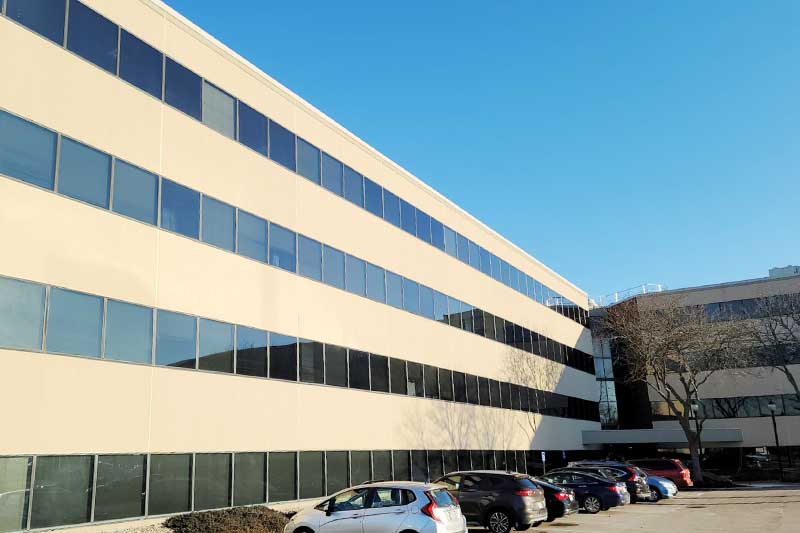





A parking structure absorbs more punishment than any other part of a commercial property. Multi-level decks, institutional lots and the long flat decks serving large-footprint plants and warehouses in the industrial corridor along I-75 north of Dayton take heavy vehicle loading every working day. They also collect motor oil, tire abrasion and, for a third of the year, the de-icing salt tracked in off treated approaches and streets. A Miami Valley winter works on all of those at once. The area sees about 105 days a year below 32 degrees Fahrenheit, and Dayton International Airport records 41.1 inches of precipitation and 23.3 inches of snow in an average year, so the surface spends much of the winter wet, salted and crossing the freezing point. Nationally about 20 million tons of sodium chloride goes onto roads each year, and what dissolves on a deck reaches the reinforcing steel and drives corrosion from inside the slab. Once the traffic coating is breached, that salt solution has a route into the structure. Owners usually meet it as staining on columns and ceilings and drips onto parked cars; the structural version is delamination over rusting bar, and then spalling.
Presto Restoration delivers parking deck restoration and waterproofing for above-grade parking structures across Dayton and the Miami Valley, from elevated decks and freestanding garages to rooftop levels and the long, flat institutional and industrial decks that serve this region’s large-footprint building stock. We install pedestrian and vehicular traffic-bearing membrane systems and replace horizontal and vertical expansion joints, with a move up to a higher-performing profile available where an owner wants one. Waterproofing and joint sealing for drive lanes, parking bays, ramps and stair towers sits inside the same scope. Above-grade parking is the only work this practice takes on, which is why a crew can read a deck’s condition before the first square foot of coating comes up. Presto works above grade only and does not take on foundations or below-grade waterproofing.
Presto’s parking scope runs from traffic coatings through full expansion joint replacement: restoration and waterproofing services built around what salt, meltwater and 105 days a year below freezing do to an above-grade deck in Dayton. Snow and ice control costs the country about $2.3 billion a year, and the corrosion damage that follows is put several billion higher.
The membrane on a parking deck is asked to do two things that pull against each other. It has to hold water off the occupied space underneath while taking the whole traffic load on its own face. That face sees tire scrubbing, vehicle loads, oil and chemical spills, thermal movement, plow and shovel contact, and a chloride solution that ponds on it and then freezes. Presto installs vehicular traffic-bearing systems on drive lanes, ramps and parking bays, with pedestrian-rated systems for walkways, stair towers and the wide open top decks that carry foot traffic on institutional sites. The systems are placed as seamless liquid urethane and polymer coatings keyed into a prepared concrete substrate. There is no seam for water to follow, and the finished wear surface is built for decades of Dayton deck traffic and the chloride that arrives with it. An Ohio Department of Transportation study found air-void spacing factors above 200 microns in over half the bridge decks examined, meaning the concrete’s built-in freeze-thaw protection was already gone, and on a deck in that condition the coating is what holds a salt solution away from the reinforcing steel. Work goes in to the letter of the manufacturer’s specification and is documented as it proceeds, so the warranty stands behind it.
The horizontal expansion joints crossing a deck’s drive lanes let the structure move as temperatures swing and loads shift. On the long uninterrupted spans typical of a flat-site institutional or industrial deck, that movement accumulates across more joint length than a compact urban garage ever has to accommodate. When the seal or the hardware fails, salted meltwater goes through the joint onto the level below, carrying chloride to steel that was detailed to stay dry. Horizontal joint replacement here means the entire assembly, original hardware included. The existing system can be matched in kind, or exchanged for a newer product line where an owner would rather not repeat it. Having installed systems from nearly every major joint manufacturer, our crews fit the profile that matches how far your deck actually moves, how much traffic crosses it, and how much salt it takes each season.
Where parking decks meet walls, columns, and adjacent building sections, vertical expansion joints handle movement with little in common with what a drive-lane joint sees, and installing them well is a separate skill. On a large flat-site deck the perimeter and the wall-to-slab transitions run long, so there is more of this joint per structure than owners tend to expect. Vertical joint work here covers the whole range: full system replacement, hardware swaps, resealing and localized repair. Sound vertical joints shut down one of the most persistent water routes in a Dayton parking structure and keep chloride-bearing water off the concrete and reinforcing steel around them.
A deck is only as dry as its least protected opening. The traffic coating is one layer; the control joints, construction joints, cold joints and the dozens of penetrations where drains, conduit and structural members pass through the slab are the rest of it. Presto assembles deck waterproofing programs from silicone, polyurethane and polymer sealants, chosen joint by joint for profile, movement and exposure. Dayton International Airport records 41.1 inches of precipitation and 23.3 inches of snow in an average year, and on a wide flat deck all of it has to travel a long way to reach comparatively few outlets. That puts the detailing at drains, scuppers and penetrations in charge of whether a structure stays watertight for decades or cycles through leak repairs, and iced outlets turn the arithmetic against the owner: a drain frozen shut leaves a salt solution standing on the slab for weeks instead of minutes.
The sealant in control joints, cold joints and minor construction joints works harder than any other material on the deck and is looked at last. Wheel loads, ponding meltwater and a slab that crosses the freezing point on the order of 105 days a year pull these seals apart early. Presto removes the failed material, preps each joint to the manufacturer’s requirements with backer rod and primer where the system calls for them, and installs traffic-rated sealant that stays flexible on a cold slab. Intact seals keep water from slipping under the coating and into the slab, where chloride and freezing produce a documented sequence: scaling, map cracking and cement paste that disintegrates, with magnesium chloride de-icers going further and chemically reducing concrete’s compressive and splitting tensile strength.
A Dayton parking deck restoration runs through five phases: establish what is actually failing, specify systems rated for salt and repeated freezing, and leave the deck watertight.
Our review takes in the whole structure: wear surfaces and coatings, horizontal and vertical joints, joint sealant, drains and scuppers, and any active leak, rust stain or patch of scaling showing on the level beneath.
Water rarely enters a deck anywhere near where it shows up. Flood testing, sounding for delamination and dye tracing identify which joints, coatings or penetrations are actually passing it.
We specify coatings, joint replacements and sealants for your structure, its traffic and its salt load, then phase the work to keep as much of the deck in service as possible.
Work proceeds section by section so much of the deck stays open. Materials are placed to manufacturer spec, under control of substrate prep, surface temperature and cure time.
You receive warranty paperwork, product data sheets, before-and-after photographs and maintenance guidance for each system installed, including what to check after a hard winter.
Scaling in the wheel paths, blistered coating, joints that leak after every thaw, sealant that has pulled back off the joint wall? Our specialists will assess the deck and put the most cost-effective repair in writing.
Call 1-800-785-9927 or Request A Free Quote.
Serving Dayton and the Miami Valley with parking deck restoration takes dependable regional infrastructure. Presto works alongside specialized partner networks so coverage runs from major structural restoration through to routine facility upkeep.
Our sister divisions cover the smaller, recurring facility work:
Building Restoration Dayton: Targeted structural repairs and high-rise exterior preservation work.
Building Maintenance Dayton: Dedicated to the preventative maintenance that carries a property in this climate through a winter and out the other side.
Building Services Dayton: Comprehensive day-to-day commercial building support throughout the Miami Valley.
See what Presto has done for parking structures and commercial buildings throughout Ohio.
Most traffic-bearing systems are rated for a decade to two, but on a Dayton deck the governing variable is chloride exposure rather than age. Anything open to the sky goes first, since plows, shovels and tires drive dissolved salt into the wear layer all winter, and on the broad single-level decks serving institutional and industrial sites nearly the whole surface is open to the sky. Systems under cover, in stair towers or on interior levels, commonly last a good deal longer. A scheduled condition review, timed for early autumn, closes worn coating and open joints before the first salt of the season goes down on them.
Read the driving surface before anything else. Scaling, which shows as whitened flaking patches, and map cracking, a fine shallow mesh across the surface, are what chloride and repeated freezing do to cement paste, and paste that crumbles when scratched confirms it. Then sound the slab, since dull hollow areas usually mean delamination over corroding reinforcement, and look for rust bleeding down columns and slab edges, coating worn through in the wheel paths, joint hardware that is loose or leaking, and sealant that has released from one joint face. Water reaching the cars below is the last of these signs to appear rather than the first, and the earlier ones are worth acting on before another salt season passes through the slab.
Almost always, yes. The structure is taken in sections so the majority of lanes and levels stay open, the sequence is agreed with property management ahead of time, and tenants are notified before anything closes. Curing coatings cannot be driven on, so short staged closures are unavoidable, though a large flat deck usually leaves more room to work around traffic than a compact garage does. The firmer limit in this climate is the thermometer: coating and sealant placement has to fall inside the manufacturer’s temperature range, which pushes those scopes into the warmer months and leaves concrete repair, joint demolition and preparation for the cold end of the year.
Resealing changes the sealant and nothing else, which is the right call while the metal and its anchors are still sound. Replacement takes the assembly out to the blockout and sets a new joint in its place. Salt brings that second option forward, because chloride corrodes anchors and degrades the concrete the hardware bears on, so a joint that looks serviceable from above can have very little left under it. Our practice is to open one and look, then recommend the narrower repair wherever the condition supports it, or a different joint profile where the movement we measure calls for one.
Duration follows the area involved and the share of it that has failed. A coating replacement confined to one bay of a small deck can be finished in two to four weeks. A whole-structure restoration taking in concrete repair, coatings, joint replacement and sealing throughout is more often a three to six month program, and on Dayton’s wide single-level decks and lots it is square footage rather than level count that sets the length. Because the placement windows for coatings and sealants close as deck temperatures fall, the schedule is built around those windows and handed over during scoping for tenant notice and closure planning.
Yes. Permit applications for parking deck restoration are filed directly by our project management team, and we coordinate with the general contractor when one is running other work at the property. Work is scoped and executed to the Ohio Building Code, with permitting and inspection through the authority having jurisdiction: the city for a structure inside Dayton, and the relevant municipal department for the nearby communities we serve, among them Kettering, Moraine, Miamisburg, Fairborn and Beavercreek. Presto carries nationwide general liability and workers’ compensation insurance on every project.
Deck leaks, failing joints and scaling concrete become a liability problem if they are left to another winter. A parking structure evaluation from Presto Restoration finds them while the repairs are still small and affordable.
Call 1-800-785-9927 or Request A Parking Deck Evaluation online.