


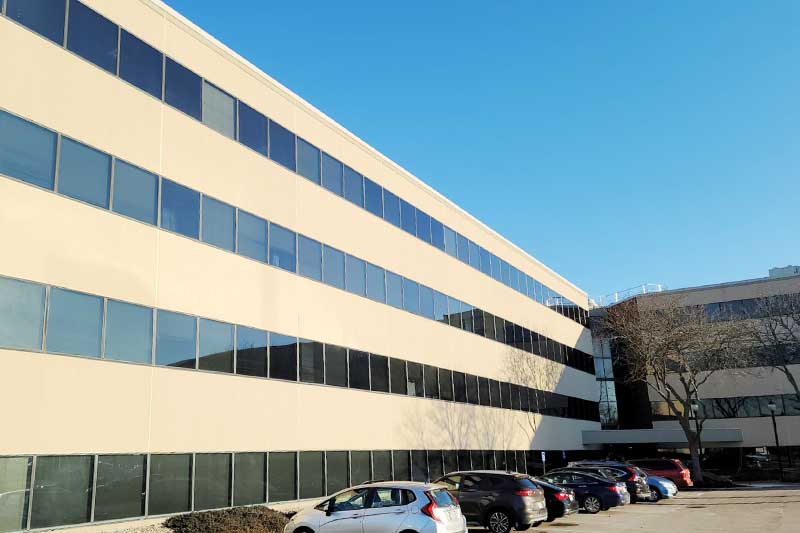
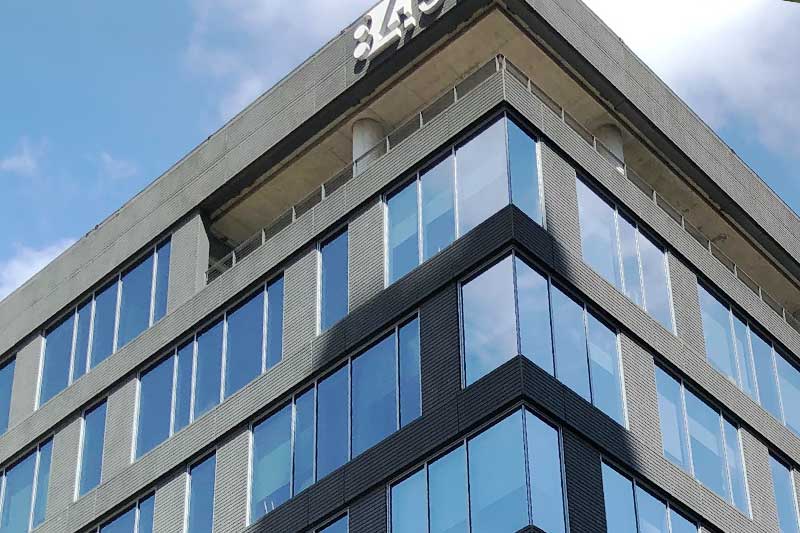
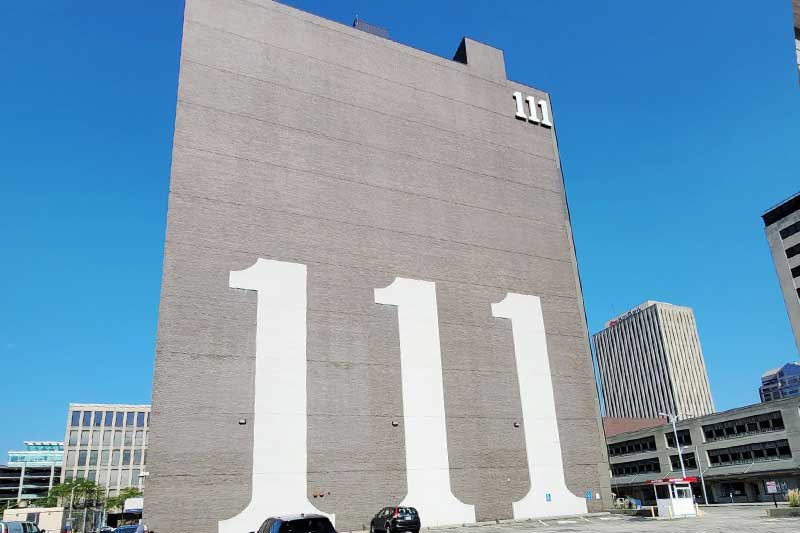





Cleveland’s downtown towers come apart in a way the glaze on their own cladding explains. The steel-framed blocks put up between 1900 and 1930 around Playhouse Square, Historic Erieview and the Warehouse District wear glazed terra cotta and cut stone, and that glaze is close to impermeable over a porous body. Once it crazes, water gets in, cannot leave through the face, freezes behind the glaze and lifts it off in sheets, after which the bared body drinks faster than it ever did. Behind the units, the frame’s embedded relief angles and spandrel beams rust, the corrosion product swells to several times the steel it came from, and it jacks the masonry outward. Add 63.8 in of snow a year, a lake that parks the shoreline on either side of freezing, and 49% of possible sunshine to dry anything, and a loose unit over a public sidewalk stops being anybody’s maintenance item.
Presto Restoration builds facade restoration, caulking and waterproof coating work around what a Chapter 3143 report actually asks for. A critical examination to ASTM E2270-14 falls due every five years on buildings of five stories or 75 ft that have passed 30 years, and the written report filed with the Director of Building and Housing comes back safe, safe with a repair and maintenance program, or unsafe. The second and third of those are repair scopes, not paperwork. Our rope-access and swing-stage crews reset terra cotta and stone anchorage, open jacked joints, replace spent sealant, refinish corroded metal and close the wall back up with products we manufacture ourselves. The building’s next examination then starts from a known baseline.
Sealant is the first thing to give up on a Cleveland wall, and the reason is Cleveland’s cycle count rather than its cold. Lake Erie holds the shoreline near freezing for months, so a joint crosses the freezing point again and again while it is still wet from meltwater. Every crossing works the bead, and material that has cured hard tears at the bond line instead of stretching. Presto’s high-rise technicians cut the spent sealant out, prepare and prime the joint faces, and set backer rod to the right depth. They then gun silicone or polyurethane rated for wide joint movement at low temperature. Window perimeters, expansion and panel joints, terra cotta unit joints, penetrations and coping joints are all handled in one coordinated pass.
Cleveland’s towers carry architectural trim, mullion, aluminum and ACM panel (Alucobond) through long wet winters under a sky clear on just 66 days a year. Finishes sit damp instead of baking dry, so oxidation, alkaline runoff from the masonry above, and months of meltwater sheeting down the elevation dull the color and etch the coating. Rather than budget for wholesale replacement of the panels, let our metal restoration crew recover the finish already on the building. Micro-abrasion under close control lifts oxidation, corrosion and contamination held in the surface, and refinishing then returns factory color and luster. The result is like-new metal for a fraction of what replacement costs, on a schedule fitted to the narrow dry window this market allows. (Restored metal is normally sealed afterward under a clear protective coating: that step sits with our Commercial Waterproofing services, and owners typically buy the two scopes together.)
Glass on a Cleveland high-rise collects damage that no cleaning contract will reverse. Alkaline runoff from terra cotta, stone and concrete above the glass line etches the surface permanently; mineral and hard-water deposits bake in during the few clear stretches this market gets; and grit carried in on open-fetch lake wind leaves haze and fine scratching across the windward elevations. Our chemical glass restoration process dissolves staining, lifts mineral contamination and takes off surface damage without cutting into the glass itself, so a curtain wall reads clear again. (To hold that clarity through a full winter, ask about our proprietary Glass Defender treatment, which the commercial waterproofing page covers in detail. Most owners buy the two together.)
Brick, cut stone, precast and stucco share one weakness in a lake climate: they hold water. Cleveland’s 41.03 in of yearly precipitation soaks in, and with only 49% of possible sunshine a wall seldom dries before the next freeze, so a saturated substrate cracks, spalls and grows biological staining while the wall’s finish still looks sound. Presto installs elastomeric waterproof coatings that cure into a flexible, breathable membrane. It moves with the wall through winter contraction and summer expansion, and bridges hairline cracking as wide as 1/16 inch. Bulk water is held at the face while vapor already in the assembly is allowed out, which counts for far more here than in a market that dries fast. Factory colors and finishes are available across the full palette.
From the Hoyt Block and Perry-Payne sandstone of the Warehouse District to the glazed terra cotta and cut stone on the city’s 1890s and 1920s towers, the Rockefeller Building and Society for Savings among them, masonry is what Cleveland’s commercial core is made of. Terra cotta is the delicate case: a hard glaze over a porous body, and once the glaze crazes the unit takes on water it has no way to shed. We open every stone project by mapping the substrate and cleaning gently enough not to scar a fired face, then apply penetrating sealers and breathable coatings that keep moisture out without sealing it in. Spalled units and failed patches get color-matched repair engineered to move the way the original material’s body moves.
In a brick wall the mortar fails long before the brick does, and in Cleveland the failure starts at the top. Meltwater standing on parapet and coping soaks the joints beneath it, then crosses the freezing point again and again while the lake keeps the shoreline hovering near thaw, until the joint’s face crumbles out into the wall cavity.
Presto’s masonry crews cut eroded joints back to sound mortar at the proper depth, then place new mortar matched for color, for compressive strength and for composition, and tool each joint to bring back the wall’s as-built profile: structural repointing and decorative tuckpointing from one accountable crew.
On the 1850s to 1900s loft blocks of Cleveland’s Warehouse District, we specify lime-based blends soft enough to protect period brick and sandstone.
Every Cleveland facade project moves through five phases, set up to find every loose unit and jacked joint before a number is quoted, keep crews and occupants safe over an open downtown sidewalk, and hand back a record the owner can file against the next five-year cycle.
We read the wall from the sidewalk, by drone and at arm’s length off suspended access. Terra cotta, stone, sealant, metal, glass and coatings are photographed and logged: every drummy or displaced unit mapped before pricing.
Suspected leaks and hidden deterioration get controlled water spray testing, infrared thermography scans and moisture readings, so the intrusion is traced back to its actual entry point instead of being sealed over at the stain.
What we find is written up as a line-item scope: quantities, named products, and phasing sequenced around the drying window. Your project manager carries access, occupant notice and permitting with Building and Housing.
Certified rope-access and swing-stage crews carry out the repair to manufacturer specification, with field supervisors holding quality control and logging progress and weather every day.
Turnover brings the full package: warranty documents, data sheets for every product used, before-and-after imagery, plus a maintenance plan timed to the next required Chapter 3143 examination.
Covering downtown Cleveland, the Cuyahoga River districts and the east-side communities sitting under the snow belt’s heaviest bands takes more than a crew that drives in for a week. Presto runs a coordinated network of specialized divisions, so a client has continuous coverage from a full envelope program down to routine facility care.
For preventative and everyday support, property managers can contact our sister divisions directly:
Building Restoration Cleveland: Structural repair and high-rise exterior preservation, handled as its own discipline.
Building Maintenance Cleveland: Ongoing preventative maintenance that keeps a building performing through a long winter and a short drying season.
Building Services Cleveland: Comprehensive commercial building support, handled day to day across the markets we cover.
For more than 25 years Presto Restoration has protected commercial property nationwide, and what we do in Cleveland is shaped by what this market’s buildings actually are: steel frames from 1900 to 1930 wearing glazed terra cotta and cut stone, later curtain wall over them, and a five-year examination cycle under Chapter 3143 sitting over the lot. We scope to the classification a filed report carries rather than to a generic repair list, and we know which anchorage and jacking repairs survive a Cleveland winter and which ones reopen at the season’s first thaw. The rest of what we do sits under Cleveland building restoration services.
Not sure what your last examination report actually obligates you to fix? Call and we will talk through the classification, the units it names, and the scope that follows from it.
Call 1-800-785-9927 or use Request A Free Quote.
Chapter 3143 sets a five-year cycle. A Cleveland building of five stories or 75 ft above grade that has passed 30 years needs a critical examination to ASTM E2270-14, witnessed by the qualified inspector the owner engages, with a written report filed to the Director of Building and Housing. Repair intervals sit on their own clock: sealant every 8 to 12 years, coatings every 10 to 15, repointing every 20 to 35.
Chapter 3143 gives the inspector three classifications: safe, safe with a repair and maintenance program, or unsafe. The middle one means defects exist and a written program has to carry them forward. The third means conditions are hazardous to the public and need protection and repair on the schedule the Director sets. Either way the classification is a scope, not a filing formality. We price to the specific units, joints and relief angles the report names, and we sequence the unsafe items first so the sidewalk protection can come down sooner.
Yes. Most of what we do is on occupied office buildings, hotels and mixed-use blocks downtown. Rope access keeps scaffold off the sidewalk and out of the entry, loud tasks are scheduled around tenant hours, and phasing keeps lobbies, garages and storefronts open. Drop zones are protected properly, which matters on a narrow downtown street.
Scope and height drive it. A targeted sealant replacement on a mid-rise can finish inside two to four weeks. A full wall program covering terra cotta anchorage, jacked relief angles, coatings and metal on a twenty to thirty story tower usually runs three to six months. We plan around a short application window rather than pretending the season does not close.
Warranty length depends on which coating systems, sealants and repair methods your wall ends up getting. You receive the full warranty package at closeout, and we go through exactly what each line covers during scoping, before anything is signed.
Yes. Our project managers lodge applications with the Division of Construction Permitting at the City of Cleveland Department of Building and Housing. On facade work the Chapter 3143 report sets the repair scope, and we prepare the documentation to match. Where the building sits in one of the 29 local historic districts, an exterior change also needs a Certificate of Appropriateness under Chapter 161, and the Cleveland Landmarks Commission has 45 days to act. Presto carries nationwide general liability and workers’ compensation coverage.
Once water shows on an interior finish the wall has been open for a while, and a loose terra cotta unit will not wait for a budget cycle. Call and we will scope what your report, or last winter, turned up.
Call 1-800-785-9927 today or click Request A Quote.