






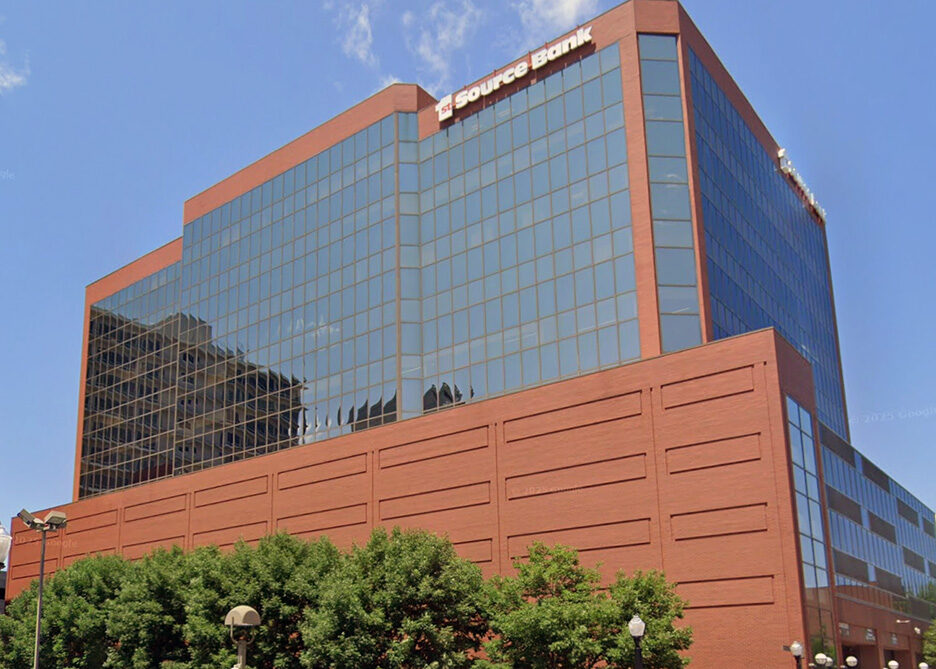
Downtown Indianapolis wears two very different envelopes and the weather is hard on both. Indiana limestone, quarried fifty to sixty miles south along the Bloomington to Bedford belt, clads the State Capitol, the downtown monuments, the Indiana Government Center and Circle Tower. It is a calcareous stone, so acid deposition dissolves its surface a little at a time, leaving granular sugaring, dark soiling crusts and chloride damage where de-icing salt splashes the lower courses. A few blocks away stands a cohort of glass towers finished between 1982 and 1990, among them OneAmerica, Fifth Third, Capital Center South, BMO Plaza, Market Tower, 300 North Meridian and Salesforce Tower. Their sealants, gaskets, glazing and anchors are now thirty-six to forty-four years old, and because the whole group went up inside nine years they reach the end of their service life together rather than one building at a time.
Marion County is a flat till plain with roughly 250 feet of relief across 403 square miles, so there is no high ground anywhere in the county to shelter a tall building. Severe convective storms load all four elevations of a tall building at once, and the record here is not theoretical: in 2006 One Indiana Square lost glass across sixteen stories to tornado-level winds and was overclad with an entirely new curtain wall, completed in 2009. Neither the City of Indianapolis nor the State of Indiana requires a periodic facade inspection, so an Indianapolis owner gets no scheduled prompt to look at any of this. The case for inspecting a facade here is voluntary risk management rather than compliance, which puts the decision squarely with ownership.
Presto builds a facade program around that pairing of stone and glass, with restoration, caulking and coating scoped together instead of bid out as separate trades. Rope access and swing-stage capability, paired with products formulated in our own plant, let a crew take each weak point in turn: pulling spent sealant, refinishing corroded metal, laying flexible elastomeric membrane, repointing brick in a mix matched to the wall. Limestone is handled differently. It is cleaned gently and then sealed breathably, because a stone losing its surface to acid has to be able to dry out rather than sit under a film that holds the water in.
Failed caulking sits behind most commercial leaks, and in Indianapolis the driver is thermal rather than solar. A joint that opens on a January night and closes again on an August afternoon travels a wide annual range, and whatever water is standing in it when the temperature falls expands as it freezes. Enough cycles of that and the sealant releases from one face and stops bridging the gap at all. The downtown towers feel it first, because their original glazing sealant dates to the 1980s and has run out past the fifteen to twenty-five year service life manufacturers rate these products for. Our high-rise crews cut the dead material out, prepare the substrate, set backer rod at the right depth, and gun in silicone and polyurethane rated for high movement at low temperature. Panel joints, control joints, window perimeters, penetrations and the expansion joints between them are all covered in one coordinated pass, so no elevation goes into winter half sealed.
The downtown curtain wall cohort leaves a great deal of aluminum, ACM panel (Alucobond), mullion and trim out in the weather. Winter dulls and pits those finishes by a route that starts down at the pavement: de-icing salt thrown up by traffic settles on lower panels and railings, freeze-thaw works moisture in behind the gaskets, and urban particulate bonds over the years into a film no ordinary wash will shift. That is worth knowing before a panel replacement budget gets signed off. Our metal team brings the original finish back with controlled micro-abrasion, which lifts oxidation, corrosion and embedded grime, followed by refinishing that returns factory color and luster. The result is metal reading as new for a share of what replacement costs, and with far less disruption to the building. (A protective clear coating usually follows: see our Commercial Waterproofing services, which sit naturally alongside this scope.)
Glass on an Indianapolis high-rise takes damage no cleaning contract will reverse. Alkaline runoff off limestone and concrete above etches the surface permanently, winter road spray throws chloride and grit onto the lower elevations, and mineral carried by irrigation water and snowmelt bakes into the pane. Our chemical restoration process takes staining and mineral deposit off and removes surface damage without sacrificing the glass, bringing a curtain wall back to genuine optical clarity. (If you want that clarity held for the long run, ask about our proprietary Glass Defender treatment. It is covered over on the commercial waterproofing page, and around here the two are usually specified together.)
Precast concrete, stucco, masonry and EIFS all have the same vulnerability once the weather turns, and that vulnerability is porosity. Water pulled into those substrates in late autumn has nowhere to go once the temperature drops, and the expansion that follows drives rebar corrosion, spalling and cracking that widens a little each season. What we install against it is an elastomeric coating system curing to a flexible, breathable film. It keeps moving with the structure across a wide annual range and bridges hairline cracking up to 1/16 inch, holding bulk water off the face while vapor already inside the wall can still get out instead of being sealed in to freeze. Factory colors and finishes run the full range, so the coating doubles as a facade facelift.
Indiana limestone, formally the Salem Limestone, is the signature cladding of this city and it is quarried only fifty to sixty miles south of it, between Bloomington and Bedford. It is also calcareous, which means it behaves nothing like fired clay brick under the same weather. Rain that is even mildly acidic dissolves the surface a little at a time, producing the granular sugaring and the dark crusts that collect on sheltered elevations, while chloride thrown up from salted streets concentrates in splash zones near grade and crystallizes inside the pores. Every stone scope therefore starts with a close reading of the substrate, then cleaning gentle and controlled enough to lift soiling without scarring the face, and then penetrating, vapor-permeable repellents that stop liquid water while still letting the stone dry. Spalled or damaged sections receive color- and texture-matched patching engineered to move with the original rather than against it.
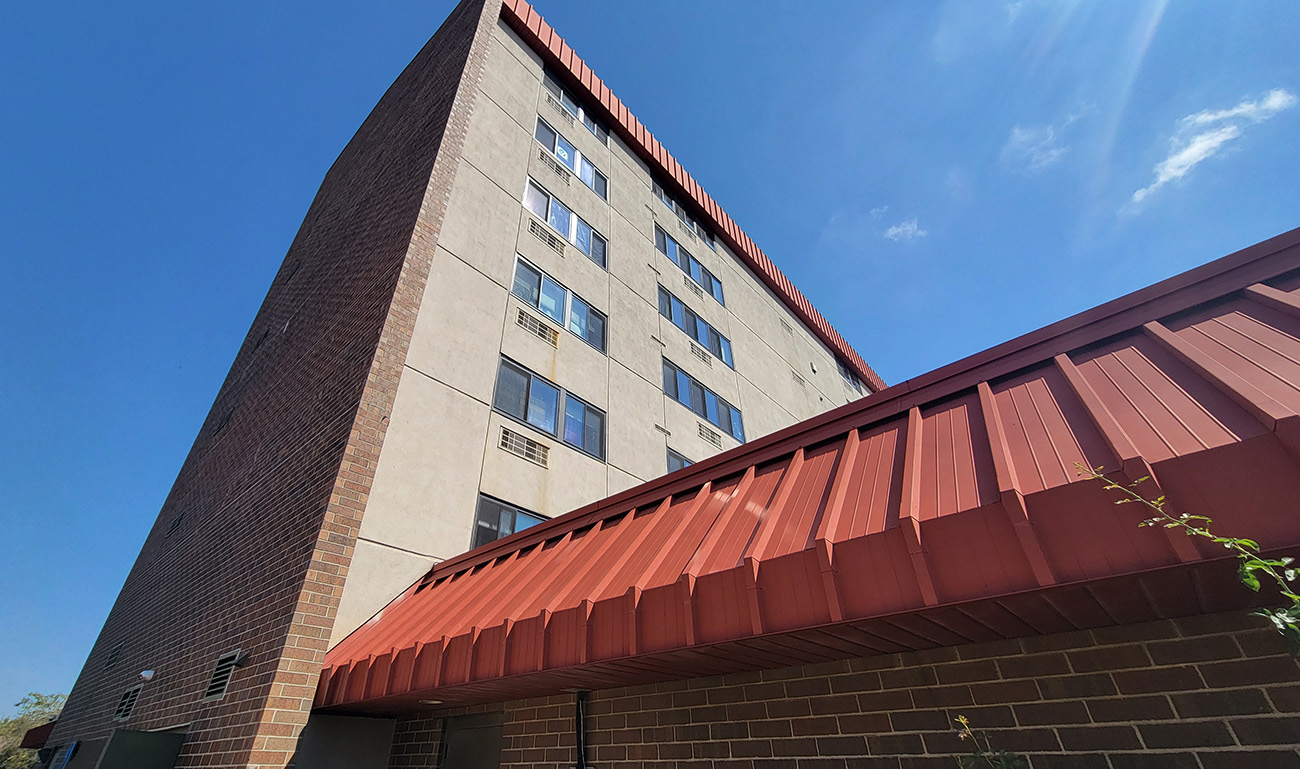
Mortar is the part of a brick wall that goes first, well ahead of the brick itself. Once the joints have eroded, meltwater runs straight into the assembly and freezes inside it, which shows up indoors as leaks and efflorescence and outdoors as brickwork that has begun to work loose.
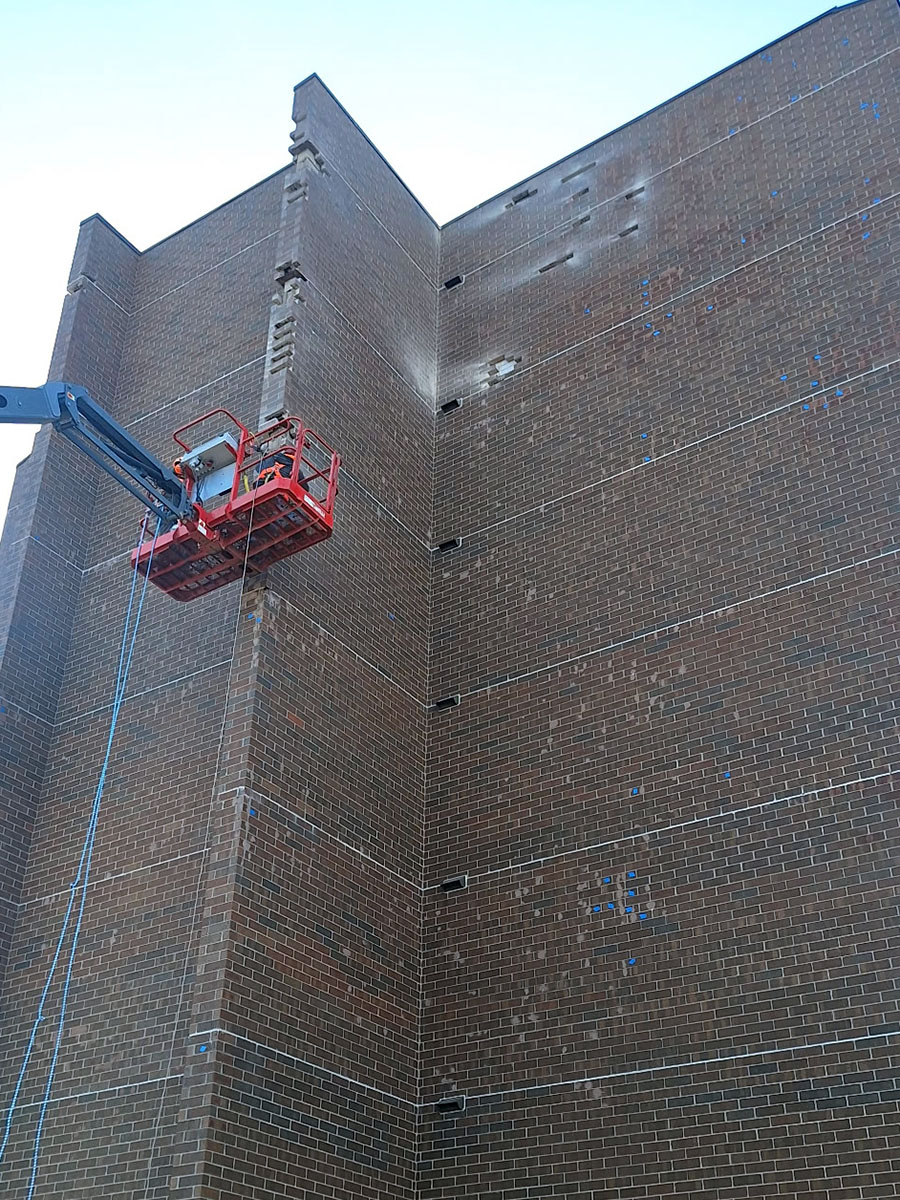
Our masonry crews cut eroded joints back to proper depth, pack in replacement mortar whose color, compressive strength and composition answer the original, then tool the finished joint back to the profile the wall started with. Repointing for structure and tuckpointing for appearance stay with one crew, so a single party answers for the wall.
In the Wholesale District, where the city holds its densest run of 19th-century commercial buildings from roughly 1863 onward, the blends we specify are lime-based and consistent with the way those walls were originally put up.
Every Indianapolis facade project runs through the same five phases. The sequence exists to get every defect on paper before the work is priced, to keep crews and occupants safe while it is live, and to leave the owner holding a documented result at handover.
The envelope gets looked at three ways: from grade, by drone, and close up from suspended access. Sealant, metal, glass, limestone, coating and masonry conditions are photographed and logged, so the defect map exists before anything is priced.
Where a leak or hidden deterioration is suspected, controlled spray testing, infrared thermography and moisture readings trace the water back to where it actually enters rather than to where it shows. Spray work is booked for days above freezing.
What the survey finds becomes a line-item scope carrying quantities, named products and a phased program. Access logistics, occupant notice, the Indiana Construction Design Release and the Indianapolis DBNS permit all sit with your project manager.
The restoration itself is carried out by certified rope-access and swing-stage crews working to manufacturer specification, with a field supervisor holding quality control and logging progress daily. Product choice and cure windows are matched to where the Indiana season actually is.
Handover comes with the full record: warranties, product data sheets, photography from before and after, and a maintenance plan timed to the local freeze-thaw calendar.
Covering downtown Indianapolis and the eleven counties around it properly is not something a visiting crew manages on its own. Presto coordinates a set of specialized regional divisions so that cover runs unbroken, from major envelope restoration through to routine facility care.
Property managers who want day-to-day and preventative support can approach our sister divisions directly:
Building Restoration Indianapolis: Structural repair at building scale, and preservation work on high-rise exteriors.
Building Maintenance Indianapolis: The preventative maintenance that keeps central Indiana property working right through the year.
Building Services Indianapolis: Comprehensive day-to-day support for commercial buildings across this market.
For more than 27 years, Presto Restoration has protected commercial properties nationwide. In Indianapolis that experience meets a market with no facade inspection ordinance at either the city or the state level, a downtown curtain wall cohort running out of sealant life on a single clock, and a permitting path that starts with an Indiana Construction Design Release before the Class 1 Commercial Structural Permit is issued. Explore our full range of Indianapolis building restoration services.
Cracked sealant, rust bleed, spalling concrete or limestone that has gone granular to the touch? Tell us what you are looking at and our specialists will tell you which repair it calls for.
Call 1-800-785-9927, or send the details through Request A Free Quote.
A hard-freeze inland climate sets its own maintenance rhythm. On an Indianapolis building we generally look at the whole envelope every 3 to 5 years, expect to replace sealant somewhere in the 8 to 12 year range, renew elastomeric coatings at 10 to 15, and repoint masonry on a 20 to 35 year cycle. Exposed limestone at splash height and any elevation that takes winter road spray should work off the shorter end of those windows, as should the downtown towers whose original 1980s glazing sealant is already past the fifteen to twenty-five year range manufacturers rate it for.
The signals worth acting on in this market are mostly freeze signals and salt signals. Sealant that has gone hard, split at the bond line or pulled back from the joint wall. Rust bleed staining stone or concrete below metal anchors, copings and panel fixings. Efflorescence blooming through brick. Limestone that has turned granular underfoot or carries a dark gypsum crust on sheltered faces. Damp patches or a musty smell on interior walls after a wind-driven storm. Glass that stays hazy after cleaning. Concrete spalling at slab edges, balconies and window heads. Spalling that turns up in February or March is almost always freeze damage working a crack open rather than ordinary aging, and lower courses above salted walkways deteriorate faster than the same detail four floors up.
Yes, and that is how most downtown work here gets done. Rope access keeps scaffolding and its street-level footprint off the property, which matters on the tight Mile Square blocks where sidewalk closure is the expensive part. Noisy operations are booked around tenant hours, property management gets a weekly look-ahead, and the lobby and entrance sequence is planned so parking and access stay in service. We also plan around the season, since a phased job that stalls at the first hard freeze is more disruptive than one scheduled to finish inside the window.
It shapes the schedule more than building height does. Most sealants, elastomeric coatings and repointing mortars carry minimum application and cure temperatures, so the productive exterior season runs from the spring thaw through late autumn. We scope and permit over the winter, which is also the right time to obtain the state Construction Design Release and the city permit, then mobilize as soon as conditions allow. Work that is genuinely temperature-independent, such as interior-side investigation and documentation, proceeds year-round.
That depends on which systems end up on your building, since sealant, coating and repair warranties all run on different terms and the manufacturer sets most of them. What we commit to is that you see those terms while the scope is still being priced, not at handover. Full documentation is assembled at closeout, and we walk ownership through the coverage, the exclusions and the maintenance conditions that keep it valid, including the drain and joint checks that matter most going into an Indiana winter.
No. Neither the City of Indianapolis nor the State of Indiana has a facade inspection ordinance for commercial buildings, so there is no mandated cycle and no filing deadline to work back from. That is worth knowing for two reasons. First, any proposal that cites a mandated inspection cycle as the reason to act is describing another city’s rules, not this one’s. Second, with no legal prompt the decision to look at a facade sits entirely with ownership, which in practice means problems here are often found later and cost more by the time they are. What Presto does handle is the permitting the restoration work itself triggers: a Construction Design Release from the Indiana Department of Homeland Security, then a Class 1 Commercial Structural Permit from the Indianapolis Department of Business and Neighborhood Services. Presto carries nationwide general liability and workers’ compensation coverage.
By the time a leak shows itself inside, the facade has already failed, and in this climate the next hard freeze will open whatever let the water through a little further. Describe what the elevation is doing and we will point you at the repair it needs.
Call 1-800-785-9927, or send the details through Request A Quote.