


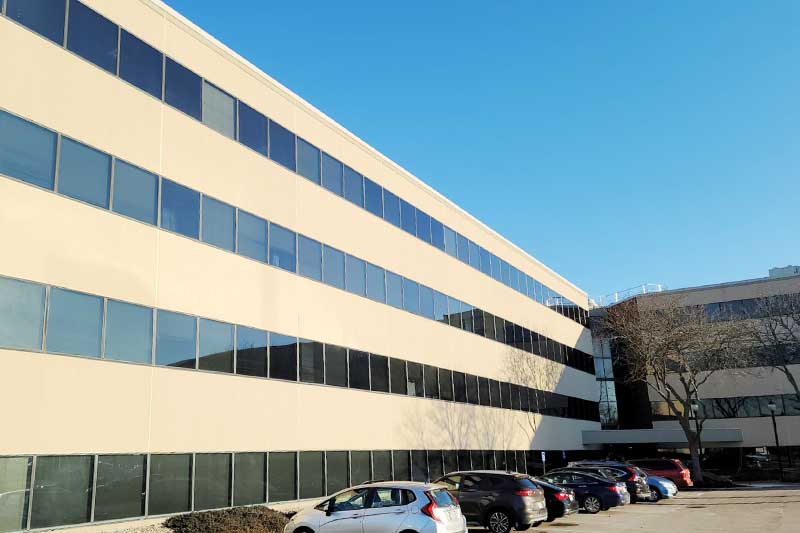
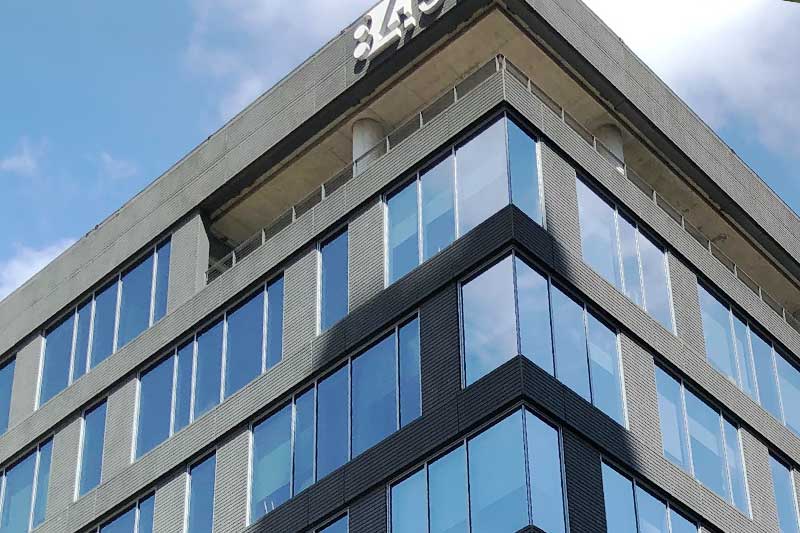
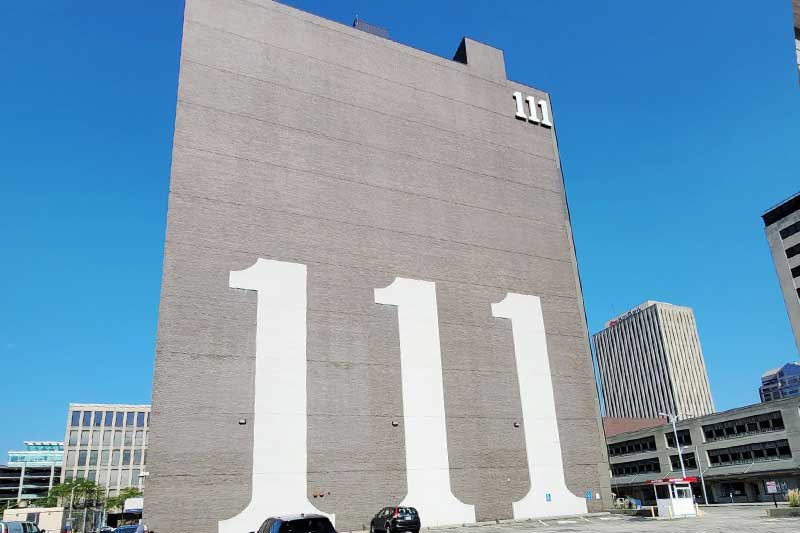






In Cleveland the stain on a tenant ceiling and the weather that caused it are rarely in the same month. Snow driven into an open coping joint or a failed window perimeter in December stays in the assembly until a thaw releases it, and only then does it travel far enough to mark a finish. Most markets can tell a contractor the building leaks when it rains. Here it leaks when the temperature climbs, which removes the one clue that usually points at the source. The steel-framed towers put up between 1900 and 1930 around Playhouse Square, Historic Erieview and the Gateway District make it harder again, because a multi-storey cavity carries water down the back of the masonry and lets it out several floors below and a bay across from where it went in. Meltwater refreezing in a scupper or an internal drain backs water up over the flashing line, so the failure sits at the outlet rather than out in the field where anyone looks first. Wind arriving over open water pushes rain into vertical joints that a calmer market never loads. With 49% of possible sunshine, an assembly wetted in December is still wet in February, so damage accumulates for a whole season before anything is visible indoors.
Presto Restoration treats leak detection and building envelope consulting as the opening move on a Cleveland restoration project rather than an add-on. Before any repair is priced, our diagnostic team establishes where water is crossing the envelope, why it crosses there, and which restoration approach will actually shut it off. That matters more here than in a market where you can wait for the next rain and watch the wall. The findings also give an owner something concrete to hand the engineer working from a Chapter 3143 examination. A note on how we take this work on: leak detection is not something we sell on its own in a small package. The diagnostic and consulting hours sit inside a full commercial restoration project, and $50,000+ is the usual floor for one.
Presto brings several diagnostic techniques to bear on a Cleveland building, and the combination that goes on a given project follows from the structure itself, the symptoms reported, and when in the year the water is showing itself, because a February stain and a July stain point at different mechanisms.
You cannot stand a Cleveland building in front of a storm and wait for it to fail, because the water doing the damage arrived weeks earlier as snow. Controlled water testing puts that timing back in our hands. We apply water to one suspected point at a time, a single vertical joint, a window or door perimeter, a balcony connection or a coping detail, hold everything around it dry, and watch inside for the water to arrive. Isolating one candidate at a time earns its keep on a cavity wall, where an entry three floors above the stain is entirely ordinary and soaking a whole elevation would only prove the wall leaks somewhere.
Wet material holds and gives up heat differently from dry material, and a heating season supplies the temperature difference that makes the contrast readable. Scanning an occupied Cleveland building from outside on a cold evening brings up saturated insulation, wet cavity fill and cold tracks running down an elevation as anomalies against the sound assembly around them. A cloudy market helps rather than hinders, since little stored solar heat is left in the cladding to muddy the image. We use thermal scanning to reduce an entire elevation to the few bays worth opening.
Moisture meters replace opinion with a number: measured moisture content in gypsum, wood, concrete masonry and other porous material, taken across a grid of points rather than only at the stain. From those readings we map how far water has travelled from a suspected entry and whether the assembly is still taking water on. This market gives a wall very little chance to dry between events, so a wall wetted in December can still read saturated in February, and repeat readings through a thaw separate an assembly that is actively wetting from one that simply has not dried.
On downtown Cleveland towers the details that fail first are the ones nobody sees from the street: coping, parapet caps, roof edge flashing, mechanical curbs, scuppers and internal drain sumps. Drone imaging gets a camera to them at close range without the cost and scheduling of rope access or swing stage rigging. High-resolution stills of a drain that has been backing water up over its flashing line, or of open joints on the elevation facing the lake, frequently identify the entry before a single opening is cut, and they show which elevations deserve hands-on work.
When thermal scanning, meter readings and water testing still leave the path unresolved, the answer is behind the finish. On a steel-framed Cleveland tower the cavity is the whole argument, since water entering at a jacked relief angle or a failed joint can run down the back of the masonry for storeys before it turns inward. Small targeted openings, cut where the data points, show what is actually happening in there, corroded steel and saturated cavity insulation included. Everything found is photographed and logged, and each opening is closed back weathertight before we leave.
Every diagnostic engagement closes with a written report built around the one building. It records the field findings, ties each confirmed failure point to a photograph and a location, sets out our conclusions on how water is moving through the assembly, and recommends the restoration approach that answers them. We write to the decision in front of the reader, because an owner weighing a repair budget and an engineer preparing a Chapter 3143 filing are asking different questions of the same wall. Everything in the scope and specifications we later propose is built on that report.
Every Presto commercial restoration project in Cleveland opens with diagnostic work, finished before the repair scope is fixed. That order is what separates us from a contractor pricing off a ceiling stain and a guess about which winter put it there.
We log every symptom and, just as usefully, when it appears: in rain, on a thaw, or right through the winter. Prior repairs, tenant reports and the building history narrow the search before any testing starts.
What the history shows decides the mix: controlled water testing, infrared thermography, moisture meter readings, drone imaging of parapets and drains, or targeted openings where the cavity has to be seen directly.
You get one written report on your building and a restoration scope priced line by line, so an owner sees what was confirmed, where it sits, and how the proposed work closes it.
Confirmed failure points go to the Presto line that repairs them: facade, waterproofing, parking deck, roof or historic preservation, crewed and warranted through one accountable contractor.
Where it applies, we retest the repaired area under water to confirm the path is closed, then hand over the full record so the next thaw is not another investigation.
If a Cleveland building keeps staining through repairs that were meant to end it, the water is almost certainly entering somewhere nobody has tested yet. Our diagnostic-first approach finds that point and scopes the fix around it. Diagnostic and consulting work is carried inside comprehensive restoration projects (typical project minimum $50,000+).
Call 1-800-785-9927 today, or click Request A Free Quote.
Leak work finishes with a located source and a sealed opening, and the building still has to be looked after the week after that. Presto pairs tracing and Infrared Thermography with Northeast Ohio specialists who carry the repair and the routine attention that follow, so an owner is never handed a report and left to find the next trade.
The repair follow-through and the ongoing attention belong to our sister divisions:
Building Restoration Cleveland: Targeted structural and exterior work on high-rise property, for when a trace ends at cracked masonry or a failed anchorage rather than a fitting.
Building Maintenance Cleveland: Preventative maintenance on the sealant joints and drainage paths a survey flags, kept up through the months when nothing on the building dries.
Building Services Cleveland: General commercial building support across Northeast Ohio once the water problem is behind you.
Browse recent commercial restoration projects across Ohio where diagnostic work located the real point of entry, often storeys above the stain, and set the restoration scope that followed from it.
Not on its own, and that is deliberate. We fold leak detection and building envelope consulting into a comprehensive commercial restoration project instead of selling them apart from one, and $50,000 is the typical minimum size for such a project. The methodology is built to produce a repair scope, and with the repair taken away the findings are information that nobody acts on. An owner who wants a one-off leak inspection, a residential opinion or a small consulting engagement will do better with a specialty inspection firm.
Controlled water testing, infrared thermography, moisture meter readings, drone imaging and invasive testing, meaning small openings cut for investigation. Which of them run depends on the structure, the symptoms and when in the year the water appears, since a stain that arrives on a thaw is telling a different story from one that arrives in a July downpour. We pick methods that change the restoration scope.
Two reasons, and they compound each other. Water often enters as snow and only shows itself weeks later on a thaw, which cuts the symptom loose from the event that caused it. Then, on the steel-framed towers built here between 1900 and 1930, the cavity behind the cladding carries that water down and sideways, so an entry at a coping or a spandrel joint can surface three or four storeys lower. A contractor who repairs at the stain repairs sound wall, the owner pays twice, and the mark comes back with the next warm spell.
That is not work we take on. Forensic engineering, expert testimony and litigation support all sit outside our lane, and a specialty forensic engineering firm is the right call for them. We do work alongside such firms on restoration projects tangled up in insurance or liability disputes, including disagreements between an owner and a condominium board over who owns a leak, but the forensic role is not ours.
Each report is written around the one building and the decision its owner is facing. It carries the field findings with supporting photography, every confirmed failure point with the cause behind it, our conclusions on how water is moving through the assembly, and the restoration scope that answers them. Because the project specifications get written straight off it, and it often becomes supporting material for an engineer working to Chapter 3143, it is written to drive the work that follows rather than to sit in a file.
It depends on building size, how tangled the intrusion has become, and which methods the wall calls for. A single suspected failure point can usually be traced in one to two days. Where several areas are suspect and each needs controlled water testing, a whole-envelope investigation runs one to three weeks. Cleveland adds a scheduling question warmer markets do not have, since water testing needs temperatures above freezing, so winter work is timed to a thaw. We set the timeline out during scoping so managers can plan the restoration phasing behind it.
If a Cleveland building keeps staining through repairs that were meant to end it, the entry point is almost certainly not where the mark is. Presto works the other way round, confirming where water crosses the envelope first and restoring that, so the leak closes instead of moving somewhere else.
Note: diagnostic and envelope consulting work is carried inside comprehensive commercial restoration projects, typical project minimum $50,000+.
Call 1-800-785-9927 or Request A Quote online.