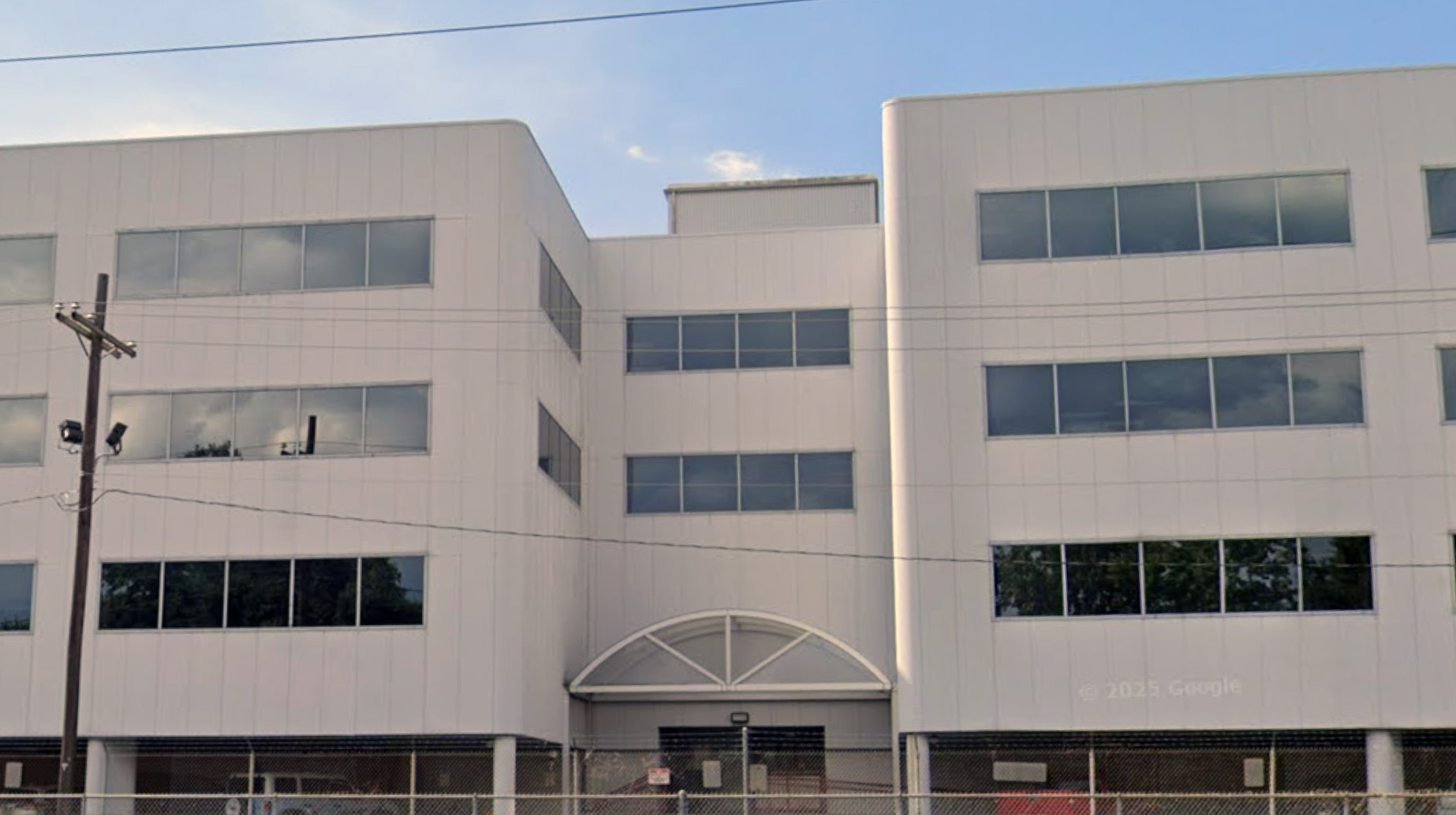
Presto Building Facade Restoration & Waterproofing
Building Facade Waterproofing & Restoration Services 1-800-785-9927

Waterproofing a building in New Orleans is a different problem from waterproofing one almost anywhere else, because the water arrives from three directions and never fully leaves. Tropical rain bands push it horizontally into joints that would stay dry under vertical rainfall. Roughly 62 inches of it fall in a year, so a joint that only leaks in a hard blow still leaks often. And between storms the vapour pressure alone keeps driving moisture through porous stucco, brick and precast, which is why a wall here can be saturated for weeks without a drop of rain having hit it recently.
That last point governs how we specify. A vapour-tight coating on a New Orleans wall traps moisture rather than excluding it, and the coating fails from behind within a few seasons. Presto installs systems that stop bulk water at the surface while leaving the drying path open: industrial silicone and polyurethane sealants, breathable elastomeric membranes, wet glazing, masonry sealers and traffic-grade deck systems. All of it is above-grade work. Presto does not waterproof foundations or below-grade assemblies in any market, and in a city where much of the ground sits at or under sea level, that boundary is worth stating plainly rather than leaving a client to discover it.
From joint sealants to full coating systems, Presto’s above-grade waterproofing services for New Orleans buildings fall into two groups: core systems that keep the envelope watertight, and specialised restoration-waterproofing that cleans and repairs a surface before protecting it.

A New Orleans structure is never quite still. Concrete frames flex under storm wind loading and cycle daily with the heat, and underneath, the drained soils away from the natural levee ridge keep consolidating, so buildings settle differentially over years rather than uniformly. All of that movement concentrates in the same places: expansion joints, control joints, and the cracks that open where a slab at grade or a plaza deck meets a wall. Once a joint has lost its elasticity it stops accommodating that movement and starts channelling water instead. We remove the failed material, prepare and prime the joint, set backer rod to the correct depth, and install sealants chosen for movement capability first and appearance second.
Glass on a New Orleans building takes a steady chemical beating rather than a dramatic one. Alkaline runoff sheets down off concrete, precast and mortar joints above and etches the glazing permanently. Airborne salt off the Gulf and Lake Pontchartrain settles and stays put through weeks of humidity instead of being rinsed away. Urban grime bonds into the surface film. Our proprietary Glass Defender treatment bonds a hydrophobic barrier to the glass so minerals cannot anchor and water sheets away instead of drying in place. Sealing the perimeter matters just as much: it keeps that chemistry outside the building rather than inside the glazing pocket, where trapped moisture rots the seal and fogs the unit from within.


Ledges, parapets, copings and balcony edges are where New Orleans rain actually sits. A vertical wall sheds; a horizontal detail holds standing water for hours after every storm, and in this climate it may not fully dry before the next one. Conventional coatings surrender there first. Silicone systems hold up under continuous wetting, stay flexible through the thermal cycling of a long Gulf summer, and do not chalk out under sustained UV the way cheaper chemistries do.
The sealant joint between glass and frame is one of the first waterproofing components to go on any commercial tower, and wind-driven rain finds it quickly. Once that perimeter seal hardens, splits or releases, water enters the glazing pocket and works inward along the frame, often surfacing on a floor well below the one where it entered. Wet glazing rebuilds that seal in place, without removing the glass, restoring the weather line at the perimeter of every affected unit.


Stucco, EIFS and concrete walls develop hairline cracking as a matter of course, and here every crack is an open invitation for the next tropical band. Elastomeric coatings bridge that cracking and move with the wall instead of splitting alongside it. The property that matters most in New Orleans, though, is permeability. These systems are breathable, so a wall that is already carrying moisture can continue to dry outward through the coating. Specify a vapour-tight film here instead and the water simply relocates: it collects behind the coating, blisters it off, and takes the substrate with it.
Brick, block, precast and cast stone absorb water readily, and in a city this humid they rarely get the dry spell that would let them shed it again. The results show up as efflorescence and salt bloom streaking down an elevation, damp interior walls, mould pressure in occupied spaces, and masonry that deteriorates from the inside out. Penetrating masonry sealers reduce liquid absorption at the surface while leaving the material vapour-open. On older soft brick we choose the sealer around the substrate’s porosity rather than applying one specification across a whole wall, because over-sealing a soft brick wall does more harm than leaving it bare.

What sets Presto apart is that we do not simply seal a surface, we clean and restore it first. On a New Orleans building that sequence matters more than usual: sealing over biological growth, salt bloom or a contaminated surface locks the problem under the coating, where it keeps working. Restoring first and protecting second produces waterproofing that looks better, performs better and lasts longer than a coating applied straight over whatever the weather left behind.

Precast concrete panels carry water-soluble minerals that leach out whenever moisture passes through them, and the runoff deposits on the surfaces below as stubborn permanent staining. New Orleans accelerates this on both counts: there is a great deal of water moving through the panel, and long humid spells let the deposits set rather than wash off. Our Leach Stop Protection service treats the mechanism at the panel rather than endlessly cleaning the streaks that keep reappearing underneath it. We clean the existing staining and treat the precast to block further mineral migration.
Architectural metal panels, curtain wall framing, mullions and Alucobond composite panels sit in warm salt-bearing air here for their entire service life, with no cold season to slow the corrosion cycle down. Sealing these assemblies keeps water out of the joints between panels and protects the finish from the film of salt and pollutant that builds up between cleanings. On older buildings the same principle extends to cast-iron gallery connections, where standing moisture at a bolted joint does the damage long before the ironwork itself looks weathered.

Every waterproofing project follows the same five-phase process: diagnose the cause correctly, specify systems suited to this climate rather than a catalogue default, and deliver watertight performance that is documented at handover.


We inspect every above-grade waterproofing system on the building, from sealed joints and coatings to exposed decks, parapets and masonry walls, photographing and detailing each failure point before anything is priced.
Water showing on the inside of a New Orleans building is often not a leak at all but condensation inside the wall, and the two call for opposite fixes. Controlled water testing, moisture readings and visual tracing tell us which one we are looking at before a system is specified.
We specify to the substrate and to the climate: silicones, breathable elastomeric systems, traffic membranes and masonry sealers, quantified as line items. The project management team handles permitting through the Department of Safety and Permits and coordinates tenant access.
Trained crews work by rope access, swing stage or lift as the building requires, installing to manufacturer specification. Cure windows and substrate moisture are checked against conditions on the day, because a system applied to a damp wall in high humidity will not bond the way its data sheet promises.
You receive complete documentation at handover: warranty information, product data sheets, before-and-after photography, and maintenance recommendations written for a climate that keeps working on the envelope year-round.
Seeing water intrusion, failing sealants or coating that is lifting off the wall? Tell us what you are seeing and where, and our team will point you toward the right system.
Call 1-800-785-9927 or click Request A Quote.
Presto Restoration has been restoring and protecting commercial buildings nationwide for more than 25 years. What that experience is worth in New Orleans comes down to specification: choosing systems that let a saturated wall dry outward, detailing horizontal surfaces that hold standing water for hours after every storm, and sealing joints that keep reopening as drained ground consolidates underneath the building. Explore our full range of New Orleans building restoration services.
Waterproofing is one part of keeping a building dry in a city this wet. Presto coordinates a network of specialised divisions so owners across Orleans, Jefferson and St. Tammany Parishes get continuous coverage rather than a contractor who appears once and disappears.
For day-to-day and preventative support, property managers can approach our sister divisions directly:
Building Restoration New Orleans: Localised structural repair and exterior preservation work.
Building Maintenance New Orleans: Preventative maintenance that keeps a humid-climate property ahead of the damp year-round.
Building Services New Orleans: Day-to-day commercial building support across the New Orleans market.
A sample of the commercial waterproofing, caulking and coating work Presto has completed in Louisiana.
Plan on 8-12 years for most exterior sealant joints, and treat that as an outer limit rather than a target. Three local conditions shorten it: sustained UV and heat through a long summer, the constant wetting that comes with roughly 62 inches of rain a year, and the differential settlement of drained ground, which asks a joint to accommodate more movement here than the same joint would absorb elsewhere. Horizontal joints, parapet copings and anything on a storm-facing elevation should be inspected earlier and more often than the rest of the building.
They sit on opposite sides of the event. Waterproofing is preventative work on the outside of the building: sealing joints, coating walls and decks, restoring the envelope so water never gets in. Water damage restoration is remedial work on the inside after it already has, dealing with saturated finishes, materials that need drying out and mould remediation. Presto does the first. In a climate this humid the interior consequences arrive quickly once an envelope fails, which is the whole argument for treating the outside as the priority.
Yes, and most of the work we do here is on occupied buildings. Rope access avoids the street footprint of scaffolding, which matters on the narrow streets of the Warehouse District and the French Quarter. The bigger local scheduling constraint is weather: sealants and coatings need a dry, correctly prepared substrate and an uninterrupted cure window, so work is sequenced elevation by elevation around the forecast rather than committed to a fixed calendar that the rain will break.
Film thickness, elasticity and permeability. An elastomeric coating goes on at roughly ten times the thickness of ordinary exterior paint and stays flexible, so it bridges hairline cracking and moves with the wall instead of splitting along with it. The property that matters most in New Orleans is the third one. A proper elastomeric system is breathable, so a wall that is already carrying moisture can dry outward through the coating. Ordinary paint, or a vapour-tight coating specified for a drier climate, traps that moisture and blisters off the substrate within a few seasons.
No. Presto works above grade only, in every market, and that has not changed for New Orleans. We waterproof walls, joints, windows, parapets, plaza decks, slabs at grade and traffic-bearing surfaces. We do not work on foundations, footings or below-grade assemblies. It is a question that comes up more often here than anywhere else on account of how low much of the city sits, so we would rather answer it plainly at the outset than have it surface halfway through a project.
Yes. Permit applications and inspections go through the City of New Orleans Department of Safety and Permits. Where the building sits in a protected district there is a second approval to clear: the Vieux Carré Commission for the French Quarter, or the Historic District Landmarks Commission elsewhere in the city. Coatings and visible sealant colours can both be subject to that review, so we prepare samples and submittals as part of the scoping phase rather than after a crew is already booked.

A sealant joint that has gone hard is cheap to replace and expensive to ignore, and in this climate the gap between those two states is measured in seasons rather than years. Tell us what you are seeing and our team will point you toward the right fix.
Call us today at 1-800-785-9927 or click Request A Quote.