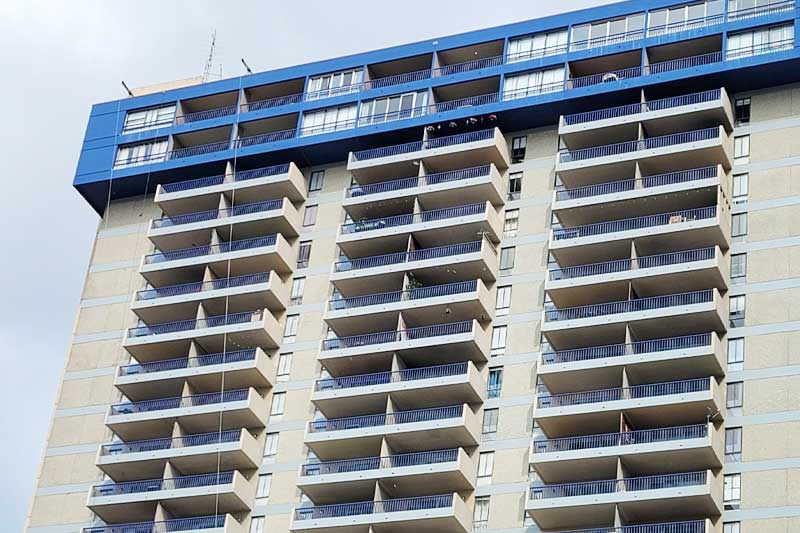


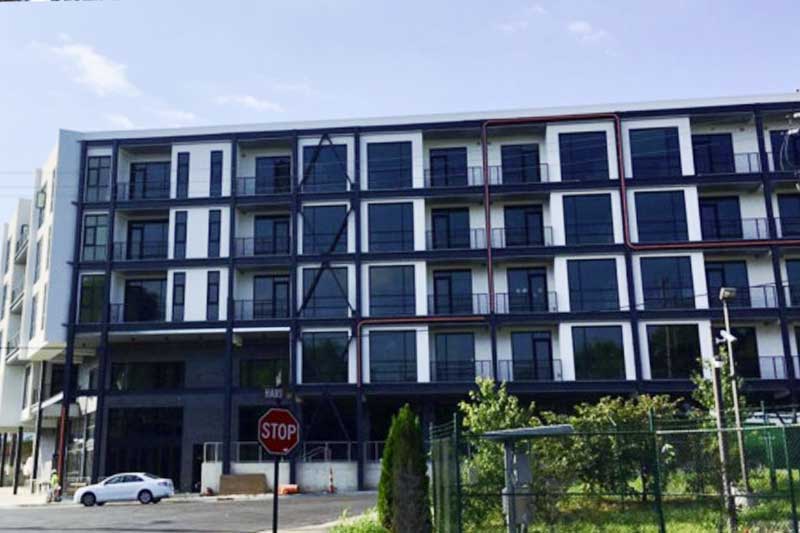






Water hardly ever enters a commercial building where it finally shows itself. The stain on a tenant ceiling may originate at a parapet three floors up, at a corroded lintel, at an open mortar joint, at a hairline crack through a spandrel, or at a window perimeter that has been leaking quietly for a year. Knoxville makes that trail harder to follow rather than easier. Downtown masonry blocks are tall, narrow and thick-walled, so water getting in at height runs inside the assembly for some distance before it reaches any finished surface. With 51.93 inches of rain arriving across 128.7 days, there is seldom one dramatic event to point at, and a winter that crosses the freezing line repeatedly keeps widening whatever route the water found last time. Owners and managers who skip a real diagnostic investigation routinely pay to replace the wrong component, then watch the same stain return after the next long rain.
At Presto Restoration, envelope diagnostics are not an optional add-on. They open every commercial restoration job we take. Our diagnostic team establishes precisely where water is crossing the envelope, what makes that particular point fail, and which restoration approach will genuinely stop it, and only then does a repair scope get proposed. Building the sequence in that way is why our restoration work holds instead of producing repeat service calls. One thing to be clear about: standalone leak detection, sold as a small one-off inspection, is not a service Presto offers. Diagnostics and envelope consulting are folded into full commercial restoration work, which typically carries a $50,000+ project minimum.
A range of diagnostic techniques is available to us for pinpointing water intrusion in a commercial building. Which combination goes onto a given project depends on the building type, the symptoms being reported and the failure mode we suspect.
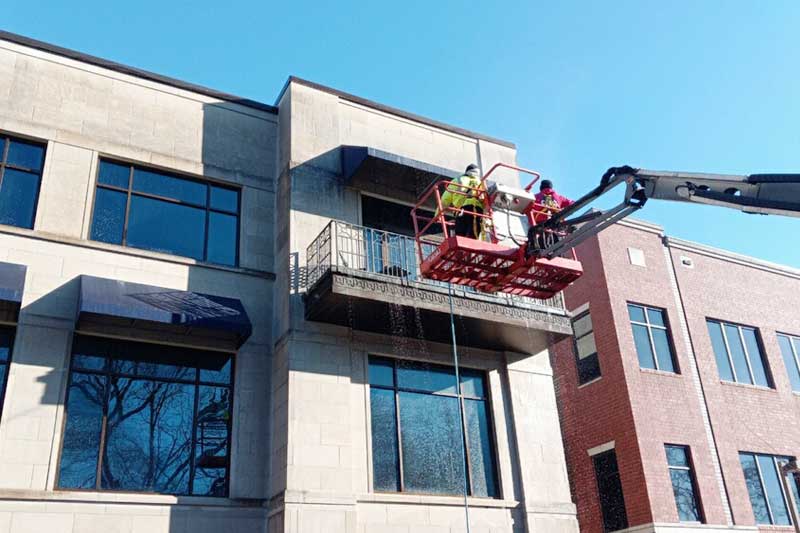
Putting water on a suspected failure point under controlled conditions and watching for intrusion in real time remains the most dependable way to confirm where a Knoxville envelope is failing. Our controlled water testing isolates individual sealant joints, window and door perimeters, parapet and coping details and wall sections, flooding them one at a time so each candidate path is either confirmed or ruled out. The method earns more here than in a drier market, because the substrate is frequently still damp from the last rain and ambient moisture readings alone will not tell you which opening is live. Isolation testing is what separates the path genuinely carrying water from the several that merely look suspicious.
Where surface symptoms are inconclusive, infrared thermal imaging picks up the temperature anomalies across a facade that signal trapped moisture, saturated insulation or early envelope failure the eye cannot see. Wet material holds and sheds heat differently from dry material, which makes thermal scanning an efficient non-destructive way to screen a large masonry or curtain wall elevation before anyone commits to invasive testing. Knoxville helps the method in one specific respect: the seasonal temperature differential across a wall here is wide enough to give usable thermal contrast for much of the year, which a market with a flatter temperature profile cannot offer.
A moisture meter returns a direct, quantitative reading of the moisture content inside drywall, wood, concrete and masonry, which lets our team map how far water has traveled from a suspected entry point and establish whether a candidate source is actively saturating the assembly around it. Across 128.7 precipitation days a year that quantitative step is essential rather than optional, because an elevated reading on a wall here can just as easily mean the wall has not finished drying out from the last week of rain. Mapping the gradient, rather than reading one number, is what distinguishes active intrusion from a building that is simply damp.
On the taller downtown buildings and across the warehouse blocks of the Old City, drone inspection delivers close-up, high-resolution imagery of upper floors, parapets, cornices and roof assemblies without the cost and scheduling load of rope access or swing-stage rigging. That counts for a lot on the narrow Gay Street and Market Square frontages, where staging is genuinely difficult. Drone footage lets us document conditions across an elevation, flag visible failure points and decide which zones justify hands-on investigation, and it is a quick way to survey an entire envelope after a hail event before crews are committed to particular faces.
Invasive testing becomes useful when thermal imaging, moisture readings and water testing have all run and the failure path is still unclear. It means opening a small section of wall, roof or cladding by selective demolition to see what is genuinely happening behind the finished surface. Where we go ahead with the step, our team makes targeted openings and records everything found in photographs and notes, then puts the test area back to a clean, weathertight condition before leaving. The method is reserved for the cases where non-destructive testing cannot produce a confident answer.
A written report closes out every diagnostic engagement, and it is built around that one building. The report sets down what the inspection found, identifies each failure point with supporting photographs, states our diagnostic conclusions and recommends a restoration approach. We write each one for the decision its reader has to make, because the board of a Knoxville residential tower, the asset manager of a downtown office building and the owner of a single converted warehouse are asking different questions of the same facts. The report then becomes the basis for the restoration scope and specifications we go on to propose.
A diagnostic investigation opens every Presto commercial restoration project in Knoxville, and it is completed before the restoration scope is finalized. That sequence is what separates our projects from contractors who price repairs off visible symptoms alone.
Every visible symptom gets recorded: interior staining, exterior deterioration, tenant complaints and any prior leak history on the building. That gives us the full picture before testing starts.
Which methods come next is decided by what the initial review turns up: controlled water testing, infrared thermography, readings from a moisture meter, drone inspection, or invasive testing where it is warranted.
Findings become a written report specific to the project, paired with a detailed restoration scope, so you can see what was found and how the proposed work resolves it.
The work is carried out by our crews through whichever Presto service line applies, whether facade, waterproofing, parking deck, historic preservation or roof restoration, aimed at the failure points that were confirmed.
Post-restoration testing is run where it is called for, to confirm the repair genuinely resolved the water intrusion, and full project documentation follows at closeout.
Where a commercial building has chronic water intrusion that earlier repairs never resolved, our diagnostic-first approach locates the actual source and puts an end to it. Diagnostics and consulting come as part of a comprehensive restoration project; the typical minimum project size is $50,000+.
Call 1-800-785-9927 or Request A Free Quote.
Covering downtown Knoxville, the Old City, Bearden and the wider Knox County market takes rooted infrastructure. Presto coordinates with specialized regional divisions so a client has complete coverage, from major structural restoration through to everyday facility upkeep.
Property managers who also need routine and localized facility services are encouraged to look at our sister divisions:
Building Restoration Knoxville: Structural repair at a local level, and high-rise exterior preservation.
Building Maintenance Knoxville: Preventative maintenance on a set schedule, keeping the property running cleanly.
Building Services Knoxville: The single resource for day-to-day commercial building support across East Tennessee.
Recent commercial restoration work around Tennessee where a diagnostic investigation found the true source of water intrusion and shaped the scope that followed.
No. Leak detection and building envelope consulting are bundled into comprehensive commercial restoration projects rather than sold separately, with a typical minimum project size of $50,000. That structure exists because our diagnostic methodology is designed to inform a restoration scope, and without the restoration component the findings are information nobody acts on. Owners wanting a one-off leak inspection, residential work or low-budget consulting are better served by a specialty inspection firm.
Isolated controlled water testing, infrared thermography, moisture meter readings, drone inspection, and, where selective demolition is justified, invasive testing. Which mix goes onto a project depends on building type, reported symptoms and the failure mode we suspect. Downtown, where the masonry walls are thick, we lean harder on isolation water testing, since a thick wall holds moisture long enough that a single meter reading on its own tells you almost nothing. The methods we choose are the ones that will feed the restoration scope, not testing carried out for its own sake.
Because the damage here accumulates rather than arrives, and accumulated damage hides its own origin. A wall taking nearly 52 inches of rain a year and crossing the freezing line repeatedly every winter develops several plausible-looking defects at once, and the ceiling stain is downstream of exactly one of them. Skip the diagnostic step and the contractor repairs the wrong component, the intrusion carries on, and the owner pays two or three times over for one problem. Investigating first is what produces restoration that resolves it.
No. Forensic engineering, expert witness testimony and litigation support are outside what Presto provides, and for a project needing any of them we recommend engaging a specialty forensic engineering firm. We do work alongside those firms on restoration projects that involve litigation or an insurance dispute; we simply do not perform that work ourselves.
Each report is written around the specific project and the specific decision facing its reader. What it usually contains: inspection findings with supporting photography, the failure points identified and their suspected causes, our diagnostic conclusions, and a recommended restoration scope. These documents exist to support the work that follows rather than to stand on their own, which is why they end up as the basis of the restoration specifications.
That depends on the size of the building, how complex the intrusion is and which methods apply. A targeted investigation of a single suspected failure point might take one to two days. A comprehensive envelope investigation across several suspected areas, with controlled water testing at each candidate location, can run one to three weeks. Weather stretches it in Knoxville more than owners expect, because water testing wants a dry starting substrate and 128.7 precipitation days a year do not reliably provide one. Timelines go out during scoping so property managers can plan around both the investigation and the restoration phasing behind it.
Chronic water intrusion in a Knoxville building that previous repairs have failed to solve is almost always entering somewhere other than where it appears. The diagnostic-first approach Presto takes locates the real entry point and delivers restoration that ends the leak rather than deferring it.
Note: diagnostics and consulting come as part of a comprehensive commercial restoration project (typical $50,000+ minimum).
Call 1-800-785-9927 or Request A Quote online.