






A facade in Greensboro is worn down by repetition rather than by any single event. The Piedmont crosses the freezing point dozens of times between November and March, and every crossing drives water a little deeper into a joint, freezes it, and levers the joint wider. Freezing rain glazes parapets, copings and sills, then melts back into the same openings. Summer arrives humid, with convective storms that soak porous brick and cast stone, and a heavy spring pollen load that settles on every horizontal surface. Under that cycle sealants harden and tear, mortar joints erode, masonry takes on water it cannot shed, and reinforced concrete begins to spall at the edges where the ice sat. By the time a stain appears on an interior wall, the joint responsible has usually been open for two or three winters.
Presto Restoration delivers a complete facade restoration, caulking, and waterproof coating program built around what a Piedmont winter actually does to an exterior. The restoration products going onto the wall are ones we manufacture ourselves, and the crews applying them work from industrial rope access lines or swing stage, whichever the elevation calls for. That combination lets us correct every weak point in the envelope: replacing sealant that has lost its movement capability, refinishing corroded architectural metals, applying flexible elastomeric membranes that keep bridging hairline cracks at low temperatures, and repointing mortar joints on Greensboro’s considerable stock of older brick. The result is a building that looks sharp, sheds water, and stops losing a little more ground each winter.
When a commercial building leaks, failed caulking is almost always the reason. Sealant is the one part of the envelope that has to keep moving, and in Greensboro it is asked to move at 20 degrees in January and again at 95 in July. Repeated freezing inside the joint, combined with that annual swing, is what finally tears the bond loose. Presto’s technicians strip out the spent material, prepare each joint properly, set correct backer rod, and install industrial-grade silicone and polyurethane sealants rated for the movement and the low application temperatures this market demands. Window perimeters, expansion joints, panel joints, penetrations, and control joints are all addressed in a single coordinated pass across the whole facade.
Greensboro’s mid-century office towers and the newer buildings along Wendover carry large expanses of aluminum, ACM panel, mullion and architectural trim. Inland they are not fighting salt, they are fighting water that sits. Runoff pools behind trim and in horizontal joints, freezes there, and lifts coatings from the edge inward, while road de-icing chemicals thrown up at lower levels pit anodized and painted finishes. Wholesale panel replacement is a large line in a budget, and it is often premature. Give our metal restoration team a look at the original finish first, because in many cases it can be recovered. Controlled micro-abrasion strips away oxidation, corrosion, and embedded contamination, and refinishing revives factory color and luster. Owners get like-new metal at a fraction of replacement cost, with far less disruption. (Sealing restored metal with a protective clear coat is the usual next step, and it falls under our Commercial Waterproofing services. The two scopes are normally run together.)
Glass on a Greensboro building takes damage that no window-cleaning contract can undo. Hard-water irrigation overspray dries and bakes mineral deposits into the surface through the summer; alkaline runoff off concrete, cast stone and mortar joints etches the glass permanently, and there is a great deal of masonry above the glass on buildings here; and winter de-icing salt thrown up from pavement leaves haze and fine scratching on lower elevations. Staining, mineral contamination and surface damage all come off chemically, and on shaded Greensboro elevations that also means the pollen film and algae growth the tree canopy leaves behind. The glass itself is preserved throughout, so the curtain wall gets back true optical clarity rather than a polished-out approximation of it. (Ask about our proprietary Glass Defender treatment if you want that clarity to hold. It is covered on the commercial waterproofing page, and most Greensboro clients take the two together.)
Stucco, EIFS, precast concrete and masonry all share one weakness, and in the Piedmont it is the expensive one: porosity. A wall that absorbs water in December is a wall that holds ice by morning, and each cycle widens the crack that let the water in. That is the mechanism behind most of the rebar corrosion, spalling, mildew and progressive cracking we are called out to on Greensboro buildings. Elastomeric waterproof coating systems, installed by Presto, cure into a single breathable membrane that stays flexible through the dozens of freeze-thaw cycles a Greensboro wall crosses between November and March. It moves with the structure through the annual temperature swing, keeps bridging hairline cracks up to 1/16 inch when the temperature drops, stops bulk water at the surface, and still lets trapped vapour escape through a humid summer. Systems come in a full palette of factory colors and finishes, so the waterproofing doubles as a facade facelift.
Greensboro is a masonry city. Cast stone and terra cotta on the downtown blocks, granite and limestone trim on the older institutional buildings, precast panels on everything built since the 1960s, and mill brick by the acre north and east of the centre. All of it is porous, and in this climate porous means water in, freeze, spall, and biological staining on the elevations the tree canopy keeps damp. We open every stone project with careful substrate evaluation and gentle, controlled cleaning that lifts contamination without scarring the surface, then apply penetrating sealers and breathable waterproof coatings that block liquid water while letting the wall dry. Spalled or damaged sections get color-matched patching engineered to move and weather like the original substrate.
In any brick wall the mortar fails long before the brick does, and in Greensboro it fails from the joint face inward, one freeze at a time. Once the joints have eroded, rainwater runs straight through the assembly, producing interior leaks, efflorescence blooms, and eventually loose and failing brickwork.
Our masonry crews cut each eroded joint back to the correct depth, then fill it with mortar matched to the original on colour, compressive strength and composition. The finished joint is tooled to the profile the wall was built with. Structural repointing and decorative tuckpointing both sit with one accountable crew rather than being split between trades.
On Greensboro’s mill buildings and its College Hill, Fisher Park and Dunleath houses, we specify lime-based mortar blends consistent with period construction, because a modern high-strength mortar in a soft historic wall moves the damage into the brick itself.
Presto runs every Greensboro facade project through a disciplined five-phase process, built to surface every defect before work begins, keep crews and building occupants safe during execution, and hand over fully documented results at completion.
Three vantage points cover the envelope end to end: ground level, drone, and suspended access that puts an inspector within arm’s reach of the wall. Nothing is priced until it has been mapped. Sealants, metals, glass, stone, coatings and masonry are each photographed and logged, defect by defect, and that record is what the numbers are built from.
A suspected leak or concealed deterioration triggers diagnostic work rather than a patch. Controlled water spray testing, infrared thermography and moisture readings are run until the intrusion is traced to its true source, which on Greensboro buildings is frequently a parapet, coping or sill joint opened by ice loading and freeze-thaw movement well above the stain showing inside.
What the inspection turned up is written into a line-item scope: quantities counted, products named, and the work broken into phases with dates against them. Your project manager handles access logistics, occupant communication, and permitting through City of Greensboro Planning and Development.
Certified rope-access and swing-stage crews carry out the restoration to manufacturer specification. A field supervisor holds quality control on the wall while the work is happening and writes up progress at the close of each day.
Warranty documents, product data sheets, before-and-after imagery and a maintenance roadmap for protecting the investment going forward: the complete record is handed to you at turnover.
Serving downtown Greensboro, the mill districts and the wider Piedmont Triad at an elite level takes more than visiting crews; it takes permanent local infrastructure. Coverage runs the whole distance, from major envelope restoration down to routine facility care, and it stays seamless because Presto coordinates a network of specialized regional divisions behind it.
Property managers looking for day-to-day and preventative support can call on our sister divisions directly:
Building Restoration Greensboro: Focused on localized structural repairs and exterior preservation on Greensboro’s older masonry stock.
Building Maintenance Greensboro: Dedicated to the ongoing preventative maintenance that keeps Piedmont properties performing through both the freeze season and the humid months.
Building Services Greensboro: Your partner for comprehensive day-to-day commercial building support across the Greensboro market.
Protecting commercial properties across the country is work Presto Restoration has been doing for more than 25 years. Working in Greensboro means understanding what this market actually asks of an exterior: a freeze-thaw count that inland Piedmont elevation pushes well above the coast’s, ice loading on parapets and copings, expansive red clay working at slabs and plaza decks, permitting through City of Greensboro Planning and Development and Guilford County, and design review by the Greensboro Historic Preservation Commission on work inside a local district. See the whole range of Greensboro building restoration services.
Unsure where your facade stands? Tell us what you are seeing on the building, whether that is open joints, rust bleed, spalling at the parapet or a stain that only appears after a thaw, and our team will point you toward the right fix.
Call 1-800-785-9927 or Request A Free Quote.
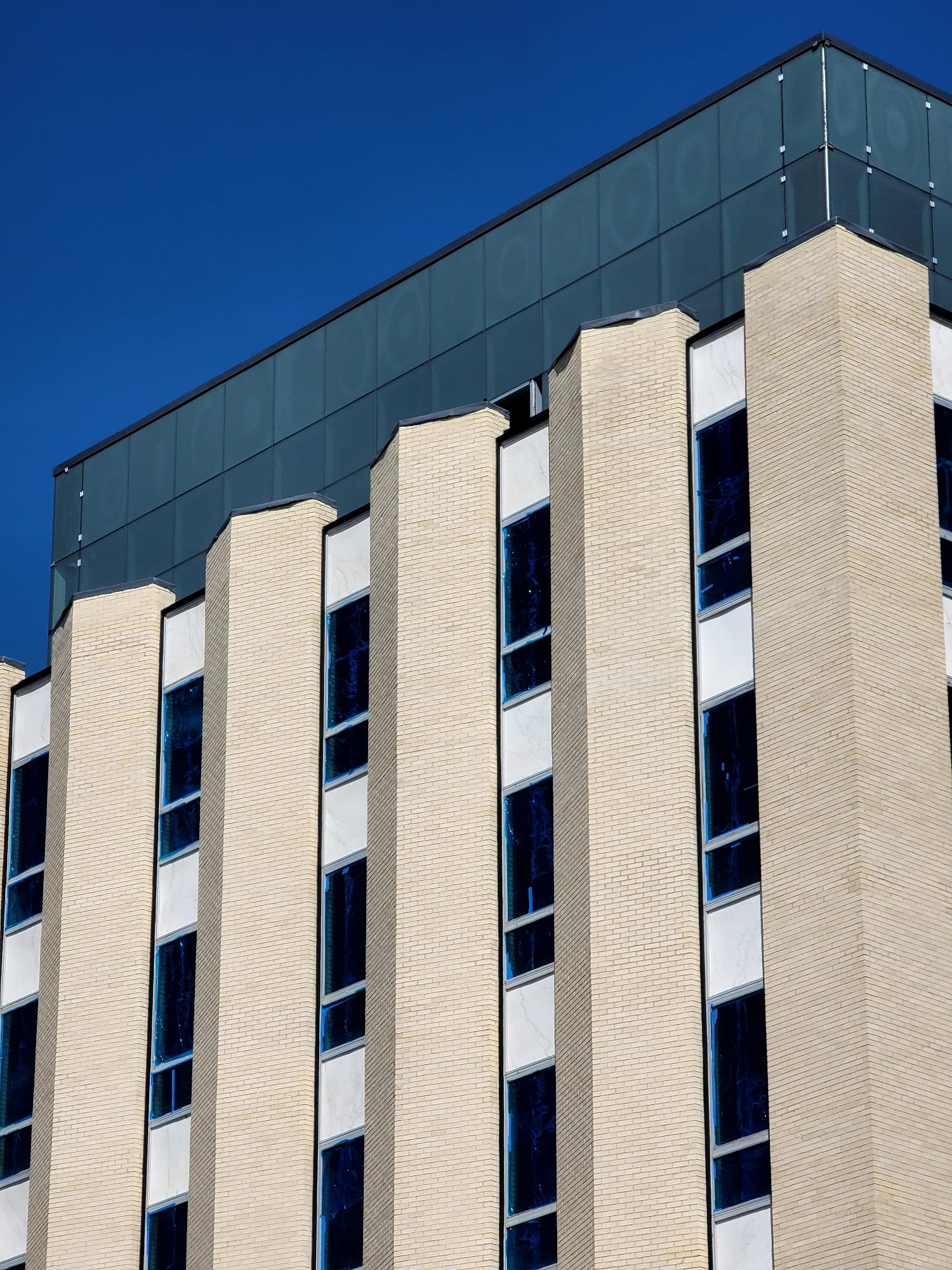
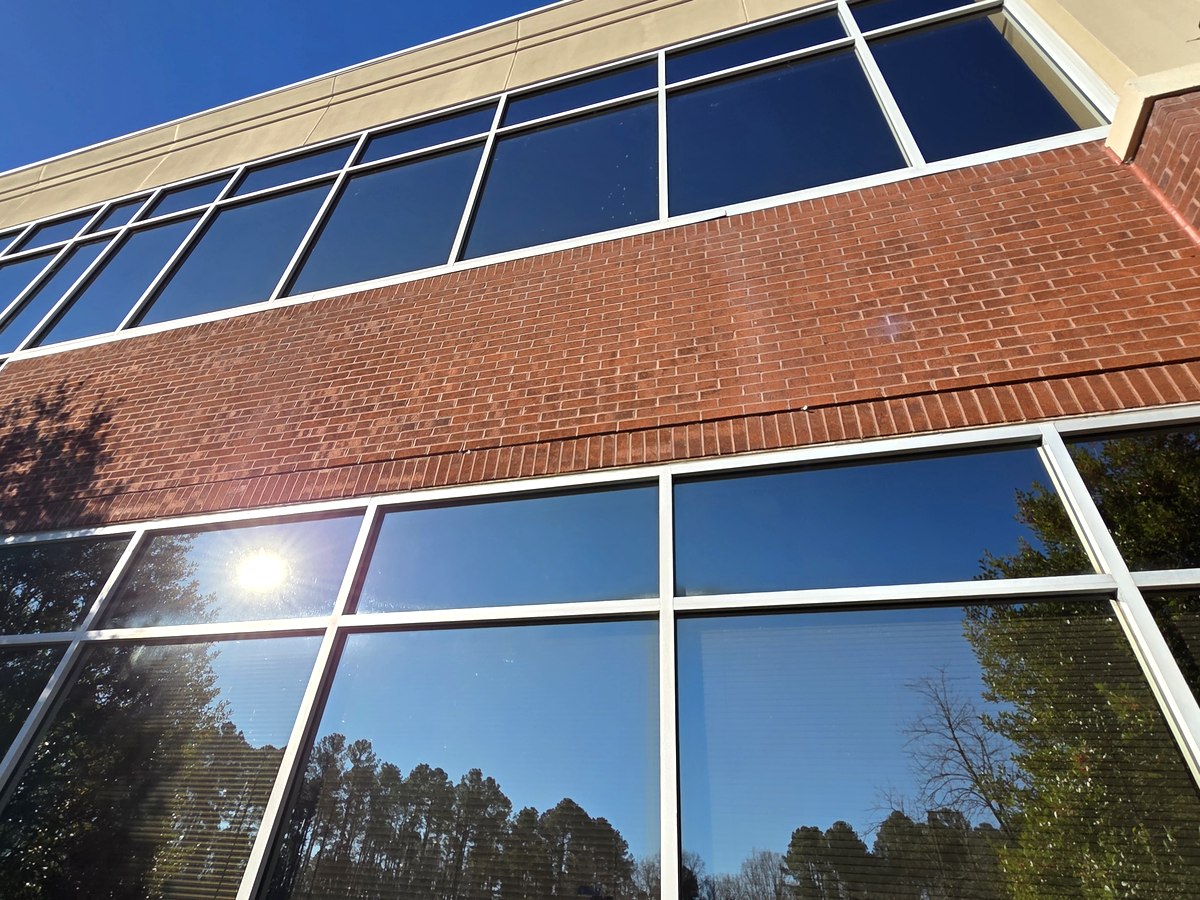
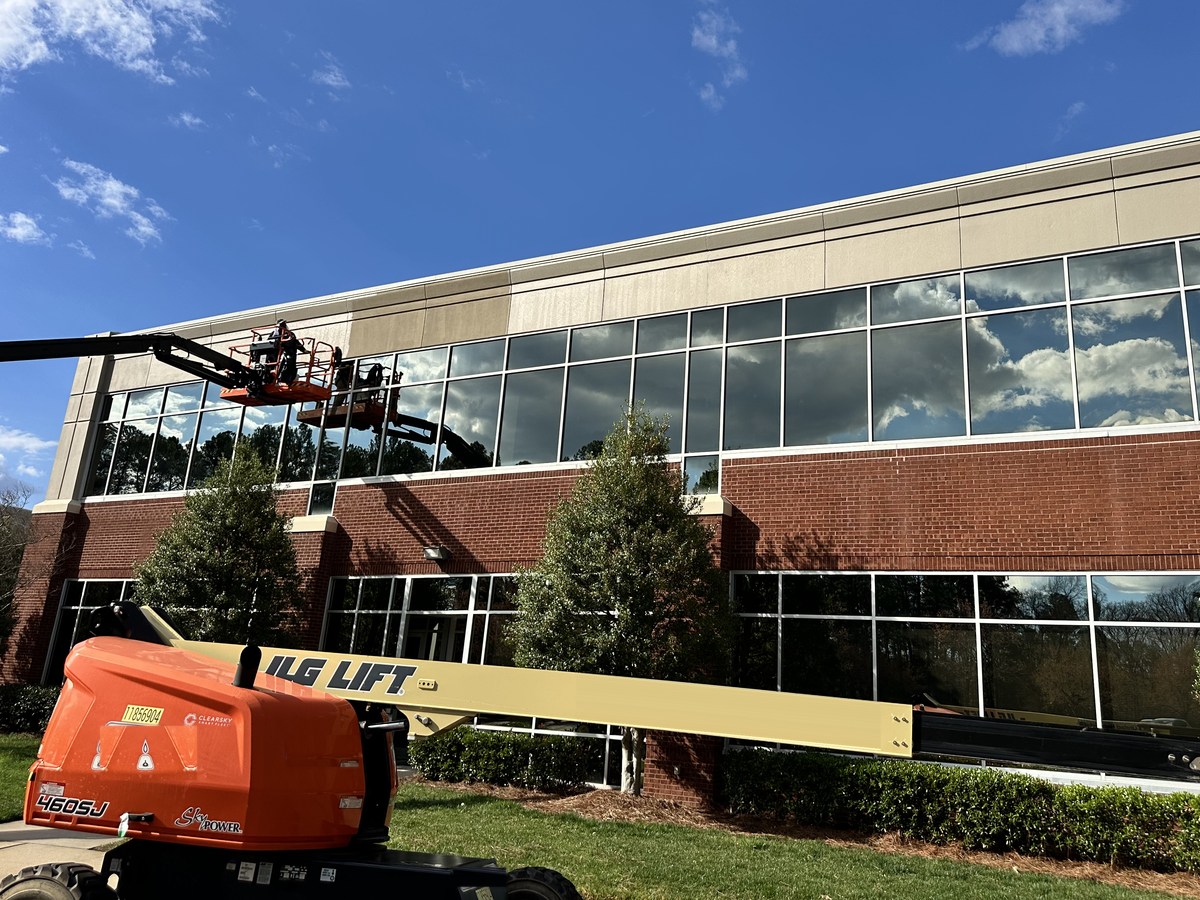
Inland Piedmont exposure is gentler than a coastline but harder than most owners expect, because the damage is cumulative rather than dramatic. As a general guide we recommend a full building envelope inspection every 3 to 5 years, sealant replacement every 8 to 12 years, elastomeric coating renewal every 10 to 15 years, and masonry repointing every 20 to 35 years. Buildings with a lot of exposed parapet, coping and horizontal ledge, which describes most of Greensboro’s older brick stock, sit at the shorter end of every one of those windows, because those are the surfaces where meltwater sits and refreezes.
Watch for caulking that has cracked, shrunk, or pulled loose from its joints; rust streaks bleeding from fasteners or panels down onto brick or concrete; white efflorescence blooming on masonry and cast stone; stucco or EIFS that is chalking, cracking or discoloured; interior stains or musty odours near exterior walls, especially ones that appear during a thaw rather than during rain; glass that stays hazy after cleaning; and spalled concrete or exposed rebar at parapets, ledges and deck edges. Any of these warrants a professional envelope evaluation before another winter runs through the same joint.
Yes. We work regularly on occupied offices, hotels, university buildings and mill conversions across Greensboro. Rope access avoids the footprint and the noise of scaffolding, disruptive tasks are scheduled outside peak hours where possible, property managers and boards are kept updated throughout, and the work is phased so lobbies, entrances and parking stay usable.
Height and scope drive the schedule, and so does the calendar. A focused sealant replacement on a mid-rise can finish in two to four weeks. A full restoration covering caulking, coatings, masonry and metals on a downtown tower or a large mill complex typically runs three to six months. The Piedmont adds one constraint that southern markets do not have: most sealants and coatings carry a minimum application temperature, so cold-weather work has to be sequenced around it. We give you a firm schedule once the building is scoped, with those windows built in.
Warranty terms depend on the specific coating systems, sealants and repair methods used on your building. Owners are walked through exactly what the warranty covers during the scoping phase, while there is still no contract signed. The complete documentation then follows at closeout.
Yes. Our project managers routinely handle permit applications and inspections with City of Greensboro Planning and Development and with Guilford County. Work on a building inside College Hill, Fisher Park, Dunleath, Summit Avenue or any other local historic district goes through the Greensboro Historic Preservation Commission, and we prepare and carry that submission as part of the scope. When a general contractor is overseeing other work at the property, we coordinate permitting directly with them. Presto carries nationwide general liability and workers’ compensation coverage.
By the time a leak shows up inside a Greensboro building, the facade has usually been failing for several winters. Getting Presto onto the problem early is what keeps a sealant job from becoming a concrete repair job.
Call us today at 1-800-785-9927 or click Request A Quote.