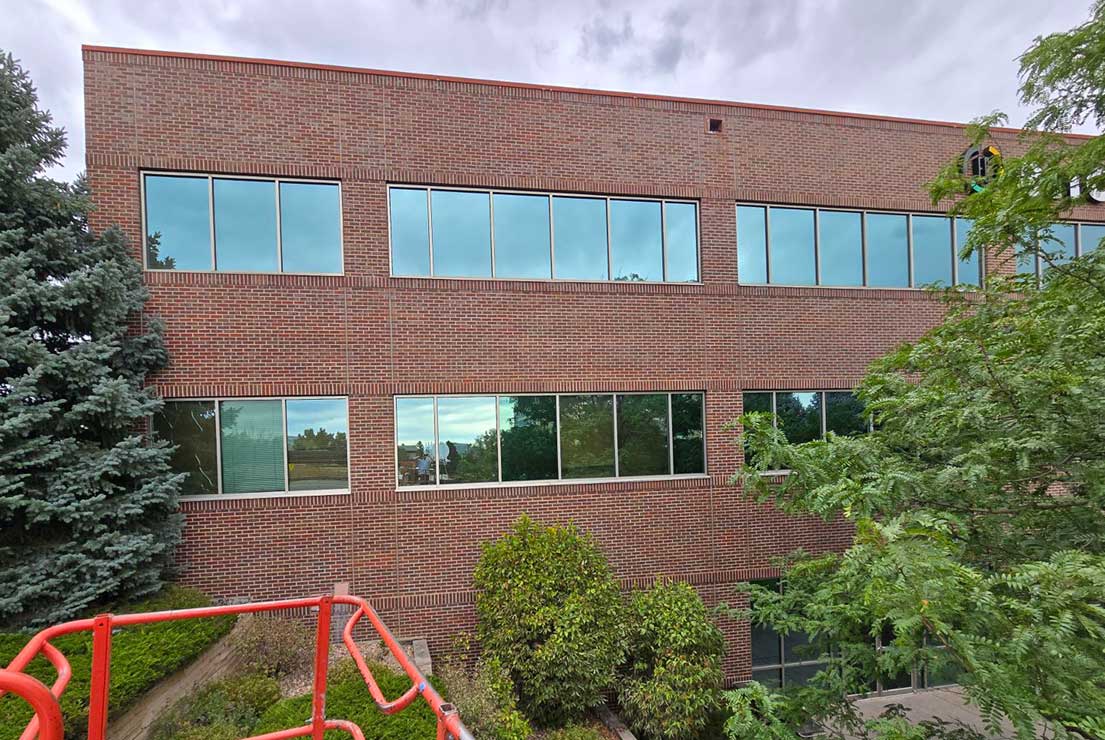
Presto Building Facade Restoration & Waterproofing
Building Facade Waterproofing & Restoration Services 1-800-785-9927

Water almost never enters a commercial building where it appears. A stained ceiling tile on the twelfth floor can lead back to a split sealant joint on the twentieth, a corroded balcony flashing, a hairline crack in a precast panel, or a curtain wall perimeter that has been admitting water quietly for months. Denver adds two complications that make guessing worse than useless. The first is timing: much of the water that gets into an envelope here arrives as snowmelt, so it enters slowly on a sunny afternoon and then freezes in place overnight, which means the leak that appears in March started in December. The second is that a summer thunderstorm can drive rain sideways into details that stay bone dry for the other fifty weeks, so the failure only reveals itself under conditions nobody was present for. Owners and managers who skip a real diagnostic investigation routinely pay to repair a component that was never the problem, then watch the same stain return after the next thaw.
Presto Restoration treats leak detection and envelope diagnostics as the required first step on every commercial restoration project we take. Before proposing any repair scope, the diagnostic team establishes exactly where water is entering, why it is entering there, and which restoration approach will actually stop it. That sequence is built into how we scope work, and it is the reason the restoration holds rather than generating repeat visits. Note that Presto does not offer standalone leak detection as a small one-off inspection. The diagnostic and consulting work is bundled into comprehensive commercial restoration projects, typically with a project minimum around 50,000 dollars.
Presto uses a range of techniques to locate the source of water intrusion, and the combination chosen for a given Denver building depends on its construction, the symptoms reported, and whether the leak behaves like a storm event or like a thaw.

The most dependable way to confirm where a Denver envelope is failing is to put water on a suspected point and watch what happens. Our controlled testing isolates a specific sealant joint, window or door perimeter, balcony connection or wall section and floods it under known conditions, so each candidate path is either confirmed or eliminated rather than left on a list. This matters more here than in a wet market, because a Denver leak may only present under a narrow set of conditions, perhaps a wind-driven storm from one direction or a thaw following a heavy snow, and waiting for the weather to reproduce itself can cost a season. Controlled testing reproduces the condition on demand and separates the real source from wherever the stain happens to surface.
Where the visible symptoms are not conclusive we use infrared thermal imaging to find temperature anomalies across an elevation that indicate trapped moisture, saturated insulation or early envelope failure that is invisible from the ground. Wet material holds and releases heat differently from dry material, which makes thermal scanning an efficient, non-destructive way to screen a large curtain wall or stucco elevation before committing to invasive work. Denver’s climate happens to favor the method: the wide gap between afternoon and overnight temperature gives strong thermal contrast, and clear skies mean fewer days when cloud cover flattens the image. It is particularly good at narrowing down which floors or bays deserve a closer look after a hailstorm.


Moisture meters give a direct, quantitative reading of the moisture content inside drywall, timber, concrete and other porous material, which lets us map how far water has traveled from a suspected entry point and confirm whether a candidate source is still actively wetting the assembly. In Denver the readings carry unusual weight, because the ambient air is dry enough that genuinely wet material stands out sharply against its surroundings rather than blending into a generally damp building. The corollary is that a wall which has dried out between events can read close to normal, so we take readings in relation to the weather that preceded them rather than in isolation.
On Denver’s downtown towers and mid-rise commercial buildings, drone inspection captures close-up, high-resolution imagery of the upper floors and the roof without the cost and scheduling of rope access or a swing stage. It has become the fastest way to assess an elevation after a hailstorm, since impact damage to metal panel, parapet caps and roof-level detail is often invisible from the street and entirely visible from ten feet away. On larger properties we use the imagery to document conditions across the whole envelope, flag the visible failure points, and decide which elevations justify hands-on investigation before anyone is put on a rope.


When thermal imaging, moisture readings and water testing still leave the path unclear, invasive testing settles it. That means selective removal of a small section of wall, roof or cladding to see what is actually happening behind the finished surface. Where we take that step, the openings are targeted, everything found is documented with photographs and notes, and the test area is restored to a clean, weathertight condition before the crew leaves, which in a Denver winter is not a formality. We hold this method back for the cases where non-destructive testing cannot produce a confident answer.
Every diagnostic engagement ends in a written report built around the one building. It records what the inspection found, identifies each failure point with supporting photographs, sets out our conclusions, and recommends a restoration approach in the order the work should be done. We write to the decision the reader has to make, since an owner weighing a capital request, a manager assembling next year’s budget and a board deciding between repair and replacement are asking different questions of the same evidence. The report then becomes the basis for the restoration scope and specification we propose.

Every Presto commercial restoration project in Denver opens with a diagnostic investigation, finished before the restoration scope is fixed. That order is what separates our projects from a price quoted off whatever is visible from the sidewalk.


We record every visible symptom: interior staining, exterior deterioration, tenant reports, and the building's leak history, including which past leaks followed a storm and which followed a thaw.
What the walk-through turns up decides the methods: controlled water testing, infrared thermography, moisture readings, drone imagery, or selective opening where it is genuinely warranted.
Findings become a project-specific written report alongside a detailed restoration scope, so you can see what was found and how each proposed line item answers it.
Crews execute through whichever Presto service line the findings point at, whether facade, above-grade waterproofing, parking deck, historic preservation or roof restoration, aimed at the confirmed failure points rather than the visible ones.
Where it is called for we retest after restoration to confirm the intrusion has actually stopped, then hand over the full project documentation at closeout.
If a commercial building has chronic water intrusion that previous repairs have not fixed, a diagnostic-first approach finds the real source and ends it. Our diagnostic and consulting work is included with comprehensive restoration projects, with a typical minimum project size around 50,000 dollars.
Call 1-800-785-9927 or Request A Free Quote.
Serving the Central Business District, Lower Downtown, the Golden Triangle and the wider Denver metro takes a supporting structure behind the diagnostic team. So that clients get complete cover, from major structural restoration down to everyday facility upkeep, Presto coordinates with our specialized regional divisions.
For routine upkeep and building-level services, property managers are welcome to look at our sister divisions:
Building Restoration Denver: Structural repair and high-rise exterior work, handled one building at a time.
Building Maintenance Denver: Preventative maintenance that keeps a Denver building from drifting backwards between projects.
Building Services Denver: The place to start for comprehensive, day-to-day commercial building support across the metro.
Browse a selection of recent commercial restoration projects across Colorado, where diagnostic investigation identified the true water intrusion source and shaped the restoration scope.
No. Leak detection and envelope consulting are bundled into comprehensive commercial restoration projects rather than sold separately, with a typical minimum project size around 50,000 dollars. The reason is that our diagnostic method exists to shape a restoration scope; without the restoration attached, the findings are information with nowhere to go. Owners looking for a one-off inspection, a residential survey or low-budget consulting are better served by a specialty inspection firm than by us, and we would rather say that at the outset.
Controlled isolated water testing, infrared thermography, moisture meter readings, drone inspection, and selective invasive opening where it is warranted. The mix depends on the building, the symptoms and the suspected failure mode. On Denver work the balance tends to shift toward thermography and drone imagery, because the temperature contrast between afternoon and night gives strong thermal signal and because hail damage is best assessed close up from above. We choose methods that will change the restoration scope, not methods that fill out a report.
Because the entry point and the evidence are usually on different floors, and here they are often in different months as well. A leak appearing on the fourteenth floor of a downtown tower may originate at a parapet flashing on the eighteenth, a cracked panel several floors up, or a curtain wall perimeter that has been failing for years. Snowmelt makes the trail harder still, because water can enter slowly over weeks and only announce itself once a freeze pushes it somewhere new. Skip the investigation and a contractor repairs the wrong component, the intrusion carries on, and the owner pays two or three times for one leak. Investigate first and the restoration actually ends it.
No. We do not offer forensic engineering, expert witness testimony or litigation support, and for work of that kind we would point you to a specialty forensic engineering firm. We do work alongside such firms on restoration projects where litigation or an insurance dispute is running, which in Denver is most often a hail claim or a dispute over responsibility for a long-standing leak, but the forensic role is theirs and not ours.
Each report is built around the specific building and the decision the reader has to make. It typically covers the inspection findings with supporting photography, the failure points identified and their probable causes, our diagnostic conclusions, and a recommended restoration scope in a sensible order of work. Because the report becomes the basis of the project specification, it is written to support what follows rather than to stand alone as a document.
It depends on the size of the building, how tangled the intrusion is, and which methods apply. A targeted investigation of one suspected failure point may take one or two days. A comprehensive envelope investigation across several suspected areas, with controlled water testing at each, can run one to three weeks. In Denver, add the weather: controlled water testing needs above-freezing conditions, so a mid-winter investigation may lean on thermography and moisture readings first and confirm by water test once the temperature allows. We set out the timeline during scoping so managers can plan around both the investigation and the restoration phasing that follows.

If your Denver building has chronic water intrusion that earlier repairs have not solved, the entry point is almost certainly not where it looks. Presto’s diagnostic-first approach identifies the real one and delivers restoration that ends the leak rather than deferring it.
Note: our diagnostic and consulting work is included with comprehensive commercial restoration projects, typical minimum around 50,000 dollars.
Call 1-800-785-9927 or Request A Quote online.