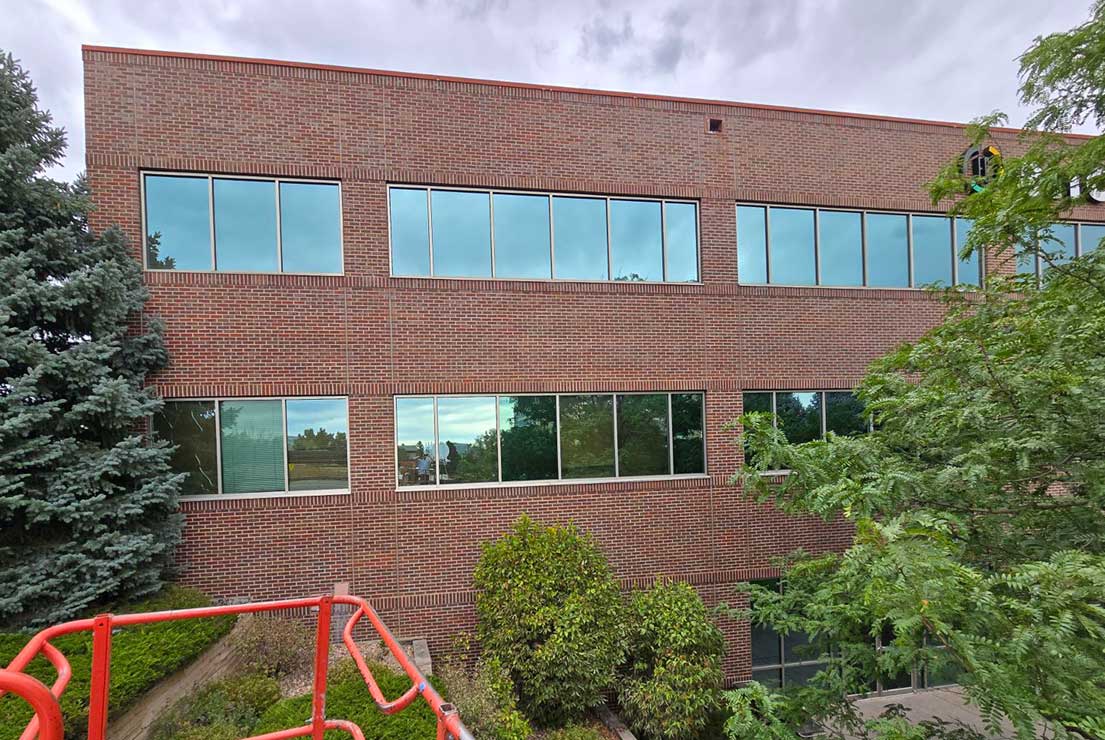
Denver’s historic commercial fabric was built out of what the railroads brought to a high-plains city between the 1860s and the early 1900s. Lower Downtown is the clearest example: block after block of rail-era warehouses in red brick with stone trim, designated a Denver historic district in 1988 and largely responsible for the fact that the neighborhood still exists at all. Around it sit the terra cotta and cast stone of the early commercial blocks, the sandstone and rhyolite of the pre-war institutional buildings, and the wood and brick of Curtis Park and Five Points. None of it was built for what this climate does. The mortar in those walls is deliberately soft, the brick is porous, and both are now asked to survive a temperature swing that crosses freezing in both directions on the same day, air dry enough to draw moisture out of the wall between events, sunlight that comes with a mile of elevation, and hail. Repair a wall like that with modern high-strength materials and you do not slow the deterioration down, you concentrate it in the historic brick instead of the joint, where it becomes irreversible.
Presto Restoration has hands-on experience with landmark and designated buildings across the country, and every historic assignment gets the same materials-first treatment. Our scopes generally follow the National Park Service’s Preservation Briefs, which remains the field’s most widely used technical reference, adapted to the architectural style, the material palette and the review requirements of the particular Denver property. In practice that means lime-based mortars mixed to match the original in strength and color, cleaning gentle enough for soft brick and weathered sandstone, and in-kind repair rather than replacement. It also means understanding where the Denver Landmark Preservation Commission’s design review sits in the program, because on a designated building or one inside a historic district the exterior scope has to survive that review before it can be built. Whether a property carries local Denver designation, sits inside a district such as Lower Downtown, or is individually listed on the National Register, the standard the work is held to is the higher one.
Presto covers the full range of historic preservation work for landmark buildings, locally designated structures and architecturally significant commercial property across Denver and the surrounding metro.

Failed mortar is the most common defect on Denver’s historic masonry and the repair most often got wrong. The warehouses and commercial blocks of the 1880s through the 1930s were laid up in soft lime mortar that could flex with the wall, take up minor stress without cracking, and let moisture leave as vapor. That last property is what matters most here, because a wall that cannot dry between a thaw and the next freeze will destroy itself from the inside. Repoint it with a modern Portland-cement mix and the moisture is trapped in the softer historic brick, which then spalls, and the original material is not replaceable. Our masons match the new mortar to the original in strength, color and composition, grind the failed joints to depth without chewing into the surrounding masonry, and tool the joint back to the profile the wall was built with. It is the slower way to repoint a historic building, and it is the only one that leaves the building intact.
Sandstone, rhyolite, cast stone, granite and glazed architectural terra cotta carry the detail on Denver’s pre-war buildings, and getting the cleaning wrong on any of them is permanent. Over-aggressive cleaning opens the pore structure of a soft sandstone, which in a freezing climate is the same as scheduling its failure; it also strips decades of patina and can bleach a stone that was never meant to look new. On terra cotta the glaze is the waterproofing, and once it has been abraded off, water gets into the body of the unit and freezes there. We match method to material and condition, working with micro-abrasion, historically appropriate chemical cleaners and controlled water pressure rather than defaulting to one process for the whole elevation. Where stone has spalled or cracked we carry out color- and texture-matched repair engineered to behave like the material around it. The aim is a surface that reads as genuinely preserved rather than resurfaced.


Wood sash and steel-casement windows are among the most characteristic details on Denver’s older commercial buildings, and they are routinely thrown away rather than repaired. Replacing them with modern aluminum or vinyl units usually undermines a building’s standing with the Landmark Preservation Commission, and the replacement rarely outperforms a properly restored original. Our window work keeps the original glass, frames and hardware in place and fixes what has actually failed: glazing compound that has gone hard and dropped out, corroded steel muntins, seized hardware, and perimeter sealant that has opened up under the daily temperature swing. Restored well and maintained, a historic window will comfortably outlive a modern unit rated for a couple of decades, and it keeps a facade that a designation was granted for.
Traditional lime stucco appears across Denver’s older institutional buildings, apartment blocks and the Spanish Revival and Mission-influenced commercial work of the 1920s, and it behaves nothing like the acrylic and EIFS products used today. Historic stucco was troweled on in successive coats over wood or metal lath, and each layer was designed to let moisture pass rather than hold it. Patch that with a modern cement or acrylic-based product and moisture is sealed into the wall assembly, where a freeze will take it apart along the boundary between the two materials. We rebuild historic stucco with lime-based formulations, repair the lath where it has gone, and finish to match the original texture and the hand of the original work. That last point is not vanity: an obvious patch on a designated building is a review problem as well as an aesthetic one.


Bronze storefronts, cast-iron columns and pilasters, wrought-iron railings and pressed metal cornices run through Denver’s historic inventory, from warehouse loading fronts in Lower Downtown to the entrances of the early office blocks. Corrosion here concentrates where water is held rather than where the air is aggressive: behind a cornice, at the base of a column, in the joint between metal and masonry, anywhere meltwater collects and then freezes. The patina on bronze and copper, meanwhile, is part of what makes the element historically valuable, so removing it is a loss rather than a cleaning. We take out active, structurally damaging corrosion while keeping authentic patina wherever it is not compromising the metal, then refinish with methods that respect the original character. Stripping historic metalwork back to bare substrate is a last resort here, not a default.
Waterproofing a historic Denver building calls for the opposite instinct to waterproofing a new curtain wall. Old masonry, lime mortar and lime stucco were built to breathe: water that gets in during a spring snow or a thunderstorm is meant to evaporate back out through the wall, and in this dry climate it genuinely can, given the chance. Seal that assembly with a fully impermeable modern system and you remove the chance. The moisture stays in, and then it freezes, and the damage happens behind a surface that still looks sound. Our historic facade waterproofing uses vapor-permeable water repellents and joint sealants compatible with lime-based construction, and reserves fully impermeable systems for the specific locations the original design intended them, such as a parapet cap or a horizontal ledge.

Historic work in Denver moves more slowly than a standard commercial restoration, and it has an extra dependency: on a designated building the exterior scope has to clear design review before it can be built. Our five-phase process is built around both facts, so that every defect is found up front, the materials specified are period-correct, and nothing irreplaceable is damaged on the way to fixing something else.


We record every area of deterioration and separate original fabric, which is irreplaceable, from later non-original additions, which are not. Nothing is touched until we understand what the building actually is.
We identify the original materials precisely: the lime mortar mix, the stone or terra cotta type, the stucco composition, the window glazing and the metal alloys. Where a material is uncertain we recommend laboratory analysis rather than guessing.
Findings become a detailed scope with quantities and period-appropriate product specifications, prepared in a form that supports a Landmark Preservation Commission submission, and coordinated with owners, preservation consultants and architects.
Trained crews carry out the work with period-appropriate materials and traditional technique where it is called for, inside the season the materials allow. Quality control is strict, because there is no rework available on a substrate that cannot be replaced.
You receive the whole record: before-and-after photography, material data sheets, warranty details and maintenance guidance. On a designated Denver property that record also supports future design review submissions.
Whether your Denver historic property is already showing visible wear or you are getting out in front of it, describe what you are seeing and our team will tell you what preservation-grade practice would do about it, and what design review is likely to want to see.
Call 1-800-785-9927 or Request A Free Quote.
Covering Lower Downtown, Five Points, Curtis Park and the rest of Denver’s designated districts consistently takes a supporting structure rather than a crew that visits. Presto coordinates a network of specialized divisions so clients get continuous cover, from a major historic envelope restoration down to routine facility upkeep.
For day-to-day and preventative needs, property managers are welcome to contact our sister divisions directly:
Building Restoration Denver: Structural repair and high-rise exterior work, taken one building at a time.
Building Maintenance Denver: The ongoing preventative maintenance that keeps a Denver property performing year to year.
Building Services Denver: The place to start for comprehensive, day-to-day commercial building support across the Denver market.
Explore recent historic preservation and landmark restoration projects Presto has completed across Colorado.
Ordinary restoration is trying to get a building watertight and functional with whatever modern material does the job best. Preservation adds a second and harder requirement: keep the original character, materials and craftsmanship intact while restoring performance. In practice that means lime mortar instead of Portland cement, calibrated cleaning instead of blasting, and reversible repair wherever it is available, so a later generation is not locked into our decisions. On a Denver building it also means specifying for a wall that has to dry out between freezes, which rules out several products that would otherwise be the obvious choice. It costs more and takes longer, and it is the only approach that protects both the designation and the reason the designation exists.
Because it is the part of the wall that is supposed to fail. Denver’s pre-war brick buildings were laid up with soft lime mortar that is deliberately weaker than the brick around it, so that when the wall moves the mortar takes the strain and the masonry does not crack. Lime also lets moisture vapor pass out through the joint. In a climate where a wall can be wet in the afternoon and frozen by dawn, that drying path is the difference between a joint that needs repointing in thirty years and a brick face that delaminates. Repoint the same wall with a hard modern cement mix and the moisture and the movement are both forced into the brick, and that damage cannot be undone.
Yes, and these buildings often start from a better position than owners expect. Original wood sash and steel-casement windows, restored with fresh glazing compound and a properly detailed perimeter seal, perform comparably to new replacements. Thick brick and stone walls carry real thermal mass, which is genuinely useful in a city where the outdoor temperature moves twenty-five degrees between night and afternoon: the wall damps that swing instead of transmitting it. Breathable, vapor-permeable waterproofing also tends to outlast an impermeable modern coating on these assemblies, because it does not trap water where it can freeze. We work on the envelope; for mechanical and insulation upgrades, owners normally bring in a contractor experienced with historic-rated systems.
Longer than standard restoration, for three reasons that stack. The materials and hand techniques are slower, the quality-control standard is higher, and on a designated building the scope has to clear design review before work starts. A facade restoration on a smaller historic commercial building here might run two to four months. A full preservation scope on a larger landmark can reach six to twelve months or more. Denver adds a fourth constraint that owners often miss: lime mortar and lime stucco need to be placed and cured above freezing, so a program that starts too late in the year stops until spring. We lay all of that out during scoping rather than discovering it in October.
Yes, across the range of designation levels, from locally designated Denver landmarks and contributing buildings inside a district such as Lower Downtown, through to properties individually listed on the National Register. What is required differs with the designation, with whether the work triggers Landmark Preservation Commission review, and with which parts of the scope are visible from a public right of way. We establish the property’s status during the initial survey and set out plainly what coordination the proposed work will need before anyone signs anything.
The Landmark Preservation Commission sits within Denver’s Department of Community Planning and Development and carries out design review for alterations to designated properties and districts. The submission itself is normally driven by the owner working with a preservation architect or consultant who knows the Commission’s expectations. Our part is to supply an accurate scope, period-appropriate material specifications and documentation that stands up to that level of scrutiny, and then to build what was approved. We stay in contact with the owner’s preservation team throughout so the work supports whatever submissions and approvals are needed, and we comply with the applicable local and state requirements on every job.
Yes. Our historic scopes generally track the National Park Service’s Preservation Briefs, which remain the most widely used technical reference for this work in the United States. The Briefs cover the topics that matter most on Denver’s building stock: masonry cleaning, mortar formulation, historic window restoration, terra cotta and stucco repair. Depending on a property’s designation and style we layer in further guidance where it applies. Owners working with a preservation architect are welcome to review our proposed scope against the relevant Briefs before anything begins.

A historic building cannot be recreated once it is gone, and modern materials will not put one back. Tell us what your Denver property is doing and our team will set out what it needs to hold its character, its performance and its designation into the next generation.
Call 1-800-785-9927 or Request A Quote online.