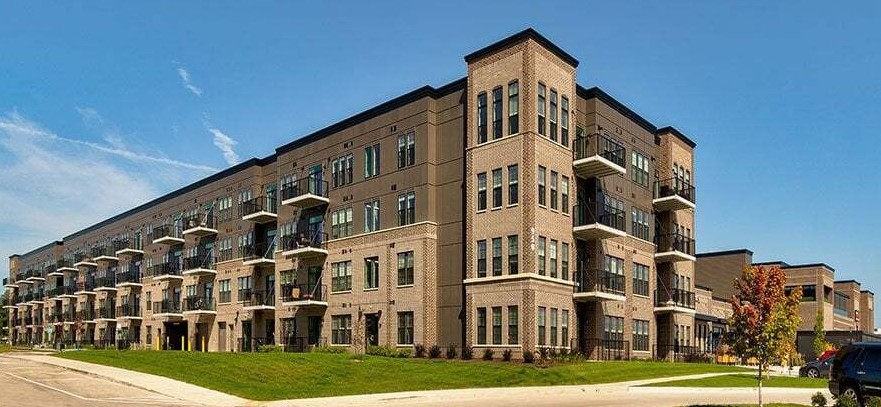
Presto Building Facade Restoration & Waterproofing
Building Facade Waterproofing & Restoration Services 1-800-785-9927

A parking structure in Council Bluffs is the part of the property that collects the winter. Every vehicle that uses it arrives carrying brine, slush and road salt from the street and drops that load on the deck. The deck is then plowed, scraped and salted again on its own account. Chloride is the problem, and it does not evaporate. It sits in the concrete, works down through worn traffic coatings and failed joints, reaches the reinforcing steel, and corrodes it. Corroding steel expands, and expanding steel breaks the concrete apart from the inside. That is why spalling on a Midwest deck usually starts underneath rather than on the surface, and why it is well advanced before anyone sees it.
Freeze-thaw does the rest. Water that has found its way into a crack or a tired joint freezes overnight and levers the opening wider, and in Council Bluffs that happens repeatedly through the season rather than once or twice a winter. Presto restores above-grade parking structures: elevated decks, standalone garages and rooftop parking. We install traffic-bearing membranes rated for plow contact, replace expansion joints rather than simply resealing them, and detail the drainage so meltwater actually leaves the structure instead of standing on it and refreezing.
Traffic coatings through expansion joint replacement, the whole line of parking deck restoration and waterproofing work, specified around what a western Iowa winter does to an above-grade structure.

A parking deck membrane has an unforgiving assignment: keep water out of the levels below while surviving tire scrubbing, vehicle loads, oil and chemical spills, thermal movement and, here, the edge of a plow blade. Presto installs high-performance traffic-bearing membranes for drive lanes and parking bays, with pedestrian-rated systems for walkways, stair towers and rooftop amenity decks. They go down as seamless liquid urethane and polymer coatings bonded tightly to the concrete, which removes the laps and seams where water normally finds its way in. On a deck that takes de-icing chemicals every winter, the membrane is not a finish. It is the layer standing between the chloride and the reinforcing steel.
The horizontal expansion joints crossing a garage’s drive lanes exist so the structure can move with temperature, and in Council Bluffs it moves a long way. A deck that sits near ninety-five degrees in July and well below zero in January cycles through more range than almost any other element on the property, and the joints absorb all of it. When the seal or the hardware gives out, meltwater runs straight through to the levels beneath and carries chloride with it. Presto performs complete horizontal expansion joint replacement, hardware included. We can match the existing system in kind or upgrade to a higher-performing product line, and because we have installed systems from virtually every major manufacturer, we can select for the movement range and traffic volume your structure actually sees.


Where a deck meets walls, columns and adjacent building sections, vertical expansion joints take movement that behaves quite differently from the movement in a drive lane, and they need a different installation technique to perform. These are also the joints that collect plowed snow, because that is where it gets pushed. A pile of salted snow sitting against a vertical joint for a week is a concentrated chloride source held right at the point of entry. Presto provides the full scope of vertical joint work: complete system replacement, hardware swaps, resealing and targeted repair. Getting them right closes one of the most persistent water paths in the structure.
A deck is dry only when every path is closed, and the membrane is one of them. The others are the control joints, the construction joints, the cold joints and the dozens of penetrations where drains, conduit and structural members pass through the slab. We build the waterproofing program around silicone, polyurethane and polymer sealants picked per joint profile and exposure. Drainage carries more weight here than in a warm market, for two reasons. Meltwater arrives slowly and steadily rather than in a downpour, so a half-blocked drain gives no warning: it simply ponds, and then it freezes. And where the deck discharges matters, because the ground around a Council Bluffs structure takes saturation badly.


The sealant in a control, cold or minor construction joint does the hardest work in the structure and gets attention last. It carries wheel loads, sits under ponding meltwater, and is expected to stay flexible at fifteen below. It cracks and debonds early. We cut out the failed material, prepare each joint to the manufacturer’s requirement with backer rod and primer where the spec calls for them, and install traffic-rated sealants chosen for low-temperature movement rather than for a mild climate. Sound joints stop water slipping past the membrane and soaking directly into the slab, which is the pattern we find over and over in decks that have been waterproofed a piece at a time.
Every Council Bluffs parking deck project moves through a proven five-phase process built to pinpoint the real problem, specify systems that survive chloride and freeze-thaw, and deliver waterproofing that lasts. Membranes and sealants both have minimum application temperatures, so the schedule is built around the open season from the start.


We walk the entire garage: traffic membranes, horizontal and vertical expansion joints, joint sealants, drains, and any active leaks or staining on the levels below.
Leaks in a parking structure rarely surface where the water actually gets in. Targeted water testing and tracing pinpoint the joints, membranes, or penetrations causing the problem.
We select traffic membranes, joint replacements, and sealants matched to your structure and traffic patterns, with phasing planned to keep the garage as usable as possible.
Crews phase work section by section so parts of the deck stay open. Materials go in per manufacturer spec, with tight control over substrate prep and cure times.
You receive full warranty paperwork, product data sheets, before-and-after photos, and maintenance guidance for every system installed.
Membrane breaking up, joints leaking, sealant pulling off the joint walls? Describe what you are looking at and our specialists will walk you through the likely cause and the cheapest fix that actually holds.
Call 1-800-785-9927 or Request A Free Quote.
A deck needs attention between restoration cycles as much as during them, especially through a winter that puts chloride on it every week. Presto works alongside specialized regional networks so owners get the whole range, major structural restoration down through everyday upkeep.
For routine upkeep and localized facility work, property managers can go straight to our sister divisions:
Building Restoration Council Bluffs: localized structural repair and exterior preservation.
Building Maintenance Council Bluffs: the preventative work that gets a property through the winter months.
Building Services Council Bluffs: day-to-day commercial building support across the city.
See how Presto has protected parking structures and commercial buildings across Iowa.
Where the roads are salted all winter, a traffic-bearing membrane runs ten to twenty years, with the system, the traffic volume and the maintenance history setting the number. The exposed top deck is in a category of its own: it takes the plow blade, the de-icing chemical and the whole freeze-thaw cycle with nothing over it, and it generally comes due well ahead of pedestrian membranes in covered areas. Inspect the structure every five years and the deterioration gets caught while it is still a coating problem instead of a steel problem.
Water dripping or staining on the level below. Cracking or bubbling in the membrane. Joint hardware loose, lifting or leaking. Sealant pulling off the joint walls. Efflorescence on the concrete. Rust streaks down a slab edge or a column, which normally means chloride has already reached the steel. Flaking on a drive lane, or a hollow sound underfoot. Each of those is worth a look before the damage stops being a surface problem.
Nearly always. Work is phased across sections so most of the structure stays open, scheduling runs through property management, and tenants get notice of any temporary lane or level closure. Membranes do need uninterrupted cure time at a surface temperature inside the manufacturer’s window, so short phased closures happen and the sequence is built around the forecast. Closing the whole garage is rare.
Sealing renews the sealant and leaves the hardware where it is, which is right when the hardware still does its job and only the sealant has gone. Replacement takes out the old hardware or the whole joint system and installs new, which is what is needed once the hardware is worn or no longer taking the movement. With this much annual thermal range, hardware wears faster here than it does in a mild climate, so replacement is the honest answer more often in Council Bluffs than it would be further south. We assess the actual condition and say which one it is, including where an upgrade to a newer system earns its cost.
Size and scope set most of it and the season sets the rest. A focused membrane replacement on a small deck runs two to four weeks. A full restoration of a large multi-level structure, traffic coatings plus joint replacement plus complete sealing, runs three to five months. Because membranes and sealants both carry minimum application temperatures, field work is planned for the open season and the scoping is done ahead of it, so the project starts on a date rather than on a forecast.
Yes. Permit applications for parking deck restoration are filed by our project management team directly with the City of Council Bluffs and Pottawattamie County, and we coordinate with the general contractor where one is running other work on the property. Presto carries nationwide general liability and workers’ compensation insurance and meets the applicable local and state requirements on every project.

Chloride that has already reached the reinforcing steel is a structural repair. The same deck caught while the membrane is merely worn is a maintenance item. The gap between those two is a few winters, so it is worth knowing which one you are looking at.
Call 1-800-785-9927 or Request A Parking Deck Evaluation online.


