







Water almost never gets into a commercial building where the damage appears. The ceiling tile staining on the twelfth floor may be fed by a joint that failed on the twentieth, by flashing rusted through at a balcony, by a crack in the concrete too fine to see from the ground, or by a curtain wall perimeter that has been quietly admitting water since the spring. Chattanooga makes that lag worse. Rain arrives often rather than dramatically, valley fog keeps shaded elevations from drying, and winter freeze-thaw cycling opens paths inside the wall that nothing on the surface reveals. As a result, the routes water travels through concrete, masonry, and sealant systems here are rarely straight lines. Skip the diagnostic work and what usually follows is paying for a repair to the wrong part of the building, then watching the identical stain come back the week after the next long rain.
Nothing gets quoted here until the envelope has been investigated. The team establishes three things first: the point water is actually getting in, the reason it is getting in at that point, and which repair will genuinely close it. Doing the diagnosis before the scope, rather than after the first failed repair, is the reason our work is not back on a service call two winters later. One caveat worth stating plainly: this is not sold as a call-out. We do not take small one-off inspections. The diagnostic and consulting work is carried inside a full commercial restoration project, and those typically start at a $50,000+ project minimum.
Several techniques are available for finding where water is entering a Chattanooga building, and which of them get used depends on the structure, on what the tenants are reporting, and on what the failure looks like from the outside.
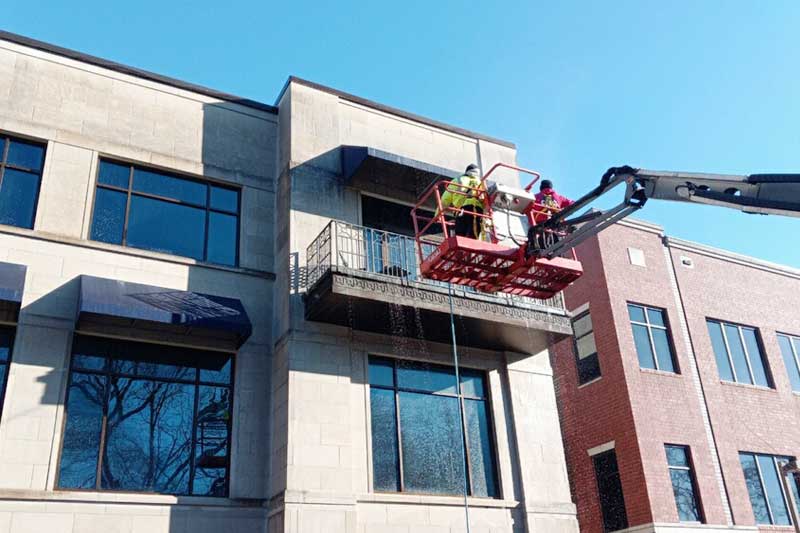
Nothing settles the question like putting water on the suspect and watching what happens inside. One joint, one window or door perimeter, one balcony connection or one panel of wall is isolated and flooded under a controlled rack, and either it leaks or it is ruled out, on the spot. That matters especially in this valley, where a joint may only leak when the wind is driving rain up off the river at a particular angle, or only once a hard night has widened it. Isolating each candidate is the only way to be sure which one is feeding the stain.
Where the surface is not telling us enough, a thermal camera will. Damp material gains and loses heat at a different rate from dry material beside it, so a wet pocket behind a panel, soaked insulation or a failure that has not yet reached the face all show as a temperature difference on the image. It lets a whole curtain wall or masonry elevation be screened in an afternoon without opening anything up. The cool, dry mornings this valley gets in late fall are ideal scanning conditions, because the temperature differential between wet and dry material is at its widest.
A meter gives a number rather than an impression, taken inside the drywall, the timber, the block or whatever porous material is in question. Read enough of them and the spread of water away from a suspected entry point can be mapped, which also answers whether that entry point is still actively wetting the assembly around it or simply used to. In air this damp a high reading does not automatically mean a leak, which is exactly why the numbers matter: they are what separates water coming through the wall from water that was simply in the air around it.
A drone will put a camera against the top of a downtown or riverfront elevation in an hour, at a resolution that shows an open lap, without anybody rigging a swing stage to get there. On a larger property that footage becomes a record of the whole facade, across the downtown core, the Southside and the North Shore, with the failure points marked and the zones that warrant hands-on work identified. It is the quickest way to look at an entire envelope after a storm or before winter, and it tells you which elevations are worth putting a crew on.
Occasionally the camera, the meter and the spray rack all come back inconclusive. At that point the answer is to open the wall: a small, deliberate section of cladding, wall or roof taken out so the assembly behind the finish can be seen directly. On older Chattanooga masonry it is often the only way to see whether water has been tracking inside the wall for seasons. The openings are kept small and specific, everything exposed is photographed and written up, and the area goes back weathertight before the crew leaves the building. It is a last resort rather than a routine step, used only where nothing non-destructive will settle the question.
You finish holding a document about your building rather than a template. It sets down what was inspected, where the failures are with photographs against each one, what we concluded from that, and what we would do about it. How it is pitched depends on who has to act on it, because a board running a downtown office building and a single owner with one commercial property are asking different questions of the same wall. Whatever scope and specification we propose afterwards is built on that document.
Work in Chattanooga starts with the investigation and the scope is written afterwards, in that order. Quoting the other way round, off what is visible, is how a building ends up paying twice.
We record every visible symptom: interior staining, exterior deterioration, tenant complaints, and any prior leak history for the building, including whether the problem shows up after heavy rain or after a freeze. That distinction narrows the search considerably in Chattanooga.
Findings from the walk-through determine which methods we deploy next: controlled water testing, infrared thermography, moisture meter readings, drone inspection, or invasive testing where warranted.
We turn the findings into a project-specific written report paired with a detailed restoration scope, so you know exactly what we found and how the proposed work resolves it.
Our crews carry out the work using the relevant Presto service line: facade, waterproofing, parking deck, historic preservation, or roof restoration, targeted at the confirmed failure points and scheduled around the Chattanooga weather each system needs.
Where called for, we run post-restoration testing to confirm the repair actually resolved the water intrusion, then deliver full project documentation at closeout.
Water still coming into your Chattanooga building after somebody has already been out to fix it? Investigating first is how the actual source gets found and closed. This work is carried inside a full restoration project rather than sold on its own, and those typically start at a $50,000+ project minimum.
1-800-785-9927, or send a Request A Quote.
Covering downtown Chattanooga, the Southside, the North Shore, and out to Hixson, East Ridge and Collegedale takes more than one crew on call. Cover across the whole range, from a major structural job through to everyday upkeep, comes from working with specialist regional divisions here.
The divisions below handle the routine, local side of the same property:
Building Restoration Chattanooga: Focused on structural repairs and exterior preservation on taller buildings.
Building Maintenance Chattanooga: Dedicated to the ongoing, preventative maintenance that keeps a Chattanooga property running through a wet season.
Building Services Chattanooga: Day-to-day commercial building support, market-wide in Chattanooga.
Recent Tennessee restoration projects where the investigation found the real entry point and set the scope that followed.
No. Diagnostic investigation and envelope consulting are part of a restoration project rather than something Presto sells on its own, and the projects they attach to generally start around $50,000. The reason is practical: our diagnostics exist to produce a repair scope, and findings nobody is going to act on are just paper. If what you need is a one-off leak inspection, a residential problem or a low budget opinion, a specialty inspection firm is the better fit and we will say so rather than take the job.
We pick the method from the symptom rather than running everything. Infrared thermography, moisture meter readings, controlled isolated water testing, drone inspection of parapets, roofs and upper elevations, and where nothing else will settle it, selective invasive testing that opens a small area of the assembly to see what is behind it. Building type, the pattern of the staining and the suspected failure mode decide the mix. In this valley thermography needs a real temperature difference across the wall to see anything, so the productive time for it is a winter morning after a cold night, and that is worth knowing before scheduling.
Because water almost never enters where it appears. Chattanooga adds two complications. Wind-driven rain arrives off the plateau and around the ridges from directions the original drawings did not anticipate, so the wetted face is often not the face the stain shows up on. And a crack that is closed in August is open in January, which means an intrusion path can be seasonal and can test clean at the wrong time of year. Skip the investigation and the repair goes to whichever component was easiest to blame, the water carries on arriving, and the owner pays for the same wall two or three times over. Finding the actual path first is what makes the restoration scope worth the money.
No. Forensic engineering, expert testimony and litigation support are not services we offer, and a project needing them should go to a forensic engineering firm. We do work alongside those firms on restoration projects where a dispute or an insurance claim is running in parallel, including owner association arguments about who owns a leak, but the investigative and testimonial role stays with them and the repair work stays with us.
Each report is shaped around the building and the decision the owner has to make with it. In practice that means documented findings with photography, the failure points we located and what we believe drives each one, our conclusions on the intrusion path, and a recommended repair scope tied to those findings. Where seasonal movement is part of the story the report says so, because in this climate a joint that tests sound in September may not be the same joint in January. These are written to become the basis of the project specification, not to sit on a shelf.
It scales with the building and with how many candidate paths there are. Chasing a single suspected failure point is often a day or two on site. A whole envelope investigation across several elevations, with controlled water testing at each suspected location, more commonly runs one to three weeks. We give Chattanooga property managers that timeline during scoping along with the repair phasing that follows, because the systems themselves have seasonal windows and there is no benefit in closing out an investigation in December if the sealant cannot go in until March.
When a Chattanooga building keeps taking water in after somebody has already repaired it, the reason is nearly always that the entry point is somewhere other than where it was looked for. Investigating first locates it, and the repair that follows ends the leak rather than deferring it another season.
To be clear about how it is sold: the investigation is carried inside a full commercial restoration project, and those typically start at a $50,000+ project minimum.
Reach us on 1-800-785-9927, or send a Request A Quote online.