


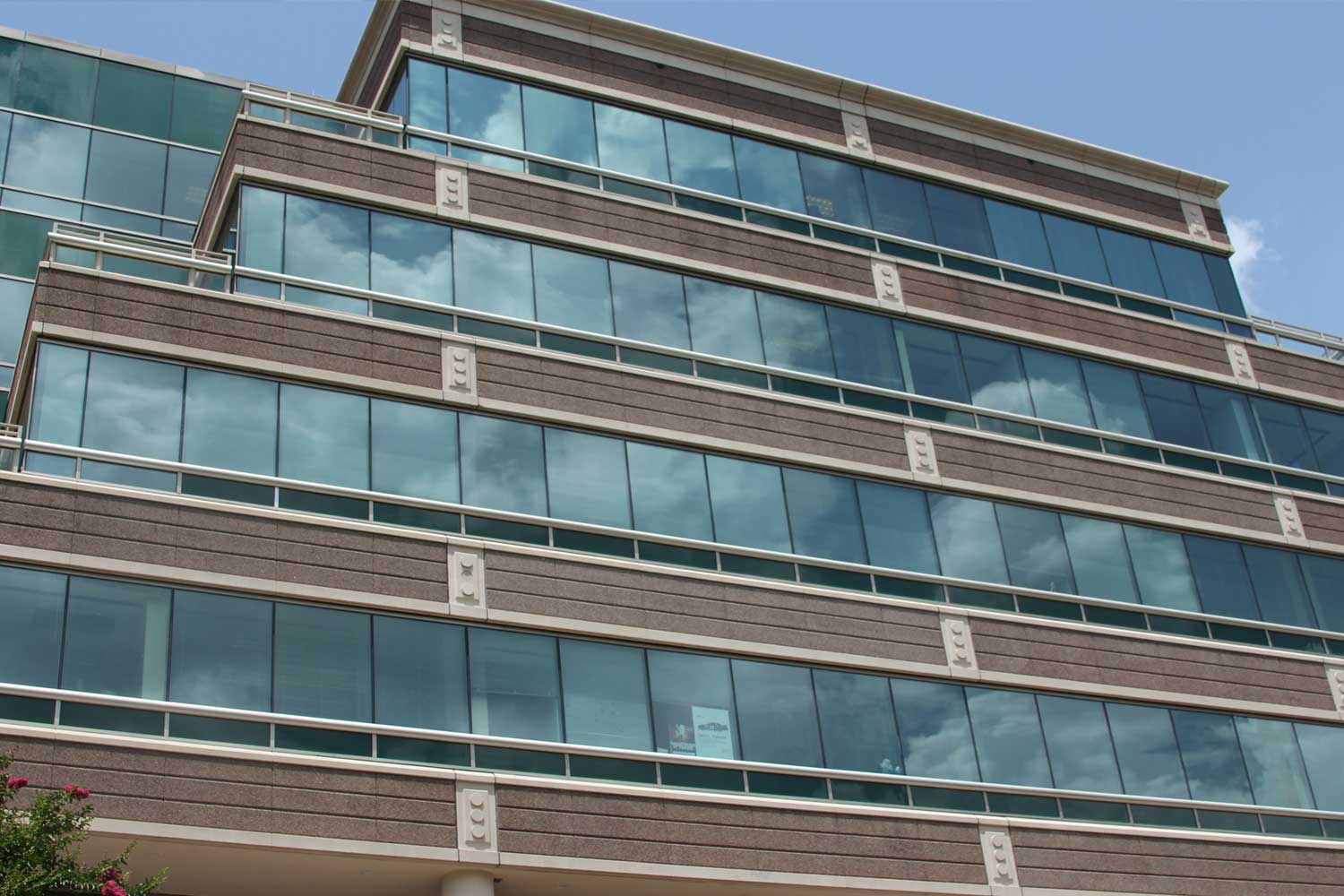
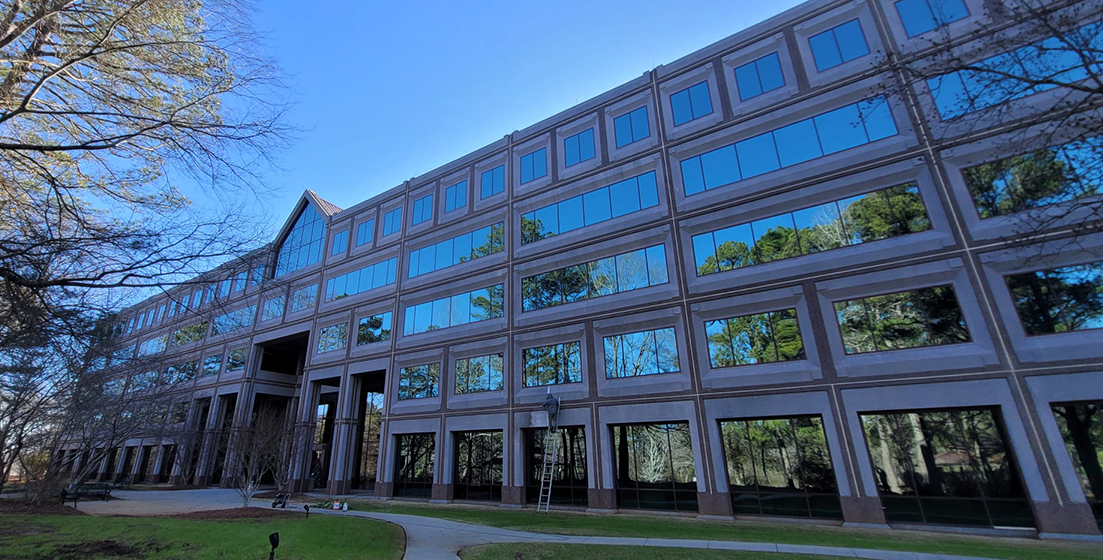
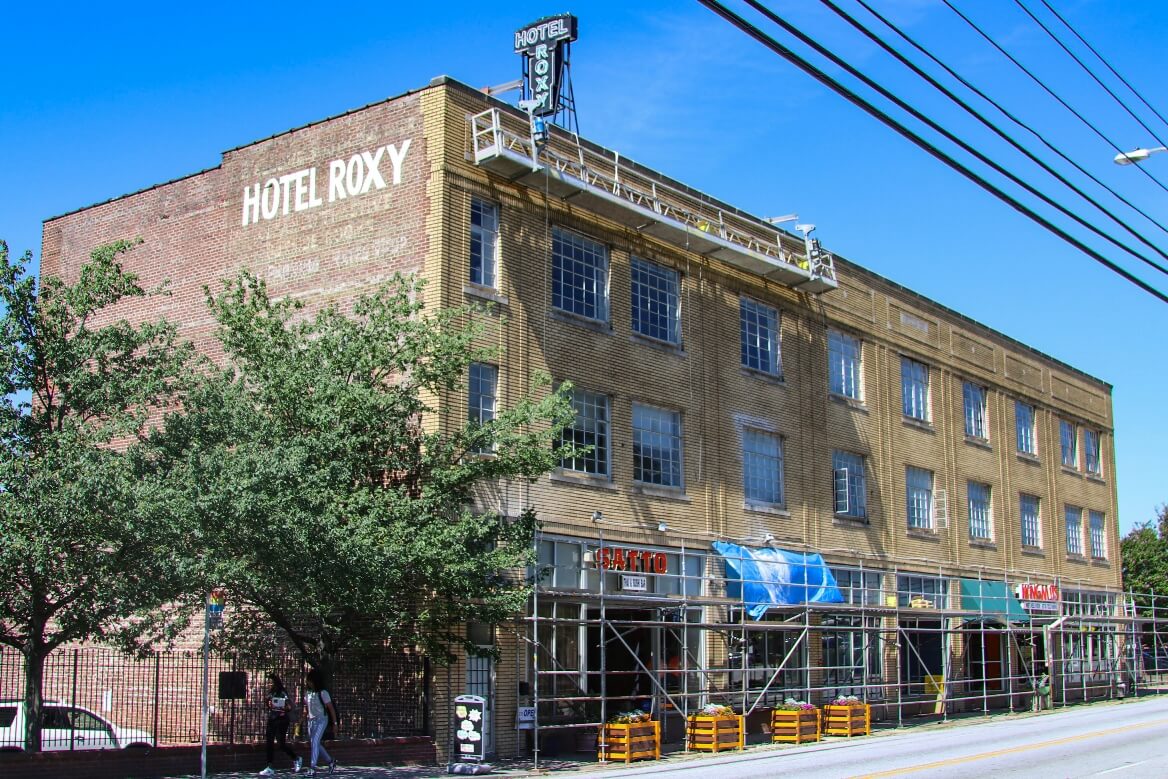






Water almost never enters a commercial building anywhere near the place the damage finally shows. A stained ceiling tile on the 12th floor can trace back to an open precast joint on the 20th, a corroded window head flashing, a hairline crack that widens a little with every freeze, or a curtain wall perimeter that has been leaking quietly for years. Atlanta's summer thunderstorms are the natural test of all of it: wind-driven rain arrives from a direction the building rarely sees, finds the one joint that has given up, and travels. Winter changes the behavior again. Water already sitting in a wall from October migrates when it freezes and reappears somewhere new, which is why a leak that seems to have moved is almost always one leak and not two. Owners, managers, and boards who skip a real diagnostic investigation usually pay twice: once for a repair aimed at the wrong component, and again when the same stain comes back with the next storm. The whole point of diagnosis is to know which component is at fault before the money is committed.
For Presto Restoration, diagnosis comes before pricing, and no Atlanta restoration project starts until we can say what is failing and why. Our diagnostic team works backward from the symptom to the opening, establishes what let the water past it, and settles on the repair that will hold. That answer is not always an envelope answer. On Atlanta's hilly sites, plaza decks and slabs at grade produce leaks that present as facade failures and turn out to be waterproofing failures, and the fix for one does nothing for the other. Because the diagnosis sets the scope, our restoration work holds up instead of generating repeat service calls. We do not sell leak detection on its own as a quick one-off inspection. The diagnostic and consulting work travels with a full restoration project, which generally starts around $50,000.
No single instrument finds every leak, so Presto pairs methods until the entry point is proven rather than assumed. The combination used on a given project depends on the building, the symptoms reported, and the suspected failure mode, and in Atlanta that varies more than it does in a city built out in one decade. A Midtown curtain wall leak is usually a sealant and glazing problem. A Castleberry Hill brick warehouse leak is usually masonry saturation. Those two need different methods, different equipment, and different questions asked first.
The most dependable way to confirm exactly where an Atlanta building envelope is failing is to apply water directly to a suspected failure point. Then we stand inside and watch, in real time, for where it comes through. Testing is done in isolation: one sealant joint, one window or door perimeter, one balcony connection, one panel of wall at a time. Each candidate path is either confirmed or eliminated before the next one is wetted. Running a hose down a wall proves very little. An Atlanta thunderstorm drives rain up under a horizontal joint and sideways behind a glazing stop, often from the one elevation the building almost never takes weather on, so the test has to reproduce that direction and that pressure to mean anything. Done properly, isolation testing is the only method that reliably separates the real source from the place the stain happens to surface.
Where the visible evidence runs out, infrared thermal imaging reads the facade by temperature instead, and the anomalies it picks up are usually trapped water, insulation that has taken on moisture, or a joint starting to fail long before anything shows from the sidewalk. Wet materials hold and shed heat differently than dry ones, which makes thermal scanning an efficient non-destructive way to screen large curtain wall, precast, and masonry elevations before committing to invasive testing. Atlanta’s wide day-to-night temperature swings in spring and fall give the camera the differential it needs, and a scan run after a hard freeze will often show saturated insulation across an entire bay where the tenant only ever reported one ceiling stain.
Moisture meters put a number on what is inside the assembly, since drywall, wood substrates, concrete masonry, and other porous materials all read differently wet than dry. Plotting those readings shows how far the water has run from a suspected opening, and whether that opening is still feeding the wall around it. Atlanta summers are humid enough that elevated readings sometimes point to condensation rather than intrusion: a chilled surface, an uninsulated slab edge, a cold line running through a warm cavity. Condensation is a legitimate diagnosis in this climate and it is not a leak. Telling the two apart is what keeps an owner from paying to repair something that was never broken.
On Atlanta office towers and mid-rise mixed-use buildings, drone inspection lets us capture close-up, high-resolution imagery of upper floors, parapets, and roof assemblies. Nobody has to rig a swing stage or set up rope access to get the first look. On larger properties we use drone footage to document coping, parapet, and roof edge conditions across Midtown, Buckhead, and Downtown, including the shaded elevations where tree canopy holds moisture against a wall and hides staining from anyone standing on the sidewalk. The imagery marks the obvious failures and narrows down where somebody needs to put hands on the wall. After a summer storm it covers a whole envelope in an afternoon, which is what decides the elevations worth a crew.
Now and then the scans, the meter readings, and the water testing all come back inconclusive, and the only answer left is behind the finish. Invasive testing means opening a small, deliberately chosen area of wall, roof, or cladding and looking at the assembly itself. Openings are kept tight, and everything exposed is photographed and written up as it comes apart. The area goes back together clean and weathertight before the crew leaves. On an older Downtown or Castleberry Hill masonry wall, an opening is sometimes the only way to establish whether the brick itself is saturated through or a concealed flashing was never lapped correctly. We reserve the method for cases where non-destructive testing cannot deliver a confident answer.
Each investigation closes with a written report about that building and no other. It sets out what was inspected, names the failure points with photographs attached, states what we concluded and on what evidence, and recommends the restoration that follows from it. We tailor each report to the information the property owner, building manager, or board actually needs to make a scope decision, since the ownership group behind a Midtown tower and the single owner of an Old Fourth Ward warehouse are usually asking different questions. The scope and specifications we later propose are written off that document.
Every Presto commercial restoration project in Atlanta opens with a diagnostic investigation, finished before the restoration scope is written. A contractor pricing a repair off the stain on the ceiling is guessing at the cause, and that order of operations is the whole difference.
We record every visible symptom: interior staining, exterior deterioration, tenant complaints, and the building's leak history, including which season each leak turns up in. A leak that only appears after a freeze points somewhere different from one that only appears during a summer downpour.
What the walk-through turns up decides what comes next: controlled water testing, infrared thermography, moisture readings, drone imagery, or an opening in the wall if it comes to that.
The findings become a written report for your building, paired with a detailed restoration scope, so what we found and what we propose to do about it sit side by side.
The repair itself is run by whichever Presto service line the diagnosis calls for, facade, waterproofing, parking deck, historic preservation, or roof restoration, and it is aimed at the confirmed failure points and nothing else.
Where it is warranted we test the repaired area again, under the conditions that exposed the leak in the first place, and hand over complete project documentation at closeout.
If a building keeps leaking after repairs that were supposed to end it, the money already spent is the strongest argument for diagnosing the problem properly before spending any more. Our team confirms where water is actually getting in, and the restoration scope follows from that. Diagnostics and consulting come as part of a full restoration project, which typically starts at $50,000.
Call 1-800-785-9927 or Request A Free Quote.
A metro as spread out as Atlanta, from Downtown up through Midtown and Buckhead, asks for more than one kind of attention. Major restoration is our work; for the routine upkeep that sits either side of it, Presto coordinates with specialized sister divisions.
For routine upkeep and localized facility services, we encourage property managers to explore our sister divisions:
Building Restoration Atlanta: Focused on localized structural repairs and high-rise exterior preservation.
Building Maintenance Atlanta: Dedicated to the ongoing, preventative maintenance that keeps a building out of trouble between major projects.
Building Services Atlanta: Your resource for comprehensive, day-to-day commercial building support across the Atlanta metro.
Browse a selection of recent commercial restoration projects across Georgia, where diagnostic investigation identified the true water intrusion source and shaped the restoration scope that followed.
No. Presto’s leak detection and building envelope consulting work is bundled into comprehensive commercial restoration projects rather than sold as a standalone service, with a typical minimum project size of $50,000. This structure exists because our diagnostic methodology is built to inform a restoration scope; without the restoration component, the findings become information without action. Property owners looking for one-off leak inspections, residential inspections, or low-budget consulting are better served by a specialty inspection firm than by Presto.
Our diagnostic toolkit includes controlled isolated water testing, infrared thermography, moisture meter readings, drone inspection, and invasive testing (selective demolition for investigation). The specific mix used on a given project depends on the building type, observed symptoms, and suspected failure mode. We choose diagnostic methods that will directly inform the restoration scope, not testing for its own sake.
Water rarely originates where the visible damage shows up, and Atlanta gives it two different ways to move. A leak on the 14th floor of a Midtown tower might trace back to a failed parapet flashing on the 18th, an open precast joint several floors up, or a curtain wall perimeter that has been failing for years. In winter it gets stranger still: water already held in the wall migrates as it freezes and surfaces in a room it has never touched before. Skip the diagnostic step and restoration contractors often repair the wrong component, so the actual intrusion continues and the property owner ends up paying two or three times the original repair cost. Diagnostic investigation upfront produces restoration that actually solves the problem.
No. Presto does not provide forensic engineering, expert witness testimony, or litigation support services. For projects requiring this type of work, we recommend engaging a specialty forensic engineering firm. We do work alongside such firms on restoration projects where litigation or insurance disputes are involved, including disputes between owners, tenants, and prior contractors over who is responsible for a leak, but we do not perform that work ourselves.
Every diagnostic report we deliver is built around the specific project and the specific information the property owner needs. Reports typically include inspection findings with supporting photography, identified failure points and their suspected causes, our diagnostic conclusions, and a recommended restoration scope to address the findings. Reports become the foundation of the restoration project specifications, so they are written to support the work that follows rather than as standalone documents.
Diagnostic investigation timelines vary based on building size, the complexity of the water intrusion issues, and which diagnostic methods apply. A targeted investigation of one suspected failure point might wrap up in 1-2 days. A full envelope investigation across multiple suspected failure areas, with controlled water testing at each candidate location, can take 1-3 weeks. We provide project timelines during initial scoping so Atlanta property managers can plan around the diagnostic work and the restoration phasing that follows, including City of Atlanta permitting and any Atlanta Urban Design Commission review an older building brings with it.
Seeing staining, joint failure, or a leak that keeps coming back on your Atlanta building? Tell us what you are looking at, when it shows up, and what kind of weather brings it on, and our team will point you toward the right diagnostic path and the restoration that follows from it.
Note: diagnostic and consulting work is part of a comprehensive commercial restoration project, typically $50,000 and up.
Call 1-800-785-9927 or Request A Quote online.