




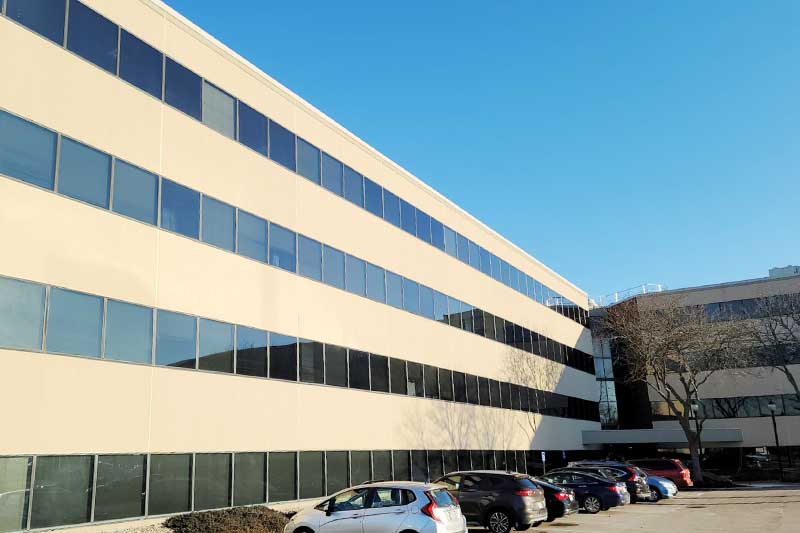
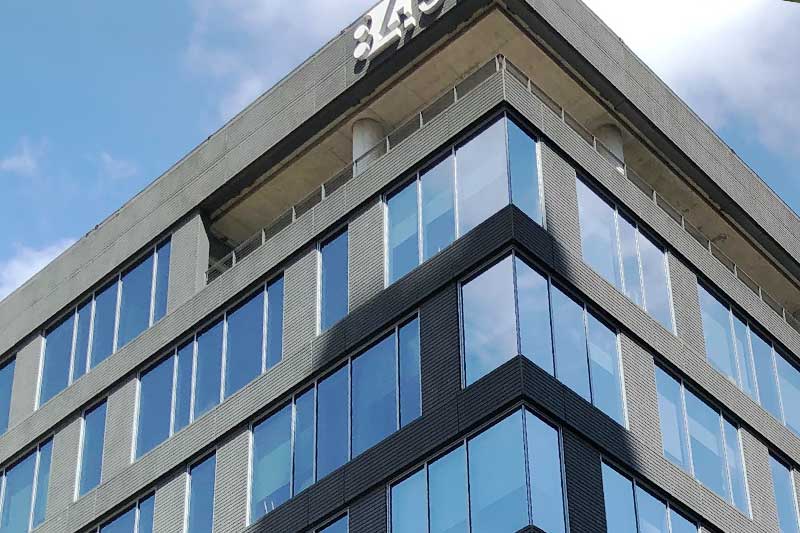
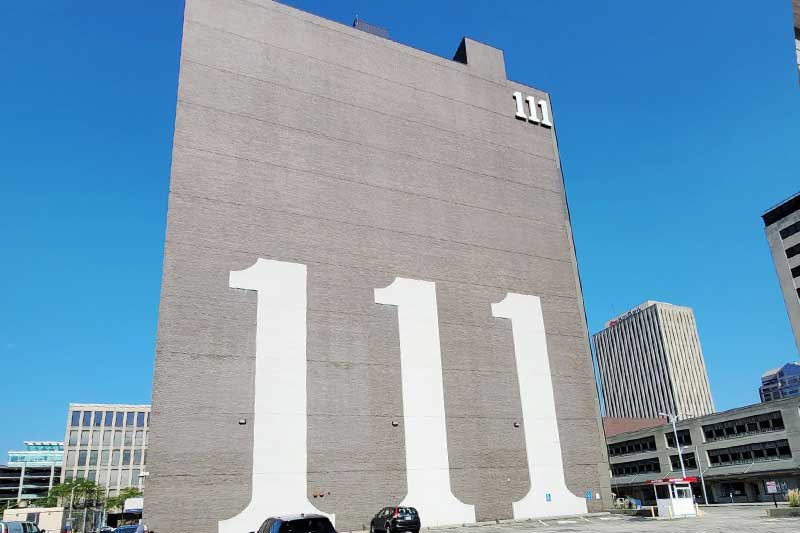


Most of what Presto is called to fix in Akron went up between 1910 and 1930, when the rubber industry made this the fastest growing city in the country and the population climbed 201.8 percent in a single decade. Those walls are thick multi-wythe brick laid in soft lime mortar, and the mortar was designed to be the part that gives way. Repoint one of them in hard Portland mortar and the physics invert: moisture and freeze expansion can no longer escape through the joint, so they push out through the brick face instead, and the brick spalls while the joint stays perfect. The exposed reinforced concrete frames of the same period fail on a parallel path, where shallow cover over the bars, a century of carbonation and repeated freezing corrode the steel until the expanding rust delaminates columns, spandrels and slab edges. Akron takes 47.2 inches of snow across 45.3 snow days, spread thin and long rather than dumped, and with 68 clear days against 160 days of precipitation a saturated wall gets very little chance to dry before the next crossing.
Presto Restoration has spent more than 25 years on commercial exteriors nationwide, on high-rise walls, parking structures and landmark buildings, and Akron draws on all of it. The scale here is unusual: the East End alone carries 1.4 million square feet of former Goodyear buildings, Goodyear Hall among them, so an envelope scope in this market is as much a phasing and square-footage exercise as a technical one. We sequence caulking, coatings and masonry repair into the stretches when substrates will genuinely cure, we match repointing mortar to the wall it is going into rather than to a spec sheet, and we submit through the Summit County Department of Building Standards with the parallel City of Akron filing that every project inside the city limits requires. From loft conversions at Quaker Square and the Bowery District to plants and warehouses along the Little Cuyahoga, what comes back is an exterior that reads as looked after and that keeps water on the outside of the wall.
Presto covers the whole exterior on commercial, industrial and institutional property across Akron, Summit County and the Portage Lakes communities, whether the scope is a single elevation or a phased program over a converted plant.
On Akron’s converted mill and factory stock, water almost never arrives through the field of a membrane. It comes in at wall-to-roof transitions, perimeter joints, and the surrounds of large steel sash openings, and rubber-era plants carry an unusual number of all three. Our scope stays above grade: wall assemblies, glazing perimeters, plaza decks, slabs and joints at grade, and traffic coatings, sealed in the order water actually travels. More than 25 years of that work, phased across campus-scale square footage rather than closing a building down.
On the 1910-1930 mill buildings that make up so much of Akron’s commercial stock, the joint is supposed to be the weak point. Soft lime mortar in a thick multi-wythe wall carries moisture back out and absorbs freeze expansion; hard Portland repointing blocks both, and the brick face starts shedding in its place. Our facade work therefore starts with what the wall is actually made of, then runs through sealant replacement, compatible repointing, brick and stone repair, patching of spalled concrete spandrels and columns, architectural metal refinishing and elastomeric coatings, so the elevation ends up safe and securely anchored rather than freshly painted.
View Our Akron Facade Restoration Services →
Structured parking in Akron is mostly institutional: hospital campuses, the University of Akron, and the decks serving downtown offices and converted plants. Those slabs stand out in the weather through 45.3 snow days a year, and the de-icing salt that arrives on every set of tires ends up dissolved in whatever ponds on a worn traffic coating. Chloride works down to the reinforcing steel, and the rust that forms occupies more room than the steel it replaced, which is what pushes the cover off a soffit or a ramp. We rebuild the deck as one system, with concrete repair, expansion joint replacement, above-grade waterproofing and a fresh traffic-bearing coating, phased so the structure keeps taking cars.
Roof area is the governing number on Akron industrial stock. One former plant can hold more roof than a downtown block, and the rubber-era buildings carry monitor and clerestory geometry that multiplies curbs, transitions and flashing runs right through the field. Restoration is usually the better answer: coating a roof that still has sound deck and structure under it buys another decade or two of service for a fraction of what a tear-off costs, and it can be taken area by area so tenancy or production carries on. We rebuild flashings, curbs and penetration seals, correct ponding, and put down silicone or elastomeric systems specified for meltwater that arrives slowly over many days rather than in one runoff event.
Akron’s landmark stock is industrial and civic rather than grand: seven National Register districts, among them Main-Market, South Main Street, Cascade Locks and B.F. Goodrich, plus buildings like the 1899 post office that is now the Akron Art Museum and the white glazed terra cotta Northern Ohio Traction and Light Building. Exterior work on a designated property goes to the Urban Design and Historic Preservation Commission for a Certificate of Appropriateness, and under Akron Codified Ordinances 31.395 the Superintendent of Building Inspection cannot issue a building permit until that certificate is in hand. The Commission has 60 days on an alteration and 90 on a demolition, and an application it does not act on inside the period is deemed approved. We prepare those submissions, match materials and detailing to 36 C.F.R. 67.7, and build repairs that survive the review.
Two things make a leak hard to find in a converted Akron plant. There is an enormous amount of membrane and wall to search, and the water almost never came in through the middle of any of it. Rubber-era buildings carry long runs of steel sash, monitor glazing and wall-to-roof transitions, and that is where the entry point normally sits, often a floor or two above the stain somebody reported. Our specialists narrow it down with moisture mapping, controlled water testing staged joint by joint, drone imaging of the upper elevations, close review of perimeters and glazing surrounds, and infrared thermography when there is enough temperature difference across the assembly to read anything. You get a documented entry point rather than an opinion.
Presto Restoration has worked on commercial exteriors across the United States for more than 25 years. In Akron that experience gets pointed at a narrow set of problems: multi-wythe mill brick that has already been repointed in the wrong mortar, exposed 1910-1930 concrete frames losing cover at columns and spandrels, and the joint density that comes with turning a plant full of steel sash into offices and apartments.
No single trade keeps a converted rubber-era building in order. Between the Great Streets districts, the East End and the office stock downtown, Akron property managers are usually running exterior restoration, reactive repair and scheduled upkeep at the same time, and Presto works alongside specialist partners in the region so those pieces do not have to be sourced one at a time.
Three sister divisions cover the recurring end of it:
Building Restoration Akron: Targeted structural repair and exterior preservation work on individual buildings.
Building Maintenance Akron: The scheduled preventative maintenance that keeps an Akron building serviceable between restoration cycles.
Building Services Akron: General day-to-day commercial building support, whichever Akron district the property sits in.
Most of our Akron work sits on industrial and formerly industrial property: rubber-era mill buildings, concrete-frame factories, and the loft, office and hotel conversions made out of them. Alongside that we work on downtown offices, hospitals, university and campus buildings, parking structures and designated landmarks. Our crews handle every exterior surface that stock uses, including multi-wythe brick, exposed reinforced concrete, stone, terra cotta, stucco, EIFS, metal panel, steel sash glazing, curtain wall and roofing.
Freeze-thaw, but the Akron version of it. The city sits roughly 39 miles inland and higher than the counties north of it, in the secondary snow belt rather than the primary one, so it collects 47.2 inches of snow spread across 45.3 snow days instead of taking it in bursts. With 68 clear days against 160 days of precipitation, a wet wall seldom gets long enough to dry before the next crossing. On thick multi-wythe mill brick the repair history usually makes it worse: the original soft lime mortar was meant to be the sacrificial, vapor-open part of the assembly, and once a wall has been repointed in hard Portland mortar the moisture and the freeze expansion have nowhere left to go except out through the brick face. Exposed 1910-1930 concrete frames fail on a parallel track, where shallow cover over the bars plus a century of carbonation corrodes the reinforcement until the expanding corrosion product delaminates columns, spandrels and slab edges.
Scope and building size decide it, and on Akron industrial stock size is usually the larger variable. Targeted sealant and joint work on one elevation can be a two to four week job. A full exterior on a converted plant is measured in months, because the wall and roof areas involved are far greater than the story count would suggest. We build the schedule around cure conditions, since 68 clear days a year does not hand out long dry stretches, and we phase the work zone by zone so tenants, production or clinical operations keep running throughout.
Yes, we file them and coordinate the inspections. Akron is one of the places where that answer surprises people, because the City no longer runs a commercial building department of its own. It was folded into the Summit County Department of Building Standards in 2009, so plan review and the permit itself now sit with the County. The City has not dropped out of the process: a job inside the city limits still goes in to Akron as well, and the City Engineering Bureau Plans and Permits Center picks up fire prevention, grading and paving, right-of-way, utility conflicts, sewer, SWPPP, traffic control, water and zoning. On a designated property nothing can be permitted until the Certificate of Appropriateness has been issued. Where a general contractor is running the wider job we file under them, and an owner who would rather hold the permits directly can do that instead. Our general liability and workers compensation cover is nationwide and active on every job we run.
Cleaning is not repair. Window washing, pressure washing and touch-up paint keep a building presentable and change nothing about how it handles water. Restoration is correction to the assembly: spent sealant replaced, repointing done in a mortar compatible with the brick around it, spalled concrete patched, corroded reinforcement treated, and the wall put back into a condition where it sheds water instead of storing it. On Akron industrial stock that difference decides the outcome, because a fresh coat over a thick wall whose joints are already open simply hides the mechanism that is taking it apart.
Watch for brick faces that are spalling, crumbling or sounding hollow while the mortar joints beside them look untouched, which is the signature of incompatible repointing. Then look for concrete spalls and exposed reinforcement at columns, spandrels and slab edges; sealant that has cracked, shrunk or pulled clear of a joint; rust bleed running below lintels and metal trim; efflorescence spreading over masonry; and interior staining that turns up during a thaw rather than during rain. Akron has no periodic exterior wall examination requirement, so nothing puts this on a calendar for you. What it does have is Codified Ordinances section 190.602, under which facades, cornices, trim, balconies, canopies, awnings and the rest have to be kept in good repair, safe and securely anchored, and free of holes, cracks and loose or decaying material, with section 190.603 allowing the City to do the work and assess the cost against the owner where a violation goes uncorrected. Tell us what you are looking at and we will point you toward the right scope. Call 1-800-785-9927 or click Request A Quote.
Brick spalling at the face instead of the joint, a concrete spandrel starting to delaminate, or water at a wall-to-roof transition? Tell us what you are seeing on your Akron building and our team will point you to the fix that addresses the cause, not the symptom.
Call us today at 1-800-785-9927 or click Request A Quote.