








San Antonio builds in stone. Three centuries of limestone, stucco, brick and terra cotta stand across the downtown core, the Pearl District, King William and the mission corridor, and every one of those materials is porous. Summers here run long and brutally bright, and the ultraviolet load that chalks a coating also cooks the elasticity out of a sealant joint. Storms roll off the escarpment north of the city and drive water at a wall in sheets rather than drops. Expansive clay works plaza slabs and joints at grade year round, an occasional hard freeze after a mild stretch takes whatever flexibility is left, and caliche dust and heavy spring pollen pack into every open joint. Once the wall’s seal is gone, mortar softens, terra cotta glaze spalls away, stucco crazes, and rusting steel lintels begin to jack the masonry above them. A building’s tenants see it as stained ceilings and musty corridors long before ownership sees it as a capital item.
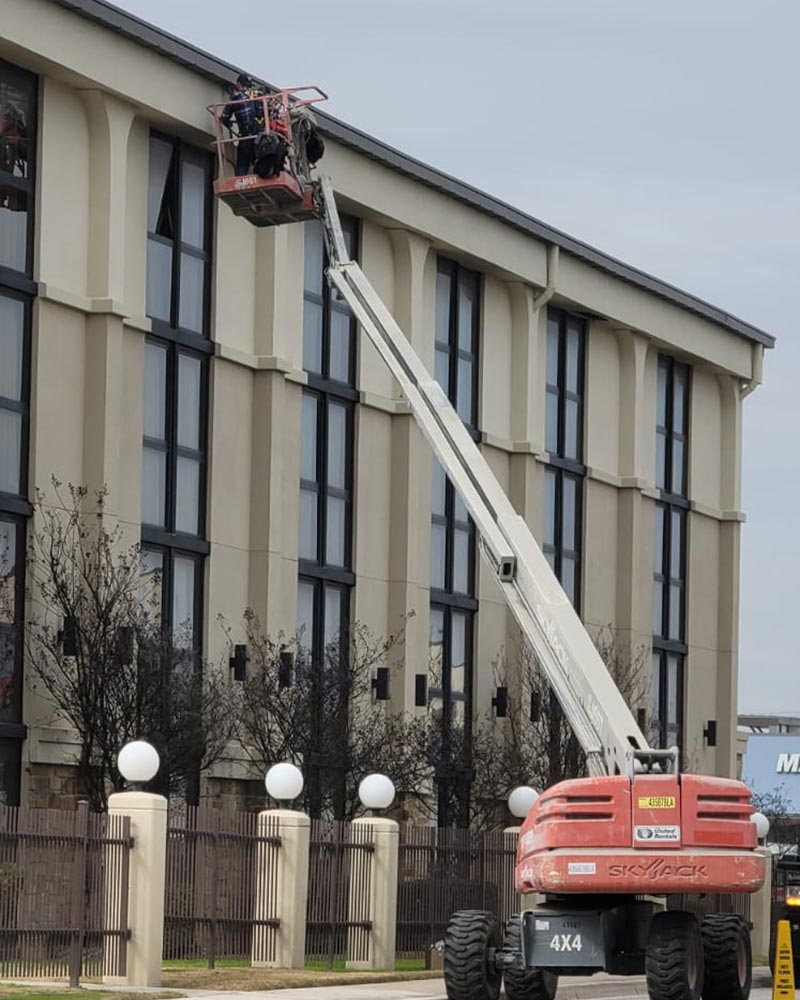
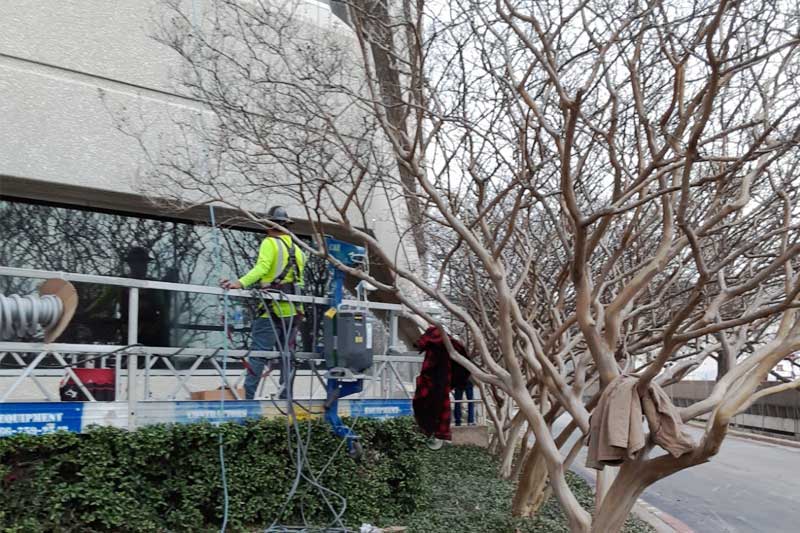
Presto Restoration runs a facade, caulking and coating program built for South Texas masonry rather than for glass. We refinish architectural metal, repair stone and brick, replace failed joint sealant, and install coatings that stay flexible through a 105 degree afternoon and a January cold snap alike. Rope access and swing stage put crews on a 1920s tower, a re-tenanted hangar at Port San Antonio or a Broadway corridor mid-rise without closing the sidewalk to scaffolding. The restoration products we use come out of our own plant, so the material going onto your building’s wall is one Presto stands behind. Our portfolio already carries facade waterproofing and window caulking work here in San Antonio, TX, and the city’s historic review process is one our project managers work through rather than around.
Most of the water that reaches a San Antonio interior came through a joint, not through the material on either side of it. Heat is the reason. A bead on a west elevation cycles through a punishing daily temperature swing for months on end, loses its recovery, and lets go of the substrate; on limestone and stucco the bond line usually fails before the sealant itself does. Presto’s technicians cut out the tired material, clean and prime the joint face, set backer rod to the correct depth, and gun in silicone or polyurethane specified for high-UV, high-movement service. Nothing is left half done: copings, window perimeters, panel and control joints, expansion joints and every penetration are cut and re-sealed in one coordinated pass, so the wall’s seal is continuous when the crew leaves.
San Antonio is not a glass city, but the aluminum storefronts, mullions, ACM panels and metal trim on downtown towers, the re-tenanted base buildings at Brooks and Port San Antonio, and the Broadway corridor mid-rises take a hard beating. Ultraviolet exposure fades factory color, anodizing goes flat, and the fine limestone dust that hangs in the air after a dry spell bakes into the finish where routine washing will never lift it. Replacement is rarely the first answer. Controlled micro-abrasion takes off oxidation and embedded contamination, refinishing brings the original color back, and the building’s own detailing survives for a fraction of what new panels cost. (We normally close a metal package with a clear protective seal, which is covered under our Commercial Waterproofing services, so the two are usually scoped together.)
Glass is the smaller part of a San Antonio envelope, but where it exists the damage is chemical, not cosmetic. Irrigation overspray and hard municipal water bake calcium and lime onto the surface through the summer; alkaline runoff from limestone and concrete above etches the pane permanently; and wind-driven caliche and construction dust scour a fine haze into the surface out on the Northwest Side. No cleaning contract reverses any of that. Our chemical restoration process dissolves the deposits and lifts the damaged layer without altering the glass itself, so a storefront or window wall reads clear again. (Ask about Glass Defender, our proprietary protective treatment, if you want that clarity to hold. It is covered on the commercial waterproofing page.)
Stucco, EIFS, precast, limestone and brick all share porosity, and in San Antonio that matters most in the half hour after a convective downpour, when a hot wall pulls water in fast. Moisture sitting inside a wall corrodes reinforcement, blows the face off precast, feeds mildew, and widens the shrinkage cracking that heat has already started. The answer on a porous wall is an elastomeric system that cures to a breathable film with real stretch left in it. Because it tracks the wall’s daily thermal cycle, it bridges hairline cracking up to 1/16 inch instead of splitting over it, sheds bulk water at the surface, and still passes vapor outward so the substrate dries between storms. It comes in a full palette of factory colors and textures, which is how a coating package often pays for the building’s repaint at the same time.
Local limestone is the material that made this city look the way it does, from the mission walls to the 1920s towers downtown, and it is soft, absorbent and unforgiving of the wrong cleaning method: pressure washing opens the stone’s face and the wrong chemistry burns it. We begin with substrate testing and a gentle, staged clean that lifts biological growth, dust loading and staining without scarring the surface, then apply penetrating sealers and breathable coatings that shed water while the wall still breathes. Spalled stone, blown precast and failed terra cotta get color-matched patching cut to the original profile. Where a King William or Southtown property sits under the city’s historic review, the material approach is documented and approved before anyone touches the building’s elevation.
Mortar is the sacrificial part of a brick wall and it is meant to fail first. At the Pearl and along the older industrial blocks, joints that have taken decades of heat, driving rain and the odd hard freeze erode back until water runs the cavity freely, and the building’s owner sees it inside as staining and outside as loose, drummy brick.
Our masonry crews cut the failed joints back to a proper depth, mix a mortar that answers to the original on color, on strength and on how it was made, and tool the finished joint so the repair reads as part of the wall’s face rather than as a patch: structural repointing and finish tuckpointing from one accountable crew.
On San Antonio’s nineteenth-century and mission-era masonry we specify soft lime mortars, because a modern portland mix is harder than the stone it sits against and will quietly destroy the wall’s weakest element.
Five phases, every time. The sequence exists so that nothing is priced before it has been looked at properly, so crews and occupants stay safe while the work is live, and so ownership finishes holding a documented record of what was done to the building.
Ground level first, then drone, then hands on the wall from suspended access. Every joint, panel, stone face and coated area is photographed and logged elevation by elevation, so the scope that follows is built on the building’s actual condition.
When a leak is hiding, guessing gets expensive fast. Controlled spray testing, infrared scanning and moisture metering trace the path back to the real entry point, which on a masonry wall is rarely anywhere near the stain showing inside.
What the survey found becomes a priced line-item scope: quantities, named products, phased calendar. Your project manager owns access, tenant notice and permitting through San Antonio DSD or Bexar County.
Trained crews work the elevation to manufacturer specification. A field supervisor holds the quality line on site and logs each day against the scope, so nobody is reconstructing history later.
You finish holding the paperwork: warranty certificates, product data, before and after photography by elevation, and a maintenance interval sheet so the next cycle is planned rather than discovered.
Covering the San Antonio market properly takes more than a crew that flies in and leaves again. Presto coordinates a group of specialized divisions so a property gets the same standard whether the job is a full envelope restoration or the routine care that keeps one from being needed.
For everyday and preventative work, these sister divisions can be reached directly:
Building Restoration San Antonio: Structural repair and exterior preservation on individual buildings.
Building Maintenance San Antonio: Scheduled upkeep that keeps a South Texas elevation from aging faster than the building’s systems do.
Building Services San Antonio: Day-to-day commercial building support across Bexar County and the surrounding market.
Presto Restoration has spent more than 25 years protecting commercial property nationwide, and the people who show up on your San Antonio elevation know what a South Texas summer does to a sealant joint by August. That experience covers what this market actually runs on: Certificate of Appropriateness review in the local historic districts, permitting through the city’s Development Services Department, and the way limestone, stucco and terra cotta behave when heat, caliche dust and a violent rain event land on a building’s wall in the same week. Everything Presto does in this market sits under San Antonio building restoration services.
Seeing split joints, staining or a leak on your San Antonio building? Send us what you are looking at and our team will point you toward the right repair.
Call 1-800-785-9927 or Request A Quote.
Heat and ultraviolet exposure set the schedule here more than anything else, and masonry buildings run on longer intervals than sealed curtain wall. As a working rule: a full envelope inspection every three to five years, sealant replacement somewhere between eight and twelve years, coating renewal at ten to fifteen, and repointing anywhere from twenty to thirty-five years depending on mortar and orientation. West and south elevations always come due first.
Sealant that has hardened, shrunk back or torn away from the joint face. Rust bleed running from lintels, anchors or panel fasteners down onto stone and stucco. White efflorescence on brick and cast stone. Stucco that chalks under your hand or has crazed into map cracking. Damp patches, blistered paint or a musty smell along an exterior wall inside. Glass that stays cloudy after cleaning. Loose or drummy brick, and spalled terra cotta or precast around windows and parapets. Any of those is worth a professional opinion before the next storm season.
Yes, and most of ours are. Hotels on the River Walk, occupied office towers downtown, Medical Center buildings and re-tenanted space at Port San Antonio all stay open while we work. Rope access removes the scaffold footprint at street level, loud tasks are scheduled around business hours, and elevations are phased so entrances, patios and parking stay usable.
Height and scope decide it. Sealant-only work on a mid-rise can be in and out inside a month. Put sealant, coatings, masonry and metal together on a twenty to thirty story tower and you are normally looking at three to six months, with historic review adding weeks at the front end. We commit to a firm schedule once the scope is set.
There is no single number, because coverage follows the products: each coating system, sealant and repair method carries its own term, and the mix specified for your building decides the answer. Ownership sees those terms during scoping, before anything is signed, and the whole package is handed over at closeout.
Yes, both. Our project managers file permits through the City of San Antonio Development Services Department, or with Bexar County where a property sits outside the city limits, and prepare the Certificate of Appropriateness material that the Historic and Design Review Commission and the Office of Historic Preservation require in a local historic district. If a general contractor already holds the site, we slot into their sequence. General liability and workers’ compensation coverage is nationwide, current, and on file before mobilization.
By the time water shows on a ceiling tile the wall outside has been failing for a while, and the repair has already grown. Tell us what you are seeing on the elevation and we will tell you what it usually means.
Reach us at 1-800-785-9927, or click Request A Quote.