








In commercial buildings, water rarely enters where it shows up. A stained ceiling tile on the fifth floor might trace back to a failed sealant joint two floors above, a corroded shelf angle, an eroded mortar joint, or a window perimeter that has been letting water in for months before any interior damage appeared. Greenville complicates that in a specific way. Much of the commercial inventory here is mass masonry, several wythes of load-bearing brick with no drainage cavity behind it, so water entering high on a wall can travel laterally and downward through the wall itself before it reaches a finish. Rain falls in every month of the year, which keeps the assembly loaded, and roughly 57.6 freezing nights keep pushing that moisture around inside it. Owners who skip a real diagnostic investigation often end up paying to fix the wrong component, then watching the same stain reappear the following winter.
Presto Restoration treats leak detection and building envelope diagnostics as a required first step on every commercial restoration project we take on. Before we propose any repair scope, our diagnostic team confirms exactly where water is entering the envelope, why it is entering there, and which restoration approach will actually stop it. This diagnostic-first process is built into how we scope every job. That is why our restoration work holds up instead of generating repeat service calls. Note that Presto does not provide standalone leak detection as a small, one-off inspection service. Instead, our diagnostic and consulting work is bundled into comprehensive commercial restoration projects, typically with a $50,000+ project minimum.
A range of diagnostic techniques is available for locating where water is actually entering a commercial building. Which of them get used on a given job depends on the construction, the symptoms reported and the failure mode we suspect.
The most dependable way to confirm exactly where a Greenville building envelope is failing is to apply water directly to a suspected failure point and watch for intrusion in real time. Our controlled water testing isolates specific sealant joints, window and door perimeters, mortar joints, canopy and coping connections, or wall sections, flooding them under controlled conditions to confirm or rule out each candidate path. This matters more on mass masonry than on a drained cavity wall, because a thick brick wall can hold water for days and release it somewhere unexpected, so isolation testing is often the only way to separate the real source from where the stain happens to surface.
When surface symptoms alone are not conclusive, we use infrared thermal imaging to spot temperature anomalies across a facade that point to trapped moisture, saturated insulation or early-stage envelope failures invisible to the naked eye. Wet materials hold and shed heat differently than dry ones, which makes thermal scanning an efficient non-destructive way to screen large brick and stucco elevations before committing to invasive testing. On a Greenville building it is especially useful for narrowing down which bays or floors deserve a closer look after a winter glaze event, when meltwater has had somewhere new to go.
Moisture meters give us a direct, quantitative reading of moisture content inside drywall, wood substrates, concrete masonry and other porous materials. Those readings let the team trace how far the water has moved from a suspected opening and settle whether that opening is still feeding the assembly around it. That mapping is doing more work in Greenville than it would in a drier market: with rain in every month, a mass masonry wall carries a real baseline moisture content, so the readings that matter are the ones well above the surrounding wall rather than any elevated number. Separating true intrusion from ambient load is essential before we finalize a restoration scope.
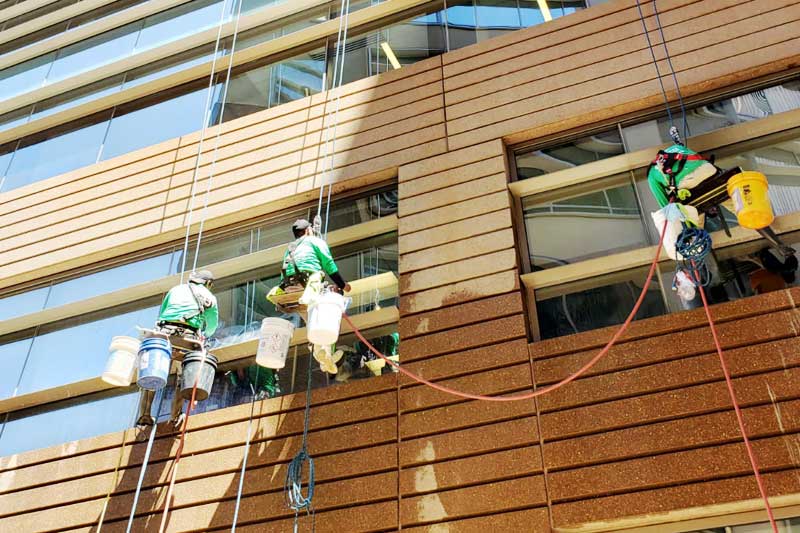
On Greenville’s downtown office buildings, mill conversions and the larger properties along Pelham Road and the Woodruff Road corridor, drone inspection lets us capture close-up, high-resolution imagery of upper floors, parapets and roof assemblies without the cost and scheduling burden of rope access or swing stage rigging. On a mill building with long blank elevations and a great deal of coping and parapet run, that coverage is worth a great deal: we use the footage to document facade conditions, flag visible failure points and target which zones need hands-on investigation. It is also a fast way to survey an entire envelope after a winter glaze event before committing crews to specific elevations.
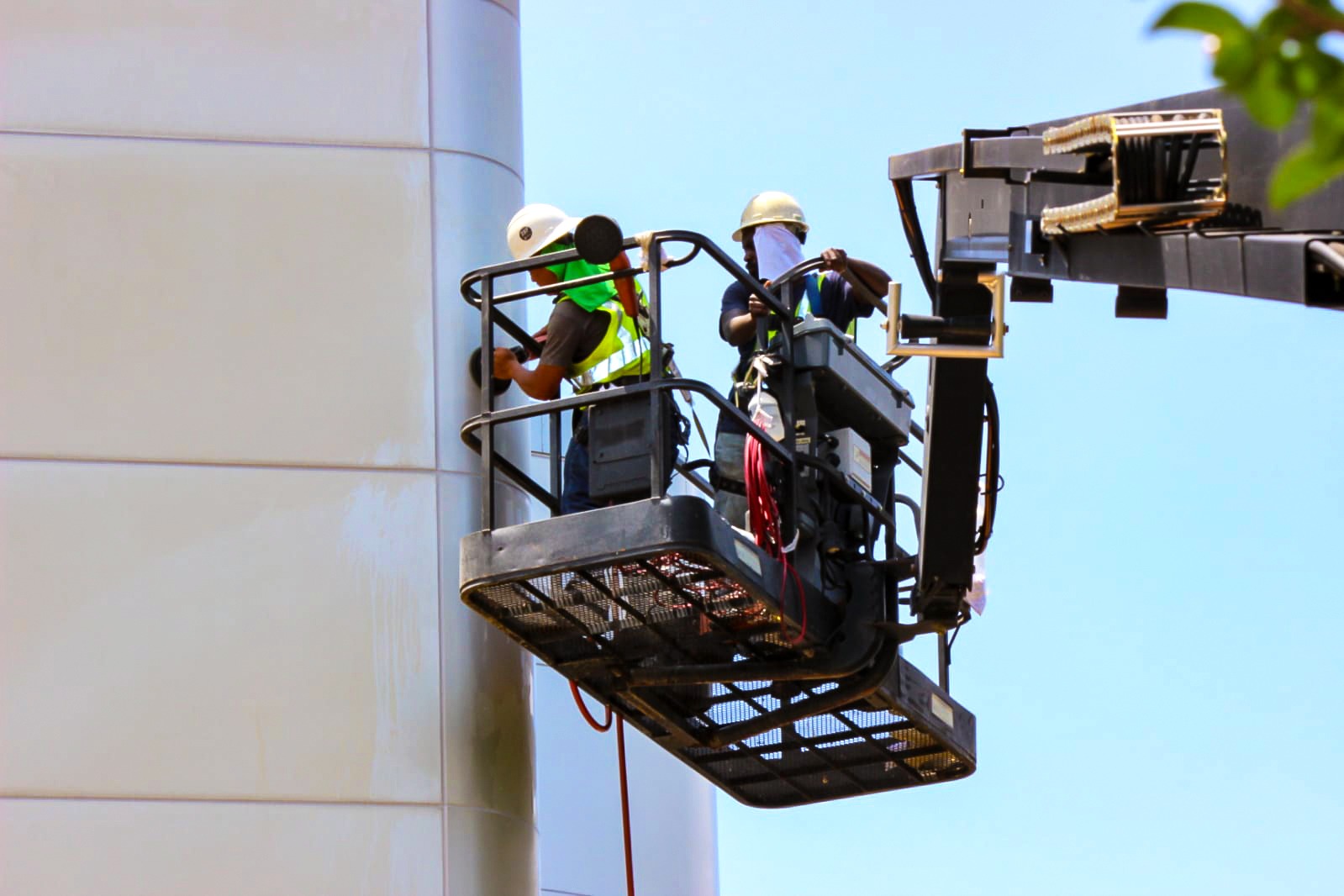
If thermal imaging, moisture readings and water testing all leave the path of the water ambiguous, opening the assembly is the next step. That means removing a small, chosen section of wall, roof or cladding to see what the finished surface is hiding. The openings are kept tight and deliberate, and everything exposed is photographed and written up as it is found. The test area is then put back clean and weathertight before the crew leaves. This route is kept for the cases where non-destructive testing simply cannot settle the question.
Every diagnostic engagement closes with a written report built around that one building. The report sets out what the inspection found, fixes each failure point with supporting photography, states the diagnostic conclusion and recommends a restoration approach. We tailor each report to the information the property owner, building manager or ownership group actually needs to make a scope decision, since the owner of a converted Greenville mill and the manager of a Pelham Road office building are usually asking different questions. It is that document the eventual restoration scope and specifications get built from.
Every Presto commercial restoration project in Greenville begins with a diagnostic investigation, completed before we finalize the restoration scope. Running it in that order is the difference between this work and a repair quoted off whatever happens to be visible.
Every visible symptom is logged, from interior staining and exterior deterioration through tenant complaints and whatever leak history the building already carries, so the picture is complete before any testing starts.
What the walk-through turns up decides what comes next: moisture meter readings and controlled water testing, infrared thermography, drone inspection, or opening the assembly where that is the only way to be certain.
The findings become a written report specific to the project, paired with a detailed restoration scope, so what was found and how the proposed work answers it are both on paper.
The repair then runs through whichever service line fits the failure the investigation confirmed, whether that is facade, waterproofing, parking deck, roof restoration or historic preservation.
Where it is warranted, the repair is water-tested afterward to prove the intrusion has actually stopped, and full project documentation follows at closeout.
If your Greenville building has chronic water intrusion that previous repairs have not resolved, and particularly if the stain comes back every winter, our diagnostic-first approach can pinpoint the actual source and fix it for good. Diagnostic and consulting work comes bundled into comprehensive restoration projects (typical minimum project size: $50,000+).
Call 1-800-785-9927 or start it through Request A Quote.
Diagnostic work spans the whole Upstate market, from Main Street and the West End to Pelham Road, the Woodruff Road corridor and out through Greer and Taylors. Presto coordinates specialized regional divisions so the coverage a client gets runs from major structural restoration all the way down to everyday facility upkeep.
Routine upkeep and localized facility services sit with the sister divisions:
Building Restoration Greenville: Structural repair and exterior preservation on individual buildings.
Building Maintenance Greenville: The recurring preventative work that keeps a property performing between restoration cycles.
Building Services Greenville: Day-to-day commercial building support across the Upstate market.
Recent South Carolina commercial restoration projects where diagnostic investigation identified the true water intrusion source and shaped the restoration scope.
No. Diagnostics here are the front end of a restoration project rather than a product sold on its own, and the typical minimum project size is $50,000. The reason is methodological rather than commercial: our investigation is designed to produce a restoration scope, and separated from the restoration it produces findings nobody acts on. If what you need is a one-off leak inspection, residential work or low-budget consulting, a specialty inspection firm is the right call and we will tell you so.
Controlled isolated water testing, infrared thermography, moisture meter readings, drone inspection, and invasive testing, which is selective demolition done to see inside the assembly. Which of those get used is decided by the building type, the symptoms and the failure mode we suspect. Greenville pushes that mix in a particular direction, because much of the older commercial stock is mass masonry rather than drained cavity wall. A thick brick assembly can carry water a long way before it surfaces, so isolation testing and moisture mapping do more of the work here than they would on a curtain wall. We pick methods that will feed the restoration scope, not methods that produce a thicker report.
Because water rarely surfaces where it entered, and mass masonry widens that gap. A stain on the fourth floor of a converted mill can originate at a failed coping two floors up, at an eroded mortar joint on an entirely different elevation, or at a window perimeter that has been leaking quietly for years. Greenville then stacks a second problem on the first. The wall is reloaded by rain in every month and worked by roughly 57.6 freezing nights, so a wrong diagnosis is not a neutral outcome that merely fails to help. It gets retested every winter, and the owner pays for the wrong repair, pays again to find the real one, and pays a third time for the damage that accumulated in between. Investigating first is what makes the restoration that follows solve the problem instead of relocating it.
No. Forensic engineering, expert witness testimony and litigation support sit outside what Presto does, and for work of that kind you want a specialty forensic engineering firm engaged directly. We do work alongside those firms on restoration projects where a dispute or an insurance claim is running, including arguments over who is responsible for a recurring leak, but the restoration is our part of it and the forensic work is theirs.
It is built for the project rather than to a template. Typically it carries the inspection findings with supporting photography, the failure points we identified and what we believe caused each one, our diagnostic conclusions, and the restoration scope we recommend in response. On a mass masonry building we add moisture mapping across the elevation, because the shape of where a wall is holding water tells you more than any individual meter reading does. The report is written to become the basis of the project specifications, so it works as a document for the restoration rather than as a standalone deliverable.
It varies with the size of the building, how complicated the intrusion is, and which methods apply. One suspected failure point, investigated directly, can be done in 1-2 days. A full envelope investigation across several candidate areas, with controlled water testing at each of them, runs 1-3 weeks. In Greenville weather is a scheduling input rather than a nuisance, because controlled water testing depends on us setting the conditions rather than the sky setting them, so a long wet stretch or a cold snap moves the sequence. We put the dates in writing during scoping so Greenville property managers can plan around the investigation and the restoration phasing that follows it.
If your Greenville building has chronic water intrusion that previous repairs have not solved, the source usually is not where it appears to be, and on a mass masonry wall it can be a long way off. Presto’s diagnostic-first restoration approach pinpoints the actual entry point and delivers restoration that ends the leak instead of postponing it to next winter.
Note: diagnostic and consulting work is bundled into comprehensive commercial restoration projects (typical $50,000+ minimum).
Call 1-800-785-9927, or go straight to Request A Quote.