










Fort Worth’s downtown is masonry, and hail is the test it keeps having to pass. On 5 May 1995 the Mayfest supercell dropped hail up to 4.5 inches across the city, piled 18 inches deep on some streets, and destroyed windows and skylights throughout downtown, including the skylights on Fort Worth City Hall. The Insurance Council of Texas assessed $1.1 billion in insured loss out of roughly $2 billion of damage. Hail is episodic. The rest is annual: about 29 nights a year at or below freezing, 37 inches of rain arriving mostly in short convective bursts, a recorded spread from 113 °F to −8 °F, and high UV through a long cooling season. On an early-twentieth-century wall, with soft lime bed joints, porous terra cotta, cast stone ornament and a projecting cornice, that combination works joints open and then puts water behind the face.
Presto Restoration is a nationwide commercial contractor with more than 25 years of experience restoring and waterproofing high-rise buildings, parking structures and historic properties. The crews on your Fort Worth building work the stock this city actually has: white terra cotta and limestone blocks around the 1895 Tarrant County Courthouse, Art Deco and zigzag moderne frontages through Sundance Square, Stockyards brick, Cultural District museum envelopes, the Camp Bowie and West 7th corridors, and the single true tower at Burnett Plaza. Our coverage runs across Tarrant County and out to Arlington, Grapevine and Southlake. We specify industrial-grade caulking systems, elastomeric coatings and our own line of glass, metal and stone restoration products for impact and freeze cycling, which is what this climate does, rather than for salt, which it does not.
Presto Restoration delivers a complete lineup of exterior building restoration, waterproofing and consulting services for commercial property in downtown Fort Worth and Sundance Square, the Stockyards, the Cultural District, the Camp Bowie and West 7th corridors, Near Southside, the Alliance corridor, and across Tarrant County to Arlington, Grapevine and Southlake.
A masonry building in Fort Worth takes water in through the top and through its joints, not from underneath. We treat everything above grade as one continuous system: bed and head joints, sealant lines, window and skylight perimeters, coping, cornice and parapet, plaza decks and traffic-bearing slabs. We work above grade only, not on foundations or below-grade waterproofing, and stating that plainly is deliberate, because the narrow scope is what lets us hold the standard inside it. Every system is specified for hail impact, thermal movement and roughly 29 freeze nights a year.
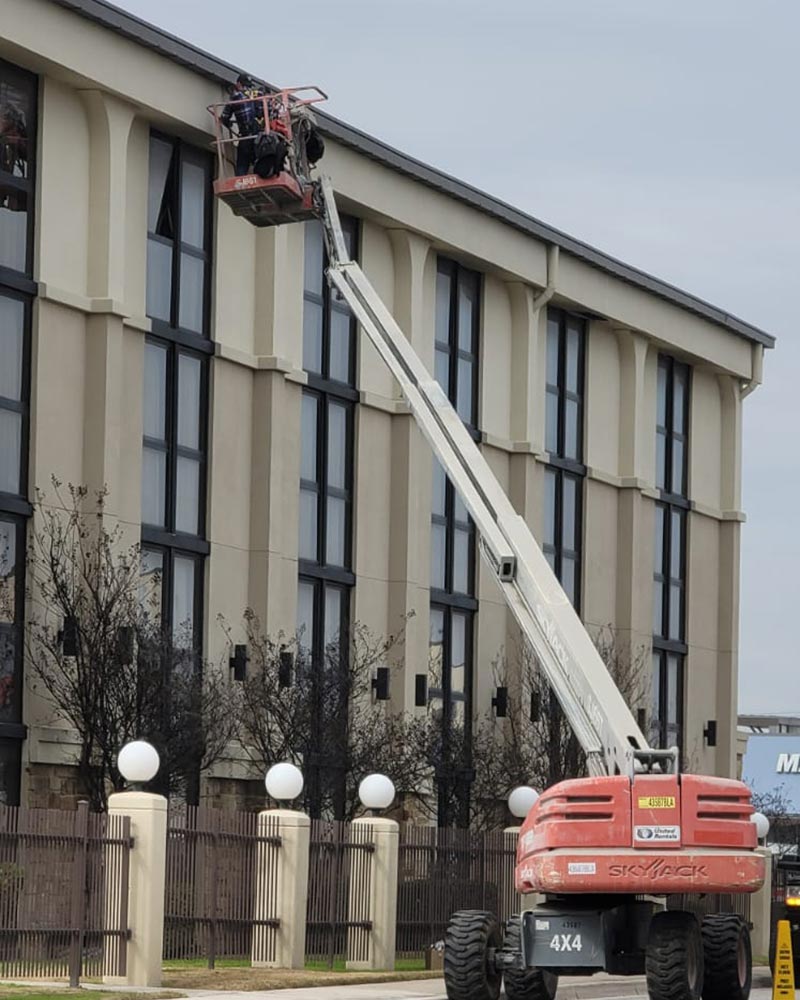
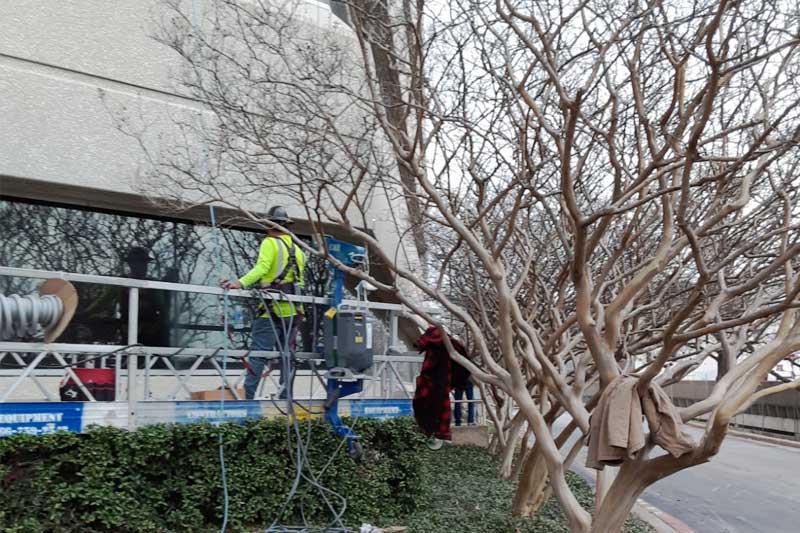
Hail is what decides a Fort Worth facade. A 1995-scale storm takes glass and skylights out outright. A smaller one bruises a coating, chips the arris off a cast stone sill and opens the sealant line behind a cornice while leaving almost nothing to see from the pavement. We rebuild the whole elevation: full caulking and sealant replacement, architectural metal refinishing, glass restoration, terra cotta and cast stone repair, repointing in a mortar softer than the brick it sits between, and elastomeric coatings over the finished face.
View Our Fort Worth Facade Restoration Services →
A Fort Worth garage deck is an exposed slab in a market that has recorded 113 °F, runs about 29 freezes a year, takes hail on the top level with nothing above it, and receives 37 inches of rain largely in violent short bursts. Traffic membranes chalk and wear through, expansion joints harden and split, and once water reaches embedded steel the spalling cycle begins and does not stop on its own. Our crews reverse it with traffic coating systems, concrete repair, horizontal and vertical expansion joint replacement, and above-grade structural waterproofing.
Before tearing off a Fort Worth roof, find out what the hail actually did. Impact bruises a membrane and fractures a brittle coating without opening a hole, so the leak surfaces months later and nobody connects the two events. Where deck and insulation are sound, restoration buys another 10 to 20 years at a fraction of replacement cost: silicone and elastomeric coating systems, rebuilt flashings, re-detailed skylight and penetration curbs, and ponding corrected before it finds a seam. Reflective coatings also pull surface temperature down through a long North Texas cooling season.
Fort Worth’s commercial landmarks are a tight run of early-twentieth-century masonry: the 1895 pink granite of the Tarrant County Courthouse, the white terra cotta of the 1914 Burk Burnett Building, the limestone shaft and terra cotta cornice of the 1925 STS Tower, the cast stone ornament of the 1929 Electric Building, and the Art Deco of the 1930 Sinclair Building and the 1931 Texas & Pacific Terminal. Exterior work on a designated property needs a Certificate of Appropriateness from the Historic and Cultural Landmarks Commission, judged against the Secretary of the Interior’s Standards. We build the scope to that standard and document it the same way.
A leak in a Fort Worth building almost never enters where it appears. Water tracks down a masonry cavity, along a shelf angle or across a suspended ceiling before it marks anything, and hail adds a second delay on top of that: an impact fractures a coating in May and the ceiling tile stains in September. Our diagnostic specialists isolate the real entry point using controlled water testing, infrared thermography, moisture meter surveys, drone imaging and hands-on inspection, then hand over a documented scope rather than a theory.
For more than 25 years Presto Restoration has protected commercial buildings across the United States. That national record is paired with working knowledge of what North Texas does to an envelope: hail striking glass, skylights and coatings; roughly 29 freeze nights a year wedging masonry joints apart; a 121-degree recorded temperature range; and the 2021 International Building Code and 2021 International Existing Building Code as Fort Worth adopted them, local amendments included.
Covering a compact downtown, the Stockyards and a county-wide spread of commercial property properly takes more than one crew type. So that clients get complete building care, from major structural restoration down to routine facility upkeep, Presto coordinates with specialized North Texas support networks.
For everyday upkeep and localized facility services, we invite property managers to explore our sister divisions:
Building Restoration Fort Worth: Focused on localized structural repair and exterior masonry preservation.
Building Maintenance Fort Worth: Dedicated to the preventative maintenance that keeps a Tarrant County property performing between restoration cycles.
Building Services Fort Worth: Your resource for day-to-day commercial building support across the Fort Worth market.
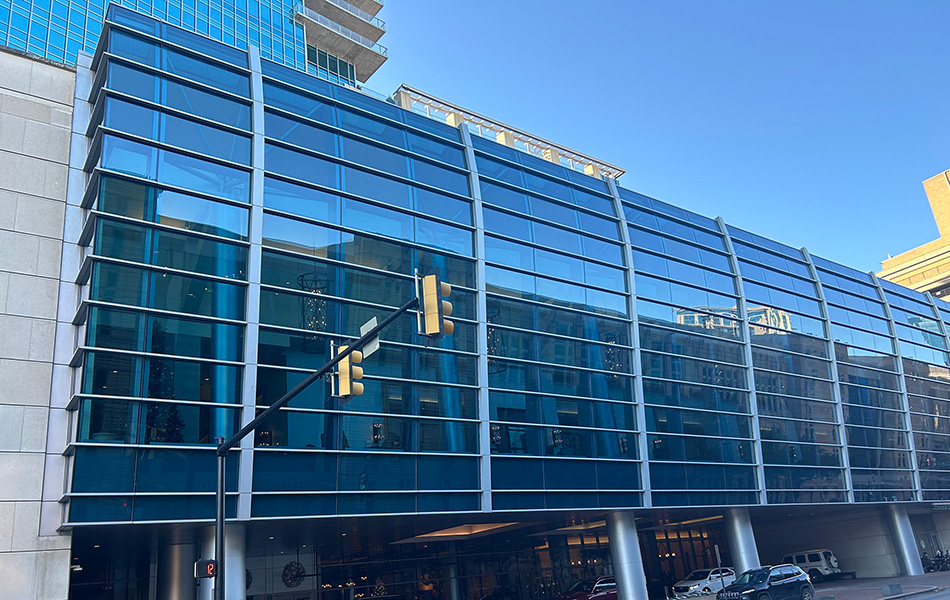
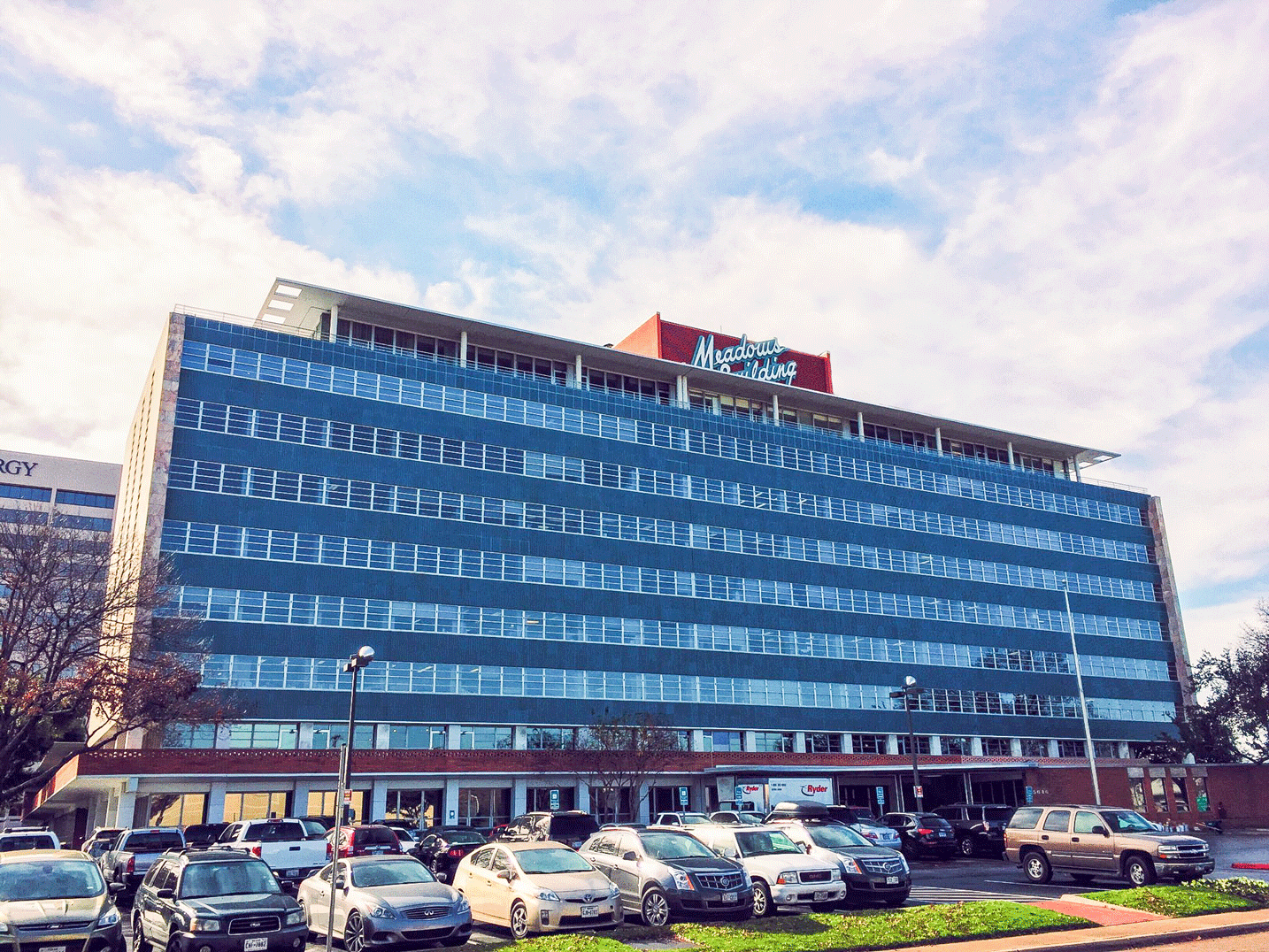
Downtown Fort Worth is a compact, older, lower core, and the work here reflects that. We restore early-twentieth-century masonry office blocks in and around Sundance Square, the terra cotta, limestone and cast stone frontages near the Tarrant County Courthouse, Stockyards brick, Cultural District museum and institutional envelopes, Camp Bowie and West 7th commercial property, Near Southside medical buildings, hotels, parking structures, and the one genuine tower in the skyline at Burnett Plaza. Every exterior surface type is in scope: glass, architectural metal, terra cotta, cast stone, limestone, brick, stucco, EIFS, concrete and roofing.
Hail comes first. On 5 May 1995 the Mayfest supercell put hail up to 4.5 inches across the city, piled 18 inches deep in places, and destroyed windows and skylights throughout downtown, the skylights on Fort Worth City Hall among them. The Insurance Council of Texas assessed $1.1 billion of insured loss against roughly $2 billion of total damage. Beneath that headline sits the annual load: about 29 nights a year at or below freezing, which turns water held in a soft lime joint into a wedge; 37 inches of rain, most of it arriving in short convective bursts; a recorded range from 113 °F down to −8 °F; and high UV through a long cooling season. Fort Worth is inland, with no salt aerosol at all, so the failure modes here are impact, thermal movement and freeze rather than corrosion.
Scope and building size decide it. A focused caulking and sealant replacement on a downtown mid-rise often runs two to four weeks. A full facade restoration on a masonry building carrying terra cotta, cast stone and a projecting cornice usually runs three to six months, because ornament is repaired unit by unit rather than by the elevation. September to November is the best working window in this market: mild, dry, past peak convection and ahead of the freeze cycle. We phase work zones so tenants, lobbies, garages and Stockyards or Sundance Square street frontage stay in use throughout.
Yes. Our team files and manages permits with City of Fort Worth Development Services, which enforces the 2021 International Building Code and the 2021 International Existing Building Code together with the local amendments adopted by ordinance in March 2022. On a designated landmark, exterior work also requires a Certificate of Appropriateness from the Historic and Cultural Landmarks Commission, nine citizens appointed by the Mayor and City Council, reviewed against the Secretary of the Interior’s Standards. Where a General Contractor is running the wider job we permit through them, and owners who prefer to pull their own permits are welcome to do so. Presto carries nationwide general liability and workers’ compensation coverage on every project.
Maintenance is recurring and cosmetic. Washing, pressure cleaning and touch-ups keep a property presentable. Restoration is corrective: it replaces failed sealant, rebuilds waterproofing, repairs spalled concrete, chipped cast stone and corroded metal, and returns the envelope to a condition where it keeps water out. In Fort Worth the distinction is sharpest after a hail season, because an impact-damaged envelope can read as clean from the pavement while the coating and the sealant line have both quietly failed.
Look for sealant that has cracked, shrunk or pulled away from a joint; rust bleed running below metal components; spalled concrete or exposed reinforcement; cast stone with fresh chips or spalls along an arris; terra cotta with crazed or missing glaze; efflorescence blooming across masonry; ceiling stains that appear only after a hard driving rain; and glass or skylights that stay hazy however often they are cleaned. Any of those is active envelope failure rather than a cleaning problem, and after a hail spring it is worth looking specifically at the roof edge, the skylight curbs and the top deck of the garage. Tell us what you are looking at, and our team will point you toward the right fix. Call 1-800-785-9927 or click Request A Quote.
Seeing cracked sealant, a stained ceiling, or hail marks on a Fort Worth building? Describe what is in front of you and our team will tell you what putting it right involves.
Call us today at 1-800-785-9927 or click Request A Quote.