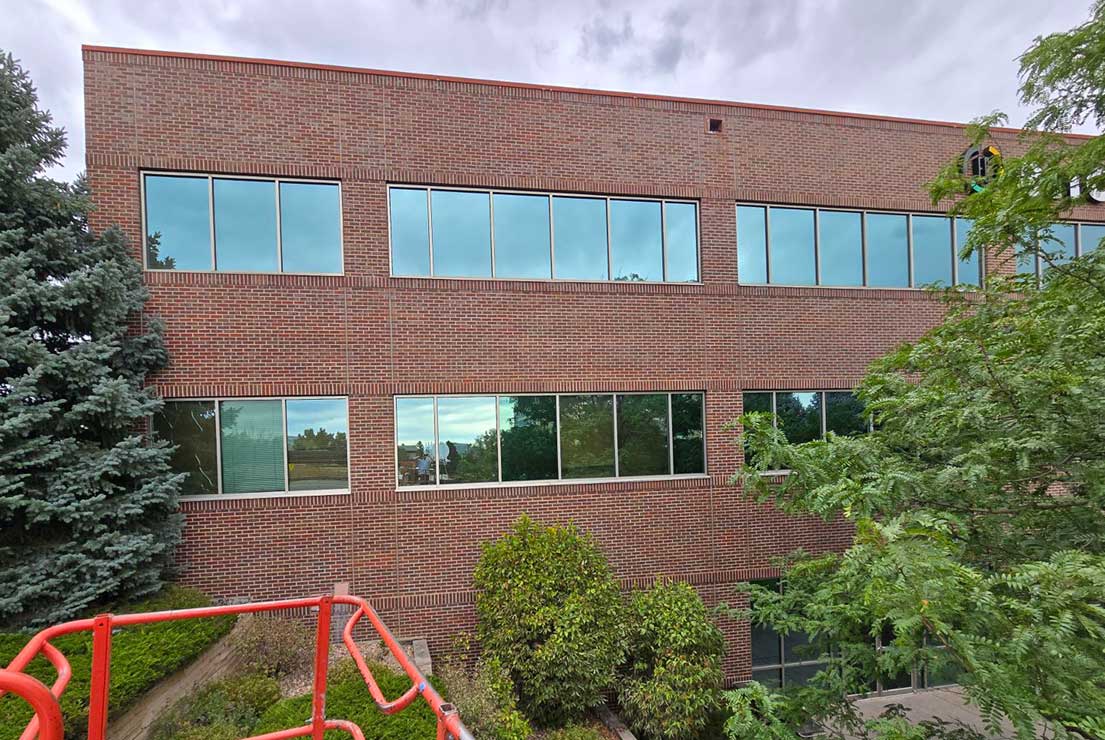
Presto Building Facade Restoration & Waterproofing
Building Facade Waterproofing & Restoration Services 1-800-785-9927

Water rarely enters a commercial building where it eventually shows. Trace a stained ceiling tile on the 12th floor and you may end up at a failed sealant joint six floors higher, at corroded coping, at a hairline crack running through a stucco substrate, or at a curtain wall perimeter that had been passing water for months before anything surfaced indoors.
On top of the ordinary mechanism, Colorado Springs supplies a second one. Summer thunderstorms bring rain hard and briefly, but across winter what gets into a building is meltwater. Snow settles at a parapet or in a roof low spot, thaws through a bright afternoon, tracks under lifted flashing and refreezes there overnight. A path like that opens by degrees and leaks on a delay, which is why a March leak has often been running since December, several floors higher up.
Locating water intrusion in a commercial building draws on a range of diagnostic techniques. The combination used on any given project depends on building type, the symptoms reported and the suspected failure mode, and in this climate on the calendar as well, since certain methods perform far better in the cold than others do.

Nothing confirms where an envelope is failing more reliably than putting water straight onto the suspected failure point and watching for intrusion as it happens. Controlled water testing isolates one element at a time, a sealant joint, a window or door perimeter, a balcony connection, a section of wall, then floods it under controlled conditions so each candidate path is either confirmed or eliminated. Temperature is the constraint. Validity and safety both require conditions above freezing, so on a winter call water testing gets sequenced against the forecast while we lead with the methods that carry no such dependency.
Where surface symptoms are not conclusive, infrared thermal imaging finds the temperature anomalies across a facade that indicate trapped moisture, saturated insulation or early envelope failure invisible to the eye. Wet material holds and sheds heat differently from dry material. This climate is unusually good for the method: a wide difference between inside and outside temperature is what makes a thermal image readable, and Colorado Springs supplies that through most of the heating season, which makes winter the best time of year here to screen a large curtain wall or stucco elevation.


What a moisture meter delivers is a direct number for how much moisture sits inside porous material, whether that is drywall, wood substrate or concrete masonry. Those readings let us map the distance water has traveled from a suspected entry point, and establish whether a candidate source is actively saturating the assembly around it. Readings carry unusual weight in a dry climate, because background moisture sits low. An elevated figure in air this dry points to an active leak far more often than to ambient humidity, which inverts the difficulty a humid market faces.
Across downtown towers and larger institutional buildings, drone inspection brings back close-up high-resolution imagery of upper floors and roof assemblies without incurring the cost and scheduling of rope access or swing-stage rigging. Its value rises sharply after a hailstorm, when the urgent question is how much roof and how many elevations actually took strikes, and whereabouts. The footage then documents conditions, flags visible failure points, and identifies which zones warrant hands-on investigation.


Should thermal imaging, moisture readings and water testing all leave the path uncertain, invasive testing settles it. That means selective demolition of a small area of wall, roof or cladding, opening up what is really going on behind the finish. When we go that route the openings stay targeted, whatever is found gets documented in photographs and notes, and the test area is brought back to a weathertight condition rather than left open across a freeze.
A written report built around that one building closes every diagnostic engagement. Inspection findings are documented, identified failure points pinpointed with photographs behind them, conclusions set out, and a restoration approach recommended. Each is shaped to what the owner or building manager genuinely needs before making a scope decision, since a downtown tower and a single-story institutional building are not the same conversation at all.

Every Presto commercial restoration project in Colorado Springs opens with a diagnostic investigation, completed before the restoration scope is finalized. That sequence is what separates these projects from a repair quoted off visible symptoms.


We record every visible symptom: interior staining, exterior deterioration, occupant complaints, and the building's prior leak history, including when in the year the leaking happens, which is often the most useful single fact on the list.
Which methods follow is decided by the walk-through, whether that means putting a drone up, reading moisture meters, running infrared thermography, controlled water testing, or invasive testing where warranted.
What is found becomes a written report specific to the project, paired with a detailed restoration scope, so there is no ambiguity about the findings or about how the proposed work resolves them.
Execution runs through whichever Presto service line fits, whether facade, waterproofing, parking deck, historic preservation or roof restoration, and it is aimed at the confirmed failure points rather than at the stain.
Post-restoration testing is run wherever it is called for, confirming that the repair genuinely stopped the intrusion, and full project documentation follows at closeout.
Where chronic water intrusion in a commercial building has survived previous repairs, leading with diagnostics finds the genuine source instead of the nearest plausible one. Comprehensive restoration projects carry the diagnostic and consulting work with them (typical project minimum: $50,000+).
Call 1-800-785-9927 or Request A Free Quote.
Dedicated infrastructure is what serving downtown Colorado Springs, Old Colorado City, Manitou Springs and the wider Pikes Peak region actually requires. Presto coordinates with specialized regional divisions in order to give a client complete coverage, major structural restoration through to everyday facility upkeep.
Property managers wanting routine upkeep and localized facility services are encouraged to look into our sister divisions:
Building Restoration Colorado Springs: Localized structural repair and high-rise exterior preservation.
Building Maintenance Colorado Springs: Preventative maintenance, including keeping drains and gutters clear before the first freeze.
Building Services Colorado Springs: Day-to-day commercial building support across the region.
Colorado projects where diagnostic investigation located the real water entry point before any repair was specified.
No. Rather than being sold on its own, our leak detection and building envelope consulting is bundled into comprehensive commercial restoration projects, typically at a $50,000 minimum. The logic is that diagnostic methodology exists in order to inform a restoration scope, and with no restoration attached the findings are simply information nobody is going to act on. An owner after a one-off inspection will do better with a building envelope consultant or a forensic engineering firm.
Five of them. Infrared thermography. Drone inspection. Moisture meter readings. Controlled isolated water testing. And invasive testing, by which we mean selective demolition for investigation. The mix that applies turns on building type, the symptoms observed and the suspected failure mode, and locally on the season too. Thermography performs best in winter, when the temperature difference across a wall is large, whereas water testing wants conditions above freezing. Methods are chosen because they will alter the restoration scope, never for the sake of testing.
Chiefly because water arrives here as meltwater rather than rain, and meltwater moves slowly and on a delay. Something showing on the 14th floor may trace to lifted flashing several floors higher that has been letting a little water through on every thaw since December, or to a parapet detail, or to a curtain wall perimeter years into failing. Omit the diagnostic step and what happens is predictable: a contractor repairs whatever component sits nearest the stain, the building dries out over summer, and the identical stain comes back the next spring.
No. Forensic engineering, expert witness testimony and litigation support are outside what Presto offers. Where a project calls for any of that, our recommendation is to engage a specialty forensic engineering firm. Working alongside such firms on restoration projects touched by litigation or an insurance dispute is something we do, and in this region that usually means a hail claim, but the forensic work itself is not ours.
Each report is constructed around one project and around the particular information its owner needs. Typical contents run to inspection findings with photography behind them, the identified failure points and what is suspected to have caused them, our conclusions, and a recommended restoration scope answering them. Since the report goes on to underpin the restoration specification, it is written to be relied upon rather than filed away.
Building size, the complexity of the intrusion and the methods in play all move it. Investigating one suspected failure point in a targeted way may take one to two days. Covering several suspected areas across the whole envelope, controlled water testing at each of them included, takes one to three weeks. Season plays a part locally as well, since a winter investigation leans on thermography and moisture mapping and may hold water testing back until conditions permit, which adds time at the front of the schedule. Timelines are given during scoping.

Chronic water intrusion in a Colorado Springs building that earlier repairs failed to solve almost never originates where it looks like it does, and in this climate the true origin is generally higher up the building and several months older than the stain. Leading with diagnostics locates the real entry point and produces restoration that ends the leak instead of deferring it.
Please note that diagnostic and consulting work comes bundled with comprehensive commercial restoration projects, on a typical $50,000+ minimum.
Call 1-800-785-9927 or Request A Quote online.