

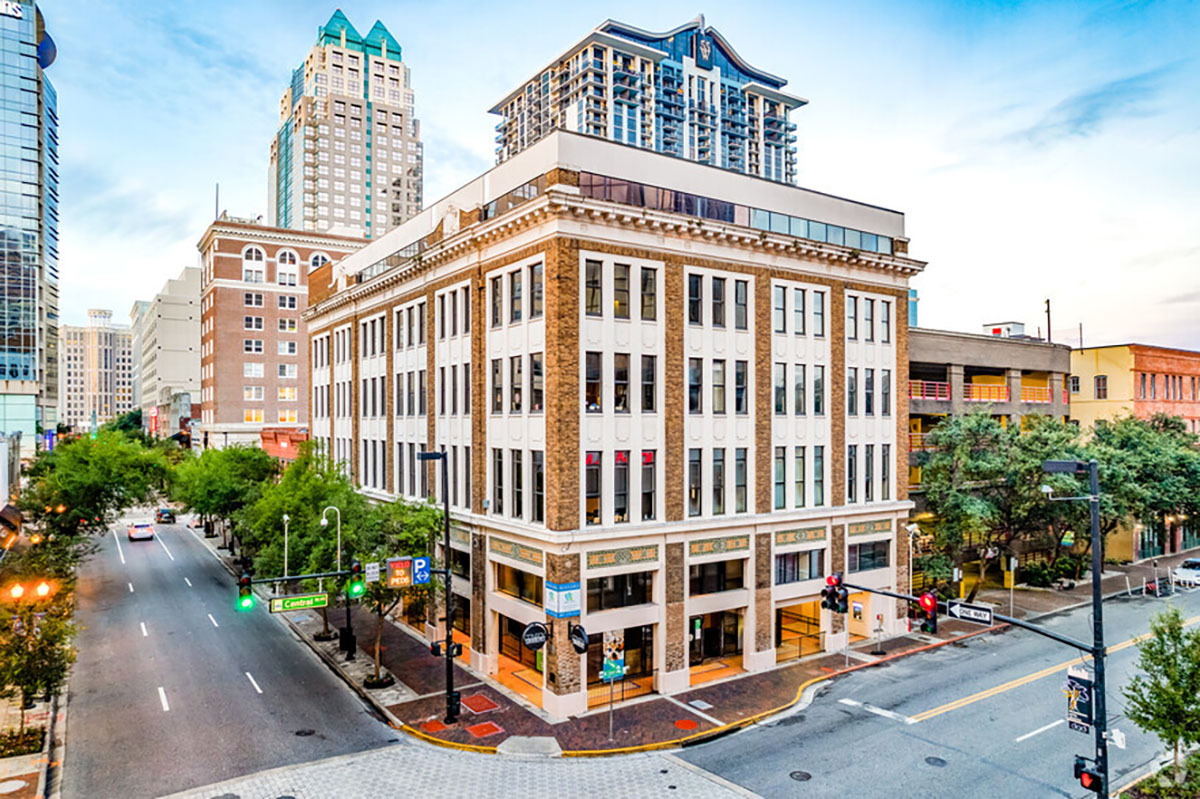






Lakeland holds an architectural inheritance that has no equivalent anywhere else in the country. Florida Southern College’s “Child of the Sun” campus is the largest single-site collection of Frank Lloyd Wright architecture in the world: twelve structures completed between 1938 and 1958 out of tan patterned cast concrete, with the Annie Pfeiffer Chapel at its center, and the whole campus carries National Historic Landmark status. A few blocks away, the Munn Park Historic District preserves dozens of early twentieth-century brick and masonry commercial buildings, listed on the National Register in 1997.
Both are under attack from the same inland Central Florida conditions: relentless ultraviolet exposure, roughly fifty inches of rain a year concentrated in violent summer storms, and humidity that lake-side shade holds against a wall for days. On mid-century cast concrete that means carbonation, rebar corrosion and surface spalling. On early-century brick it means century-old lime mortar quietly washing out of the joints. Neither responds well to modern materials applied without thought, and that is where most of the damage on historic buildings actually comes from.
Presto delivers a full range of historic property preservation services for landmark buildings, locally designated structures, and architecturally significant properties throughout Lakeland and Polk County.
Mortar failure is the single most common problem on historic Lakeland masonry, and it is also the most frequently botched repair. The brick commercial blocks around Munn Park, built largely between the 1900s and the 1930s, used soft lime mortars that could flex with the building, shed minor stress without cracking, and let moisture escape as vapor. Repointing them with modern Portland-cement mixes traps that moisture inside the softer historic brick, accelerating spalling and destroying original material that cannot be replaced. Our masons match new mortar to the original in strength, color, and composition, carefully grinding out failed joints without damaging the surrounding brick.
Cast stone, terra cotta detailing, and the patterned cast concrete that defines Florida Southern’s Wright campus all demand cleaning methods matched to the substrate. Overly aggressive cleaning etches soft cast stone, strips decades-old patina, or bleaches material that was never meant to look brand-new. Wright’s concrete in particular carries cast-in texture and inset detail that a pressure washer will simply erase. We match cleaning method to material and condition, using micro-abrasion, historic-safe chemical cleaners, and controlled water pressure rather than defaulting to one process for every surface. Where material has spalled or cracked, we perform color- and texture-matched repairs engineered to behave like the original.
Steel-casement and original wood windows are a signature detail across Lakeland’s historic stock, from the downtown commercial blocks to the ribbon glazing and inset colored glass of the Wright campus, and they are routinely lost to premature replacement. Swapping historic windows for modern aluminum or vinyl units often ends a building’s certificate of appropriateness eligibility, and the replacement rarely outperforms a properly restored original. Our window restoration work keeps the original glass, frames, and hardware in place while fixing what is actually failing: hardened glazing compound, corroded steel muntins, seized hardware, and gapped perimeter sealants that let water in during a summer downpour.
Traditional lime stucco behaves nothing like the acrylic and EIFS products used today. Historic stucco was troweled on in several coats over wood or metal lath, with each layer designed to let moisture pass through rather than trap it. Patching it with modern cement or acrylic-based products seals moisture inside the wall assembly, which accelerates deterioration in the surrounding original stucco, and in Lakeland’s humidity that trapped moisture has nowhere to go for most of the year. We rebuild historic stucco with lime-based formulations, repair lath where it has failed, and finish to match the original texture and profile.
Bronze storefronts, cast-iron detailing, wrought-iron gates, and ornamental metalwork appear throughout Lakeland’s historic inventory, particularly on the downtown commercial blocks. Sustained humidity and heavy seasonal rainfall drive corrosion on all of these metals, even without coastal salt. That said, the developed patina on bronze and copper is part of what makes them historically valuable. We remove active, structurally damaging corrosion while preserving authentic patina wherever it is not compromising the metal’s integrity, then refinish using methods that respect the original character.
Waterproofing a historic Lakeland building takes a different playbook than waterproofing a modern tilt-wall or curtain-wall structure. Older masonry, lime mortar, and stucco assemblies were built to breathe: moisture that gets in during an afternoon storm is meant to evaporate back out through the wall, not get trapped behind a sealed membrane. Applying modern, fully impermeable waterproofing systems to that kind of assembly causes serious hidden damage as trapped moisture works against the original material from the inside, and in this humidity it rarely gets a chance to dry. Our approach to historic facade waterproofing uses vapor-permeable water repellents that shed bulk water while letting the wall release moisture as vapor.
Working on a historic Lakeland property calls for a slower, more deliberate process than a standard commercial restoration job. Every Presto historic preservation project runs through a five-phase process built to catch every issue up front, spec out period-correct materials, and carry out the work without harming original fabric that can never be replaced.
We document every area of deterioration on your historic property and separate original fabric (irreplaceable) from later, non-original additions (modifiable). We don't touch anything until we understand the building's history.
We pin down the original materials in detail: specific lime mortar mixes, oolitic limestone or keystone type, original stucco composition, window glazing, and metal alloys. Lab analysis is recommended anywhere the material is uncertain.
We translate findings into a detailed scope with quantified line items and period-appropriate product specs. We coordinate directly with property owners, preservation consultants, architects, and local review boards as needed.
Trained crews carry out the work using period-appropriate materials and traditional techniques where called for. Quality control is strict, since historic projects leave no room for rework on substrate that can't be replaced.
We deliver complete project documentation: before-and-after photography, material data sheets, warranty details, and maintenance guidance. For designated properties, this record can support future preservation board reviews.
Whether your Lakeland historic property already shows visible wear or you are getting ahead of it with proactive maintenance, tell us what you are seeing and our specialists will point you toward recommendations grounded in preservation-grade practice.
Call 1-800-785-9927 or click Request A Quote.
Covering Lakeland’s historic districts and the wider Polk County market at a consistently high level takes dedicated regional infrastructure, not just visiting crews. Presto coordinates a network of specialized regional divisions so clients get seamless coverage, from major historic envelope restoration down to routine facility upkeep.
For day-to-day and preventative facility needs, we encourage property managers to reach out to our sister divisions directly:
Building Restoration Lakeland Winter Haven: Focused on localized structural repairs and commercial exterior preservation.
Building Maintenance Lakeland Winter Haven: Dedicated to the ongoing, preventative maintenance required to keep your Polk County property operating flawlessly.
Building Services Lakeland Winter Haven: Your resource for comprehensive, day-to-day commercial building support in the Lakeland market.
Explore recent historic preservation and landmark restoration projects Presto has completed across Florida.
Ordinary restoration aims to get a building watertight and functional again using whatever modern materials do the job best. Historic preservation adds a second, harder goal on top of that: keeping the building’s original character, materials, and craftsmanship intact while restoring performance. In practice that means lime mortar instead of Portland cement, calibrated cleaning instead of aggressive blasting, and reversible in-kind repair instead of wholesale replacement. It is slower and it demands different skills, and on a designated property it is the only approach that will survive review.
Pre-war masonry buildings, including most of the brick around Lakeland’s Munn Park Historic District, were built with soft lime-based mortar that is intentionally weaker than the surrounding brick. That is by design: when the building shifts with heat, humidity, or minor settling, the mortar absorbs the movement instead of the masonry cracking. Lime mortar also lets moisture vapor pass through the wall rather than trapping it, which matters enormously in a climate this humid. Repoint that same wall with a hard modern Portland-cement mix and the moisture gets trapped inside the softer original brick, leading to spalling that cannot be undone.
Yes, and a properly restored historic building often performs better than people expect. Original steel-casement or wood windows, once restored with fresh glazing compound and perimeter sealant, hold up comparably to new replacements. Thick masonry and stucco walls provide real thermal mass that evens out interior temperature swings, which is a genuine advantage through a Central Florida summer. Breathable, vapor-permeable waterproofing frequently outlasts modern impermeable coatings on these assemblies, and reflective roof coatings can cut cooling load without touching a single visible historic surface.
Historic work moves at a slower pace than standard restoration because the materials, hand techniques, and quality-control standards are more exacting. A facade restoration on a smaller historic commercial building in downtown Lakeland might run 2 to 4 months. A full preservation scope on a larger landmark property can stretch to 6 to 12 months or more. Timelines also depend heavily on any review required by the Lakeland Historic Preservation Board before work can start, which can add weeks or months on top of the construction schedule itself. We lay out realistic timelines up front during scoping.
Yes. We have worked across a range of designation levels, from locally designated historic sites to properties individually listed on the National Register and buildings within National Historic Landmark districts. Requirements differ depending on the designation, whether a certificate of appropriateness or similar local board review is required, and what portions of the scope actually trigger that review. In Lakeland that usually means the Lakeland Historic Preservation Board. We walk through your property’s designation status during the initial scoping conversation so nothing surprises anyone later.
Yes, and in Lakeland that matters more than in most markets. Florida Southern College’s “Child of the Sun” campus is the largest single-site collection of Frank Lloyd Wright architecture in the world, twelve structures built between 1938 and 1958, and mid-century cast concrete of that kind has its own failure profile: carbonation of the concrete, corrosion of shallow-cover reinforcing steel, and spalling that takes cast-in texture with it when it goes. Treating that substrate like ordinary concrete, or cleaning it like ordinary masonry, destroys detail that cannot be reproduced. Modernist and mid-century buildings need preservation-grade judgment exactly as much as Victorian brick does.
Our historic preservation scopes typically track the National Park Service’s Preservation Briefs, the most widely used technical reference for historic restoration work in the country. The Briefs cover topics directly relevant to Lakeland’s building stock: masonry cleaning, mortar formulation, historic window restoration, stucco repair, and the treatment of historic concrete. Depending on a property’s designation and architectural style, we may layer in additional standards as needed. Owners working with a preservation architect are welcome to review our proposed scope against the relevant Briefs before work begins.
Historic buildings cannot be recreated once they are gone, and modern materials and shortcuts cannot properly restore them. Tell us what your Lakeland building needs and we will help you hold onto its character, performance, and value for the next generation.
Call 1-800-785-9927 or Request A Historic Property Assessment online.