


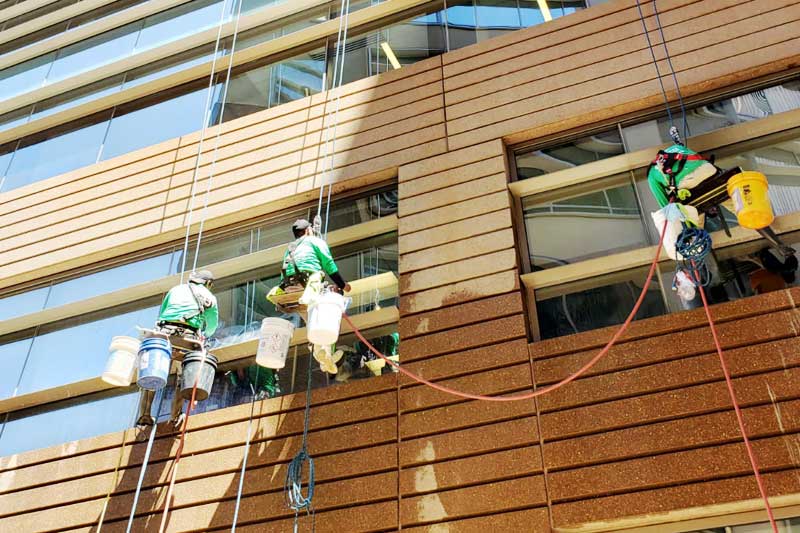
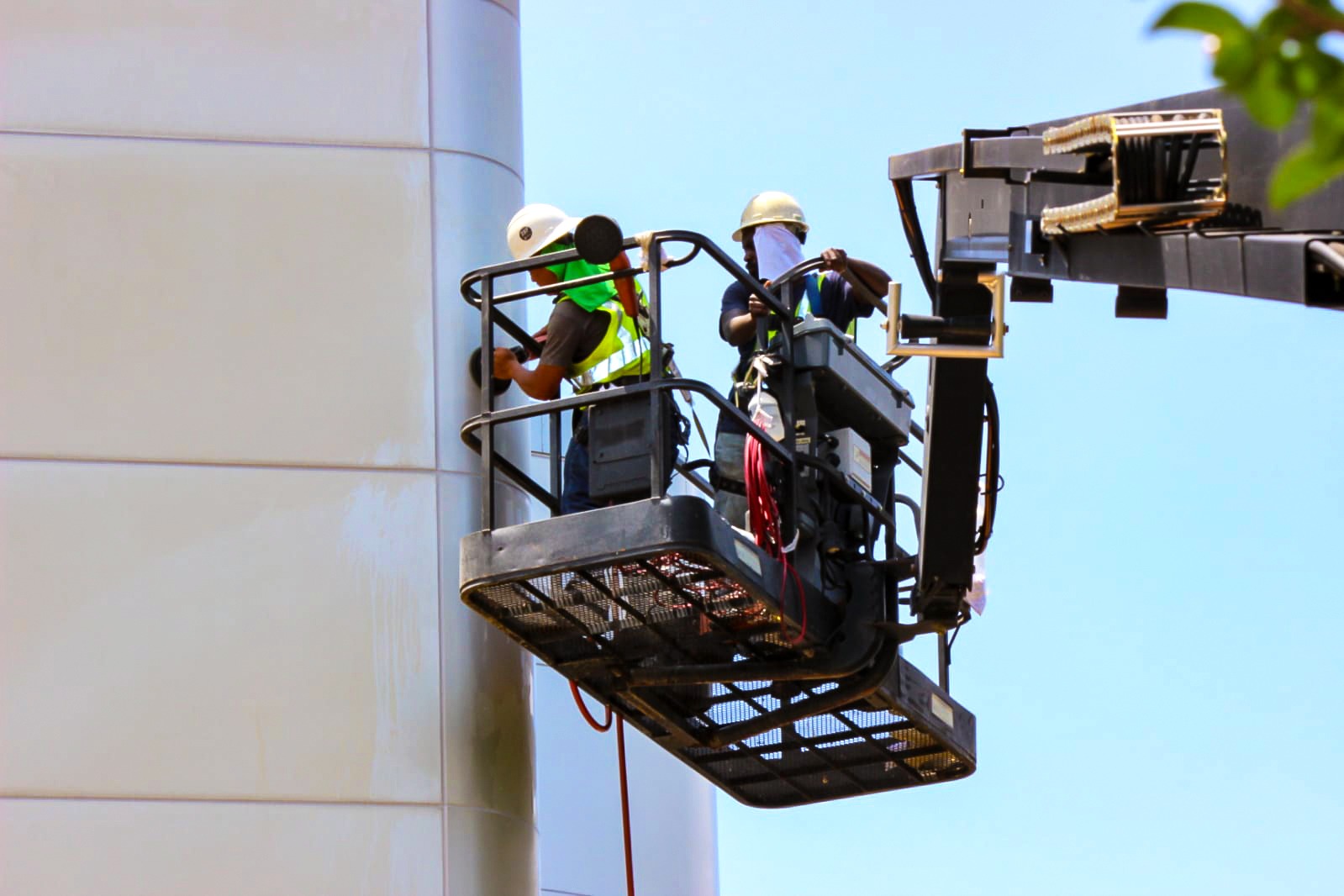





Greenville’s historic commercial fabric is a textile story told in brick. Downtown holds buildings running from the 1850s through the 1920s, among them Grady and Goodlett, dated 1856, together with a run of early-century banking and hotel fronts. The West End Commercial Historic District spans roughly 1869 to 1939 and still contains former cotton warehouses. Out in the mill villages stand the great early-1900s plants, Judson, Brandon, Monaghan, Poe, Woodside and American Spinning, several now converted, with Judson alone the subject of a renovation of more than 75 million dollars. These are heavy load-bearing structures, multiple wythes thick, daylit through window openings far larger than a modern facade would carry, and built with soft lime mortars, soft brick and cast stone that were never intended to be sealed shut or pointed hard. Working on them in a climate that keeps a wall damp the year round and carries it across freezing on roughly 57.6 nights means modern commercial methods do not merely underperform, they accelerate the damage.
Presto Restoration has worked directly on landmark and designated buildings in markets across the country. Every one of those jobs starts from the materials rather than from the schedule. Our scopes generally track the National Park Service’s Preservation Briefs, the field’s most widely respected technical reference, tailored to the specific material palette in front of us and to local review requirements. In practice that means lime-based mortars mixed to match historic strength and color, cleaning gentle enough for soft mill brick and aged cast stone, breathable water repellents rather than film-forming sealers, and in-kind repair rather than wholesale replacement. Inside the city’s preservation overlay districts, work that changes a building’s appearance is reviewed by the City of Greenville Historic Review Board through a Certificate of Appropriateness, and in the unincorporated county by the Greenville County Historic Preservation Commission. Whether your property is locally designated, sits inside the West End district or is individually listed on the National Register, we deliver work that satisfies the higher bar historic buildings require.
Presto delivers a full range of historic property preservation services for landmark buildings, locally designated structures and architecturally significant properties across Greenville, from Main Street and the West End out to the mill villages.
Mortar failure is the single most common problem on historic Greenville masonry, and it is also the most frequently botched repair. The mills and downtown blocks built between the 1850s and the 1930s used soft lime mortars that could flex with the building, shed minor stress without cracking, and let moisture escape as vapor. That last property is doing real work in a market where the wall is wet in every month of the year. Repoint the same wall with a modern Portland-cement mix and the moisture is trapped inside softer historic brick, where roughly 57.6 freezing nights a year expand it against the brick face instead of against the joint, and the spalling that follows destroys original material that cannot be replaced. Our masons match new mortar to the original in strength, color and composition, carefully grind out failed joints to the depth a multi-wythe wall actually requires without chewing into the surrounding masonry, and tool the new joints to the original profile. It is the slower, correct way to repoint a historic building, not the shortcut that ruins one.
Stone on Greenville’s historic buildings is mostly accent rather than field: cast stone surrounds and cornices, granite bases and steps, and terra cotta detail on Main Street commercial fronts such as the Bank of Commerce and the Westin Poinsett. Restoring it wrong can be permanent. Overly aggressive cleaning etches soft cast stone, strips decades-old patina, or bleaches material that was never meant to look brand new, and on a wall that stays damp most of the year an over-cleaned surface takes on water faster afterward. We match cleaning method to stone type and condition, using micro-abrasion, historic-safe chemical cleaners and controlled water pressure rather than defaulting to one process for every substrate. Where stone has spalled or cracked, the repair is matched for color and texture and formulated to move the way the original around it moves. The objective is always a surface that reads as authentically preserved, never over-polished.
Steel-sash windows are a signature detail of Greenville’s mill buildings, and they are routinely lost to premature replacement. Mill daylighting means the openings are large, often very large, so a wholesale swap is expensive as well as damaging, and it rarely outperforms a properly restored original. It can also put a property’s Certificate of Appropriateness at risk inside a preservation overlay district. Our window restoration work keeps the original glass, frames and hardware in place while fixing what is actually failing: hardened glazing compound, corroded steel muntins, seized hardware and gapped perimeter sealants that let water in during a long soaking rain. Kept up properly, a restored original will usually still be working long after a modern replacement unit has reached the end of its rating.
Stucco is less dominant in Greenville than brick, but it appears on downtown infill, on parged mill outbuildings and on early-century commercial fronts, and where it exists it behaves nothing like the acrylic and EIFS products used today. Historic stucco went on in several troweled coats over wood or metal lath, and every layer was meant to pass moisture through rather than hold it. Patching it with modern cement or acrylic-based products seals moisture inside the wall assembly, and in a market with rain in every month and roughly 57.6 freezing nights that trapped water has nowhere to go but into the surrounding original material. We rebuild it in lime-based formulations, repair the lath where it has gone, and finish to the original texture so the hand-applied character survives. Getting it right protects both performance and the appearance that gives these buildings their value.
Bronze and cast-iron storefronts, ornamental ironwork and pressed-metal cornices show up throughout Greenville’s historic inventory, from Main Street shopfronts to the utilitarian metalwork on mill buildings. What drives corrosion here is persistent moisture rather than airborne salt: a detail that stays damp through a wet winter and freezes repeatedly will rust from behind long before the visible face tells you. At the same time, the patina bronze and copper have developed is a large part of their historic value. We remove active, structurally damaging corrosion while preserving authentic patina wherever it is not compromising the metal’s integrity, then refinish using methods that respect the original character. Taking historic metalwork back to bare substrate is the last option on the list, never the first.
Waterproofing a historic Greenville building takes a different playbook than waterproofing a new curtain-wall structure. Mass masonry, lime mortar and stucco assemblies were built to breathe: the wall itself is the weather barrier, and moisture that enters during a long soaking rain is meant to evaporate back out rather than sit behind a sealed membrane. That distinction matters more here than in a drier market, because the wall is being reloaded every month and taken across freezing dozens of nights each winter, so trapped water has repeated opportunities to expand inside original material. Applying a modern, fully impermeable system to that kind of assembly causes serious hidden damage. Our approach uses vapor-permeable water repellents and joint sealants compatible with lime-based construction, reserving fully impermeable systems for the specific locations the original design called for them.
Working on a historic Greenville property calls for a slower, more deliberate process than a standard commercial restoration job. Every historic project here runs through five phases, so the problems are on the table early, the materials specified are period-correct, and the work proceeds without spending building fabric that cannot be put back.
Every area of deterioration is recorded, and original fabric, which cannot be replaced, is separated from later additions, which can be altered. Nothing is touched until the building's history is understood.
The original materials are identified precisely: the specific lime mortar mix, the brick and its bedding, cast stone or granite type, original stucco composition, window glazing, and metal alloys. Where a material cannot be identified with confidence, we recommend lab analysis.
Those findings become a scope priced line by line, with quantities and period-correct product specifications attached. We coordinate directly with property owners, preservation consultants, architects, and the City of Greenville Historic Review Board or the county commission as needed.
Trained crews execute with period-appropriate materials and traditional technique wherever the building calls for it. Quality control is tight, because there is no second attempt available on substrate that cannot be replaced.
Project documentation is delivered in full: the photographic record, material data, warranty terms and the maintenance guidance that goes with them. On a designated property that record becomes useful evidence the next time a preservation board reviews the building.
Whether your Greenville historic property already shows visible wear or you are getting ahead of it, tell us what you are seeing and our specialists will respond with recommendations grounded in preservation-grade practice rather than in whatever is fastest.
Call 1-800-785-9927 or bring it to us through Request A Quote.
Covering Greenville’s historic districts well means working on tight West End and Main Street frontages with little staging room, and on mill campuses where a single elevation can run the length of a city block. Presto runs a network of specialized regional divisions, so the coverage is continuous: preservation-grade envelope work at one end, routine facility upkeep at the other.
Day-to-day and preventative facility needs go directly to the sister divisions:
Building Restoration Greenville: Structural repair and exterior preservation on individual buildings.
Building Maintenance Greenville: The recurring preventative work that keeps a property performing between restoration cycles.
Building Services Greenville: Day-to-day commercial building support across the Upstate market.
Recent historic preservation and landmark restoration work Presto has carried out for South Carolina owners.
Standard restoration has one objective: get the building watertight and working again, using whatever modern material does that best. Preservation carries a second objective that constrains the first, which is keeping the original character, materials and craftsmanship intact while the performance is restored. On a Greenville mill or a Main Street block that shows up as specific choices: lime mortar rather than Portland cement, breathable repellents rather than film-forming sealers, calibrated cleaning rather than aggressive blasting, and repairs a future generation can reverse rather than inherit. It is slower and it costs more. It is also the only route that protects the designation and the qualities the designation exists for at the same time.
Because the mortar is meant to be the weak part. Greenville’s pre-war masonry, from the 1850s to 1930s downtown blocks out to the textile mills, was laid in soft lime-based mortar deliberately weaker than the brick around it, so movement from heat, humidity or settling is absorbed by the joint instead of cracking the masonry. Lime also lets vapor leave through the wall, which matters more here than almost anywhere, because the wall is wet in every month of the year and has to be able to dry. Repoint that wall in a hard Portland-cement mix and the relationship is reversed: the joint is now stronger than the brick, moisture is trapped in the softer original material, and roughly 57.6 freezing nights a year expand it until the brick face comes away. A spalled face cannot be put back. Getting the mix right is not a detail of the job, it is the job.
Yes, and a well-restored historic building usually surprises people on this. Original steel-sash windows, restored with new glazing compound and a sound perimeter seal, perform comparably to replacements, and on a mill building that matters commercially as much as historically. Mills were designed around daylight, which is why the openings are so large, and that scale turns window replacement into a capital project rather than an upgrade. The thick multi-wythe walls that define Greenville’s mill and downtown stock carry genuine thermal mass, which flattens interior swings through a humid summer and through a winter that crosses freezing dozens of times. Vapor-permeable waterproofing routinely outlives modern impermeable coatings here for the same reason lime mortar outlives cement: it lets the wall dry. Our scope is the envelope. Interior HVAC and insulation upgrades are work for a contractor who specializes in historic-rated mechanical systems.
Longer than standard restoration, because the materials are slower, the techniques are done by hand and the tolerance for error is lower. Downtown, on a smaller historic commercial building, 2 to 4 months is typical. A full preservation scope on a mill building can run 6 to 12 months or beyond, and deep repointing through multi-wythe walls is usually what sets that. Two things stretch it past the construction itself. Certificate of Appropriateness review by the City of Greenville Historic Review Board, where the property sits inside an overlay district, adds weeks before anything starts. Weather adds more than owners expect, because lime mortar and breathable repellents both carry cure requirements that a wet stretch or a hard freeze will simply push. We put realistic dates on all of it during scoping rather than optimistic ones.
Yes, at every level from locally designated sites through properties individually listed on the National Register. In Greenville the first practical question is which body reviews the work. A property inside a city preservation overlay district answers to the City of Greenville Historic Review Board. One in the unincorporated county falls to the Greenville County Historic Preservation Commission. Most of the commercial fabric in question sits in the West End Commercial Historic District, among former cotton warehouses now in commercial use. From there it turns on the designation itself, on whether a Certificate of Appropriateness is needed, and on which parts of the proposed scope actually trigger review, which is often fewer of them than owners expect. We work that out at the outset and map the coordination the job will need.
Usually the owner leads it, working with a preservation architect or consultant who knows the reviewing body, whether that is the City of Greenville Historic Review Board or the Greenville County Historic Preservation Commission. Our part is the technical substance behind the submission: an accurate scope, period-appropriate material specifications, mortar analysis where the board wants it, and product data that survives scrutiny. We stay close to the owner’s preservation team from start to finish so the work as built matches the work as approved, and every job is run to the local and state requirements that apply to it.
Yes. Our preservation scopes are written against the National Park Service Preservation Briefs, which remain the standard technical reference for this work in the United States. The Briefs that come up most on Greenville’s stock are the ones covering repointing historic masonry, mortar formulation, masonry cleaning, historic window restoration and stucco repair, which between them account for most of what a mill or a downtown block actually needs. Designation and construction type can bring further standards into a scope, and we add them where they apply. If you have a preservation architect on the project, we are glad to have our proposed scope read against the relevant Briefs before a crew arrives.
Historic buildings cannot be recreated once they are gone, and modern materials and shortcuts cannot properly restore them. Tell us what your Greenville property is doing, whether that is eroding mortar joints, spalling brick, failing steel sash or staining you cannot explain, and we will tell you what it needs to hold onto its character, performance and value for the next generation.
Call 1-800-785-9927 or Request A Quote online.