







Waterproofing in Greenville is a problem of persistence rather than violence. The city sits at 955 feet, roughly twenty miles out from the Blue Ridge Escarpment, and the GSP gauge records 47.19 inches annually with no dry season to speak of, so an envelope is seldom given the spell it needs to release what it has absorbed. Then cold-air damming does something a Piedmont market further from the mountains feels less often: subfreezing air trapped against the eastern slopes turns rain into glaze ice on parapets, copings, canopies and low-slope drainage, and the thaw water that follows goes wherever the sealant has already given up. The freeze season runs to about 57.6 nights, nearly all of them shallow crossings, which keeps water inside a joint or a brick expanding and relaxing instead of locking solid. Failed waterproofing here does not announce itself in one storm. It shows up as a stain that comes back every February.
Presto Restoration delivers above-grade commercial waterproofing for commercial properties across Greenville, from the Main Street core and the West End out to Pelham Road, the Woodruff Road corridor and Greer. What sets the work apart is that restoration comes before sealing. Rather than running fresh sealant over a deteriorated substrate, we bring the surface back first, which is why the finished system holds instead of failing at the same joint two winters later. Capabilities include breathable masonry water repellents, which matter more on thick load-bearing mill brick than on any veneer wall, silicone and elastomeric coating systems, and expansion joint and crack sealing. Wet glazing and glass sealing sit in the same scope, backed by our own products such as Glass Defender. Precast panels get their own treatment, Leach Stop Protection, described below. We work exclusively above grade, not on foundations or below-grade waterproofing, because deep specialization produces stronger outcomes than generalist promises.
From joint sealants to full coating systems, Presto’s above-grade waterproofing services for Greenville buildings fall into two groups: core systems that keep the envelope watertight, and specialized restoration-waterproofing services that pair deep cleaning and restoration with lasting protection.
Concrete and steel-framed buildings are designed to move with wind load and daily heat cycling, and that movement concentrates at expansion joints, control joints and cracks in the facade. In the Upstate the joint gets a second workout every winter: a shallow freeze-thaw season with roughly 57.6 crossings puts far more small movements through a sealant than a single hard freeze would. When the sealant at a movement joint fails, it becomes the fastest path for wind-driven rain, and for glaze-event meltwater, to reach the interior. We cut out and reseal those joints with high-movement silicone and polyurethane systems that stretch and compress with the structure instead of tearing away from it. On most Greenville buildings, proper joint sealing is the single highest-value waterproofing repair available.
Glass on Greenville buildings takes a steady chemical beating from above rather than from the air. Mineral-rich runoff off brick, cast stone and precast lands on the glazing below, irrigation overspray adds to it, and the spring pollen film that comes with an AAFA top-ten allergy market bonds into anything already sitting on the surface. Left alone, that combination etches and hazes permanently. Our own Glass Defender treatment lays a hydrophobic barrier onto the glass, so minerals have nothing to grip, water runs off rather than drying on the surface, and cleaning becomes easier and less frequent. Treated windows hold their optical clarity through year after year of chronic wetting.
Ledges, parapets, copings, canopies and other horizontal details are where Greenville’s problems concentrate, and for a specific reason: they are the surfaces a cold-air-damming glaze event loads with ice, and the surfaces that then hold the meltwater while the temperature crosses back over freezing. For these conditions we install high-performance silicone coating systems: seamless monolithic membranes bonded straight to the substrate, with none of the laps and terminations that ordinary products fail at. Silicone thrives exactly where other coatings die, shrugging off standing water, UV and sharp thermal swings, which makes it our default answer for the flat and near-flat surfaces on Greenville commercial buildings.
The joint where a glass unit meets its frame carries more water than almost anything else on a commercial elevation, and it is usually the first thing to give out. Once that perimeter seal hardens, splits or releases, rain pours into the wall cavity and can travel well away from the breach before it shows up indoors. Greenville adds a wrinkle worth naming: mill conversions carry window openings sized for daylighting rather than for modern glazing, so the retrofitted units in them often run wider than standard and put more linear feet of perimeter seal on a single opening than a comparable new building would. Wet glazing deals with it at the joint itself. We remove the spent sealant and install new high-performance silicone that re-establishes a watertight bond between the glass unit and the frame, reglazing storefront, curtain wall, ribbon window and punched window systems alike with documented, warrantied work.
Stucco, EIFS and concrete walls inevitably develop hairline cracks, and in Greenville every one of them is a water entry point that gets tested every month of the year rather than every storm season. An elastomeric coating answers that by never going brittle. Its film build runs on the order of ten times what ordinary paint gives, so it bridges small cracks rather than splitting along them. That elasticity earns its keep here because the substrate is cycling constantly, through daily heating and cooling in summer and across freezing on roughly 57.6 nights in winter. Our systems are breathable, letting interior moisture vapor escape rather than trapping it in a wall that is already carrying water, and they are available in a complete palette of factory colors and texture profiles.
Porous masonry drinks in water, and in Greenville it does so from a wall several wythes thick rather than a single veneer. The converted textile mills and the older Main Street and West End blocks were built as mass masonry: the wall itself is the weather barrier, with no drainage cavity behind it to catch what gets through. Load that wall in every month of the year and then take it across freezing on roughly 57.6 nights, and you get eroded joints, efflorescence streaks, spalled brick faces and damp interior walls. The treatment is a clear, breathable penetrating repellent on silane and siloxane chemistry, absorbed into the substrate so the masonry turns hydrophobic with no change to how it looks. Breathability is not optional on a wall like this: a film-forming sealer would trap the moisture already inside and push the damage into the brick. Afterward the brick looks no different, but rain now beads on the face and sheds rather than being drawn in.
The distinction is simple: surfaces are cleaned and restored before anything is sealed. That order of operations is why the finished work looks right, performs to specification and stays serviceable well past the usual. It also lets us take on failures that a straight waterproofing contractor has no way to correct.
Precast panels carry water-soluble minerals, and any moisture moving through a panel brings them to the face, where the runoff dries onto whatever sits below it as hard, permanent-looking streaks across glass, metal trim and adjacent facade elements. Cleaning alone buys a few weeks, because nothing has been done about the panel that keeps producing the minerals. Our Leach Stop Protection treats the panel itself, so the migration stops. Existing staining comes off and the precast is sealed against further migration, which is what actually ends a recurring window-staining problem rather than deferring it another season.
Architectural metal panels, curtain wall framing, mullions and Alucobond composite panels take a continual beating from UV, thermal cycling and the airborne grime that a facade this wet holds against the finish instead of letting rinse away. Instead of pushing for costly panel replacement, we apply protective clear coating systems that seal the metal and preserve the original factory finish. The clear coats bond directly to the existing surface and block moisture from reaching the substrate underneath, which meaningfully extends the service life of the original material. This approach frequently eliminates the need for expensive replacement projects and significantly cuts long-term maintenance cost.
Every waterproofing project here runs through the same five phases, so the diagnosis is settled before anything is specified and the building actually stays dry afterward.
Every above-grade waterproofing system on the building is walked, from sealed joints and coatings through exposed decks and masonry walls, and each failure point is photographed and written up.
Water intrusion on an Upstate building often traces back to a source well away from the stain, especially through mass masonry. Controlled water testing, moisture readings and visual tracing sort the actual cause from the symptom.
Products are matched to the substrates actually in front of us, silicones, elastomeric systems and traffic membranes, quantified line by line, while the project manager carries permitting and tenant coordination.
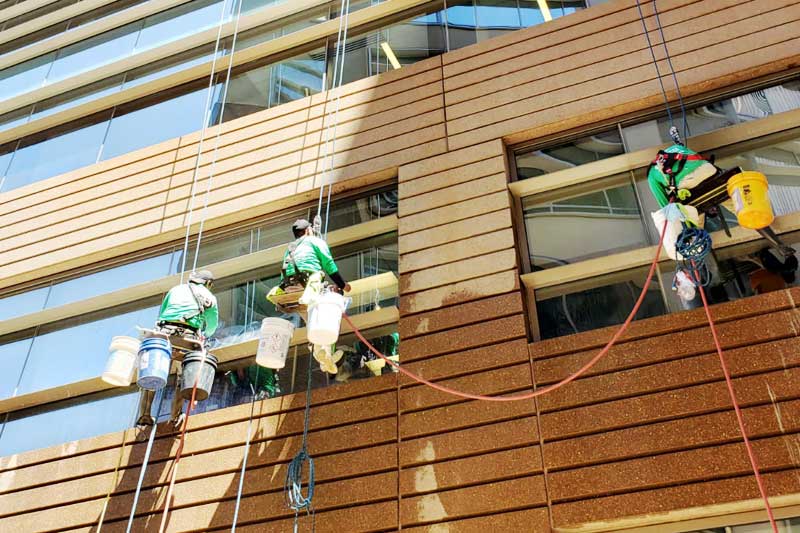
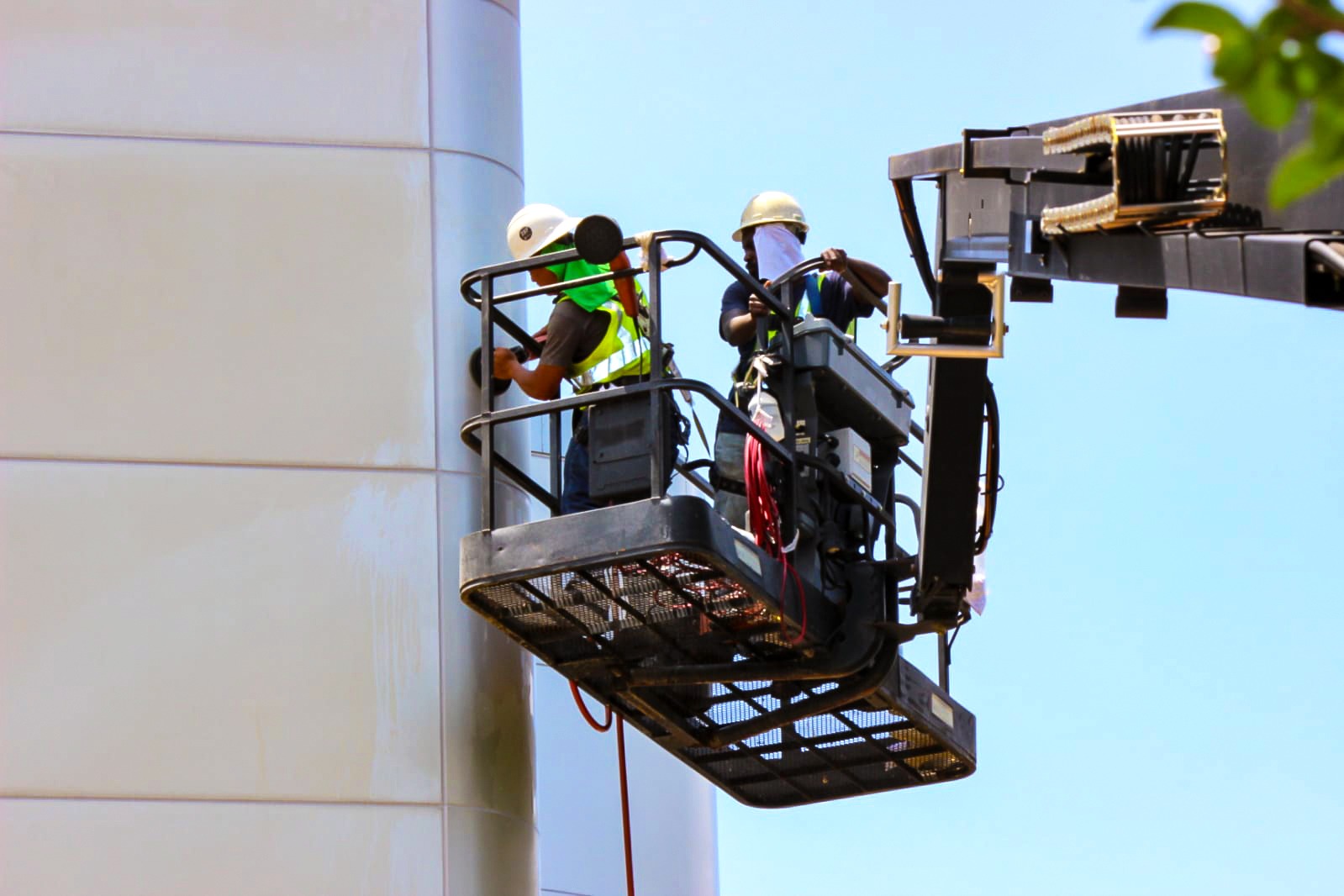
Crews work from rope access, swing stage or lifts, whichever the building and the site allow. Installation follows manufacturer specification throughout, under quality control, and it is documented as it goes.
Closeout hands over the whole file: the warranty paperwork, manufacturer data sheets, photography taken before and after, and the maintenance intervals that keep the new systems at their rated life.
Seeing water intrusion, failing sealants or coating breakdown on your Greenville building? Describe what is happening and where, and our specialists will tell you which system is failing and what the most cost-effective path forward looks like.
Call 1-800-785-9927 or send the details through Request A Quote.
Presto Restoration has been restoring and protecting commercial buildings nationwide for more than 27 years. On Upstate work that experience shows up as product selection: breathable repellents on mass masonry rather than film formers, high-movement sealants rated for a 57.6-night freeze season rather than for a single hard freeze, and silicone where a glaze event will leave standing water. It also shows up in scheduling, because permitting runs through either the City of Greenville Building and Permit Center or Greenville County Building Safety depending on where the property sits, and the county’s commercial plan review commonly takes six to eight weeks.
Waterproofing scopes in the Upstate range from a single Main Street storefront to an entire mill campus, and covering that range well takes more than one crew. To give clients the most comprehensive care possible, from major envelope restoration to ongoing facility upkeep, Presto coordinates with our specialized regional networks.
Routine upkeep and localized facility work are handled by these sister divisions:
Building Restoration Greenville: Structural repair and exterior preservation on individual buildings.
Building Maintenance Greenville: The recurring preventative work that keeps a property performing between restoration cycles.
Building Services Greenville: Day-to-day commercial building support across the Upstate market.
A sample of recent commercial waterproofing, caulking and coating work Presto has delivered in South Carolina.
The damage here is cumulative rather than dramatic, which is exactly why it gets underestimated. A joint in Greenville is wet in every month of the year, and it crosses freezing on roughly 57.6 nights, almost all of them shallow crossings that work the sealant rather than locking it solid. That is a fatigue problem rather than a weathering problem, and fatigue does not announce itself. Manufacturer ratings of 15-25 years assume a service life this market does not hand them; on exposed Greenville elevations we routinely find joints failing at ten to fifteen, and the north and west faces that dry slowest get there first. Greenville also sits about 20 miles from the Blue Ridge Escarpment, close enough that the cold-air damming events reaching the wider Carolina piedmont tend to arrive here carrying more ice. An envelope inspection on a five year interval is the practical way to find all of that before the interior does.
They sit on opposite sides of the event. Waterproofing is the work done beforehand: sealants, coatings and membranes installed so water never gets into the wall. Water damage restoration is the cleanup afterward, once it already has. Presto works the first side only, and above grade only, on the exterior systems that keep water out of the envelope. In Greenville the ordering matters more than it would in a drier market. Rain reloads the wall every month rather than a few times a year, so drying out an interior without reopening and rebuilding the joint that let the water in simply books the same stain for next winter.
Occupied is the normal condition for this work, not the exception. Offices, hotels, mill conversions, mixed-use blocks and hospitals all stay in use while we are on them. Industrial rope access does most of the heavy lifting there, because it removes the scaffold footprint entirely, and on a tight Main Street or West End frontage there is frequently nowhere to put a scaffold anyway. Noisy operations go outside peak hours, tenants hear about the sequence before it reaches them, and the phasing is set so common areas and daily operations are never all out at once.
Paint is a finish. Elastomeric is a system. Exterior paint is formulated to hold color and shed a little weather, and it has no capacity to move with the building or to bridge a crack. An elastomeric coating goes on many times thicker, stretches with thermal movement in the substrate, and spans hairline cracking so water has no route through. What decides between them in Greenville is cycle count rather than heat. A wall carrying moisture that crosses freezing on roughly 57.6 nights will split a paint film long before it opens an elastomeric one, and once that film has split the wall holds more water than it did before anyone painted it.
The signs that will not wait are the ones showing water already inside the wall: dark streaking running down from failed joints, efflorescence pushing out through brick or concrete, mortar eroded behind the brick face, damp patches or bubbling paint on the inside of an exterior wall, and any visible spalling or exposed reinforcement. Earlier than that, sealant cracked or separated from a joint wall, and coatings chalking, peeling or fading past normal wear, mean the system has reached the end of its service life rather than that it is in trouble. Waiting costs more in Greenville than in a market with a dry season, because no month here stops adding water and no winter stops working it deeper. Call 1-800-785-9927 or send the Request A Quote form and our team will help you separate what is urgent from what can be planned.
Yes. Our project management team files the applications, along with any association approvals or design review submissions a property needs. Jurisdiction follows the property line: inside the city limits that is the City of Greenville Building and Permit Center, outside it Greenville County Building Safety, whose commercial plan review commonly takes six to eight weeks. We build that into the program from day one, and we work the same way in Anderson, Pickens and Laurens counties. A building inside a preservation overlay district may additionally need a Certificate of Appropriateness before exterior work alters its appearance. Presto holds nationwide general liability and workers’ compensation insurance, and every project is run to the local and state requirements that apply to it.
A small sealant failure on a Greenville building does not stay small, because the wall behind it is loaded again every month and taken across freezing dozens of times each winter. Tell us what you are seeing and our team will tell you how urgent it actually is.
Call 1-800-785-9927, or describe it for us through Request A Quote.