







Greenville facades fail slowly and for unglamorous reasons. At 955 feet and roughly twenty miles from the Blue Ridge Escarpment, the city collects 47.19 inches of rain a year at GSP with no month reliably dry, so a wall never gets the long spell it needs to shed what it has absorbed. Winter adds ice on top of that. Air banked against the eastern slopes stays below freezing while milder air passes above, and the rain that falls through arrives as glaze, loading copings, canopies and parapets before sending meltwater back into whatever joint was already open. The freeze count runs to about 57.6 nights, shallow crossings rather than a hard seasonal freeze, so water inside brick stays mobile and keeps working. The visible results are familiar to anyone who owns masonry here: eroded mortar joints, spalled brick faces, rust bleed under lintels and shelf angles, efflorescence, and a spring pollen film that dulls glazing and light stone until it is properly removed.
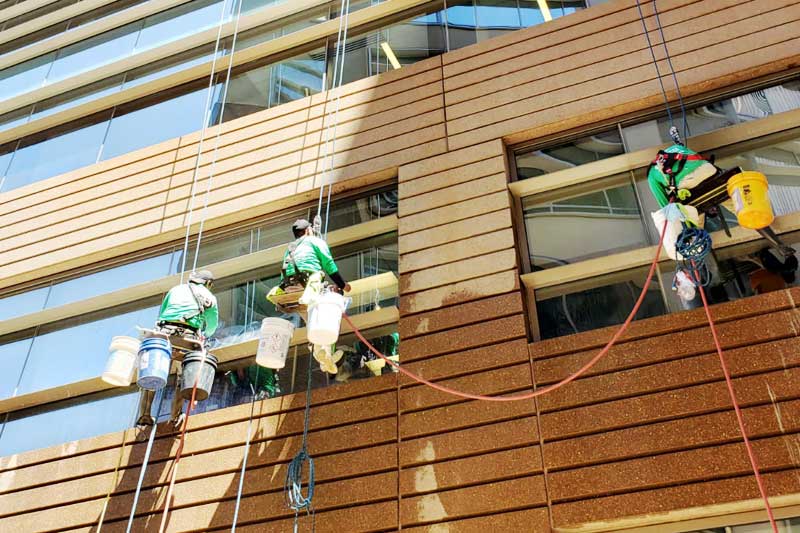
Presto Restoration delivers a complete facade restoration, caulking and waterproof coating program built around the Upstate’s dominant inventory: heavy load-bearing brick. Converted textile mills such as Judson, Brandon, Monaghan, Poe, Woodside and American Spinning carry multi-wythe walls and window openings sized for daylighting rather than for modern glazing, which changes how a perimeter joint behaves and how a scaffold or rope-access plan has to be laid out. Our crews pair industrial rope access and swing-stage capability with restoration products we manufacture ourselves, replacing spent sealants, refinishing corroded architectural metals, applying breathable elastomeric membranes and repointing to the right mortar strength for the wall in front of them.
Trace a commercial leak back far enough and the trail usually ends at a spent sealant joint. In Greenville the mechanism is repetition rather than intensity: a joint that is wet in every month of the year and then crosses freezing on roughly 57.6 nights loses elasticity through sheer cycle count, and the thaw water from a glaze event finds the split the same week it opens. Presto’s technicians strip out the spent material, prepare each joint, and set proper backer rod before installing industrial-grade silicone and polyurethane sealants rated for high movement. Window perimeters, expansion joints, panel joints, penetrations and control joints are all addressed in a single coordinated pass across the facade rather than patched one complaint at a time.
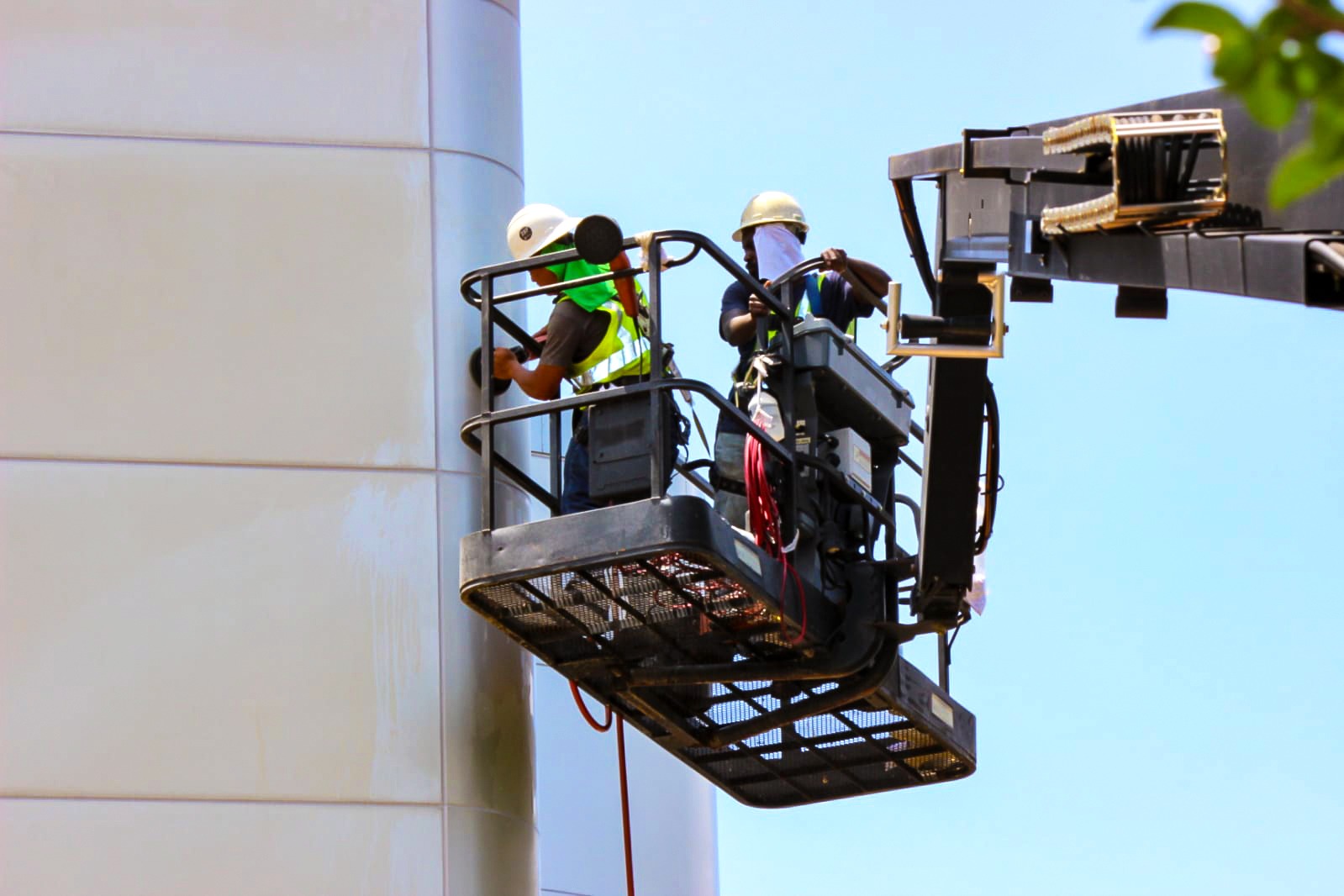
Aluminum storefront, ACM panel (Alucobond), mullions and architectural trim show up across Greenville’s newer Pelham Road and Woodruff Road inventory and on the window walls inserted into mill conversions. What dulls them here is not spray but residue: a facade that is wet most of the year holds airborne grime against the finish, spring pollen bonds into it, and mineral runoff off masonry above leaves streaks that ordinary washing never lifts. Wholesale panel replacement is rarely the first answer, and our metal restoration team can usually bring the original finish back instead. Controlled micro-abrasion strips oxidation and embedded contamination, and refinishing revives factory color and luster, giving owners like-new metal at a fraction of replacement cost. (A protective clear coating normally follows once the metal is refinished, which is why this scope pairs with our Commercial Waterproofing services on the same mobilization.)
Glass on Greenville buildings takes abuse that no window-cleaning contract can undo. Alkaline runoff from brick and cast stone above etches the surface permanently, irrigation overspray and rain runoff bake mineral deposits into it, and the spring pollen load that put Greenville at number ten on the 2026 Allergy Capitals list settles into every micro-pit and stays there. Our chemical glass restoration process dissolves staining, lifts mineral contamination and removes surface damage while preserving the glass itself, returning true optical clarity. (To hold that clarity rather than buy it back every few years, ask about our Glass Defender treatment, which is detailed on the commercial waterproofing page. Most Greenville clients bundle the two.)
Stucco, EIFS, precast concrete and masonry share one weakness in the Upstate: porosity meeting a wall that is rarely dry. With rain falling in every month of the year, these substrates stay loaded, and the shallow freeze-thaw cycle then expands that moisture dozens of times a winter instead of once, which is how hairline cracking turns into spalling and rebar corrosion. The answer on these substrates is an elastomeric coating system that cures to a membrane which stays flexible and still lets the wall breathe. The membrane moves with the structure’s thermal expansion and bridges hairline cracks up to 1/16 inch, stopping bulk water at the surface while letting trapped vapor escape, which matters on older Greenville walls that were never built to be sealed shut. Systems are offered in a complete palette of factory colors and finishes, so the waterproofing doubles as a facade facelift.
Greenville’s stonework is mostly accent rather than field: cast stone surrounds, granite bases and terra cotta detail on Main Street buildings like the Bank of Commerce of 1905 and the Westin Poinsett of 1925, plus precast panels on later commercial construction. Porous stone in a market this wet collects biological staining and efflorescence rather than salt contamination, and the difference matters because the cleaning chemistry is not the same. We open every stone project with careful substrate evaluation and gentle, controlled cleaning that lifts contamination without scarring the surface, then apply penetrating sealers and breathable coatings that block moisture while preserving the material’s natural character. Spalled or damaged sections receive color-matched patching engineered to behave like the original substrate.
In any brick wall system the mortar fails long before the masonry does, and in Greenville that is the single most consequential fact about the building stock. The mill conversions and Main Street blocks here are heavy load-bearing brick, several wythes deep, with joints that run correspondingly deeper than a modern veneer’s. Once those joints erode under year-round wetting and repeated shallow freeze-thaw, rainwater travels into the body of the wall rather than down a drainage cavity, producing interior leaks, efflorescence blooms and eventually loosened brickwork.
Presto’s masonry crews grind eroded joints to the proper depth for the wall’s actual thickness, install replacement mortar matched to the original in color, compressive strength and composition, and tool the finished joints to reproduce the original profile: structural repointing and decorative tuckpointing carried out by one crew under one scope.
On mill-era and pre-war Greenville buildings we specify lime-based mortar blends consistent with period construction, because a hard modern mix on soft historic brick moves the failure into the brick face where it cannot be undone.
Presto runs every Greenville facade project through a disciplined five-phase process, built to surface every defect before work begins, keep crews and building occupants safe during execution, and hand over fully documented results at completion.
Every elevation is examined three ways: from grade, from the air, and close up from suspended access. Sealants, metals, glass, stone, coatings and masonry are each photographed and logged, and every defect is mapped onto the elevation before a number is written.
If a leak or concealed deterioration is suspected, controlled spray testing, infrared scans and moisture readings follow, so the scope names the actual entry point rather than the spot where the water showed up.
Those findings turn into a line-item scope carrying quantities, named products and a phased schedule. Your project manager handles access logistics, occupant communication, and permitting through the City of Greenville Building and Permit Center or Greenville County Building Safety.
Certified rope-access and swing-stage crews execute the work to manufacturer specification, with a field supervisor holding quality control and logging progress each day.
Turnover includes the full record: warranties, manufacturer data, photography from before and after, and a maintenance schedule that says what to watch and when.
Facade work in the Upstate runs from tight Main Street frontages with almost no staging room to mill campuses with acres of blank brick elevation, and covering both well takes more than a crew on site. Presto coordinates a network of specialized regional divisions so clients receive seamless coverage, from major envelope restoration down to routine facility care.
For day-to-day and preventative support, these sister divisions can be contacted directly:
Building Restoration Greenville: Structural repair and exterior preservation on individual buildings.
Building Maintenance Greenville: The recurring preventative work that keeps a property performing between restoration cycles.
Building Services Greenville: Day-to-day commercial building support across the Upstate market.
For more than 27 years, Presto Restoration has protected commercial properties nationwide. On a Greenville facade that experience shows up in specification rather than in slogans: mortar matched to soft mill-era brick instead of a hard modern mix, sealants rated for the cycle count a 57.6-night freeze season produces, and coatings that stay breathable on walls that are wet most of the year. Explore our full range of Greenville building restoration services.
Cracked joints, rust bleed under a shelf angle, spalling brick faces? Describe what you are seeing on your Greenville building and our specialists will tell you what is driving it and what the realistic options are.
Call 1-800-785-9927 or start with Request A Quote.
No ordinance drives this in Greenville, or anywhere in South Carolina, so the cycle is set by condition rather than by a compliance calendar. What we plan around is a full envelope inspection on a three to five year interval, sealant replacement between eight and twelve years, elastomeric coating renewal between ten and fifteen, and repointing on a twenty to thirty-five year horizon. Where a given building lands inside those ranges is decided by exposure rather than age. West and north elevations dry slowest after rain that arrives in every month of the year, so they reach the short end of the sealant window first. Thick mill-era load-bearing brick, once pointed correctly with a mortar softer than the brick, generally holds the long end of the repointing range. It is worth saying what does not apply here: Charleston, the other South Carolina market we serve, runs its cycle off drivers Greenville does not have, because this city sits 206 miles inland at an elevation of 955 feet, and the corrosion driver that shortens a Lowcountry cycle is simply not present in the air here.
Greenville gives you two good diagnostic moments. The first is the few hours after a long soaking rain, when interior staining or a musty edge near exterior walls, dark streaking below joints outside, and damp that arrives slowly rather than all at once all point at a joint or a window perimeter rather than a roof. The second is the end of winter, when you look at the brick itself. Mortar eroded back behind the face, brick flaking or losing its face, and spalling along repeating courses are what roughly 57.6 shallow freezing nights do to masonry that has been wet since October. Between those two moments, the things worth noticing are sealant that has hardened, split or let go of one side of a joint, rust bleed trailing out of lintels and shelf angles, white efflorescence pushing out through brick and cast stone, and glazing that stays hazy after the spring pollen has washed off, which is usually etching rather than dirt. All of it says the same thing: the envelope is taking water on rather than shedding it.
Yes. We regularly work on occupied offices, hotels, mill conversions and mixed-use blocks across the Greenville market. Rope access lets us avoid the footprint and noise of scaffolding, which matters on a tight Main Street or West End frontage where there is nowhere to stage. We schedule disruptive tasks outside peak hours where possible, keep property managers and ownership updated, and phase the work so lobbies, amenity space and parking stay usable.
Scope and elevation area drive this, which is why a wide four-story mill often outruns a taller downtown office building on the schedule. Figure two to four weeks for a focused sealant replacement on a mid-rise. Figure three to six months for a full program covering caulking, coatings, repointing and metal work on a large building, with repointing through deep multi-wythe joints usually setting the critical path. Then add the weather to either one, because mortars, sealants and coatings all carry cure requirements, and a market with rain in every month and cold snaps through the winter will move a date that was set without allowing for them. Ownership gets firm dates once the building has been scoped.
Coverage is not one blanket number. Each system on the building carries its own terms: the coating manufacturer warrants the coating, the sealant manufacturer warrants the sealant, and mortar and masonry repairs are warranted on workmanship, with different lengths attaching to each. All of that is set out in writing during scoping, before anything is signed, so ownership knows what is covered and for how long on every part of the scope. The complete documentation package is handed over at closeout.
Yes. Which office reviews the work depends on where the property sits. City properties go through the City of Greenville Building and Permit Center. Properties in the unincorporated county go through Greenville County Building Safety, where commercial plan review commonly runs six to eight weeks, and we build that into the program rather than absorb it late. South Carolina has no periodic facade inspection ordinance, so nothing here is driven by a compliance deadline. What can drive a schedule is preservation review: a facade inside an overlay district generally needs a Certificate of Appropriateness from the City of Greenville Historic Review Board before its appearance changes, and we prepare the scope, material specifications and product data that submission rests on. Where a general contractor is already running work at the property, permitting is coordinated through them. Presto holds nationwide general liability and workers’ compensation coverage and meets the South Carolina building code requirements that apply on every project.
By the time a leak shows up inside a Greenville building, the joint or the mortar outside has usually been failing for several wet winters. Tell us what the exterior is doing and our team will point you toward the right fix while it is still a repair rather than a rebuild.
Reach us at 1-800-785-9927 or use Request A Quote.