

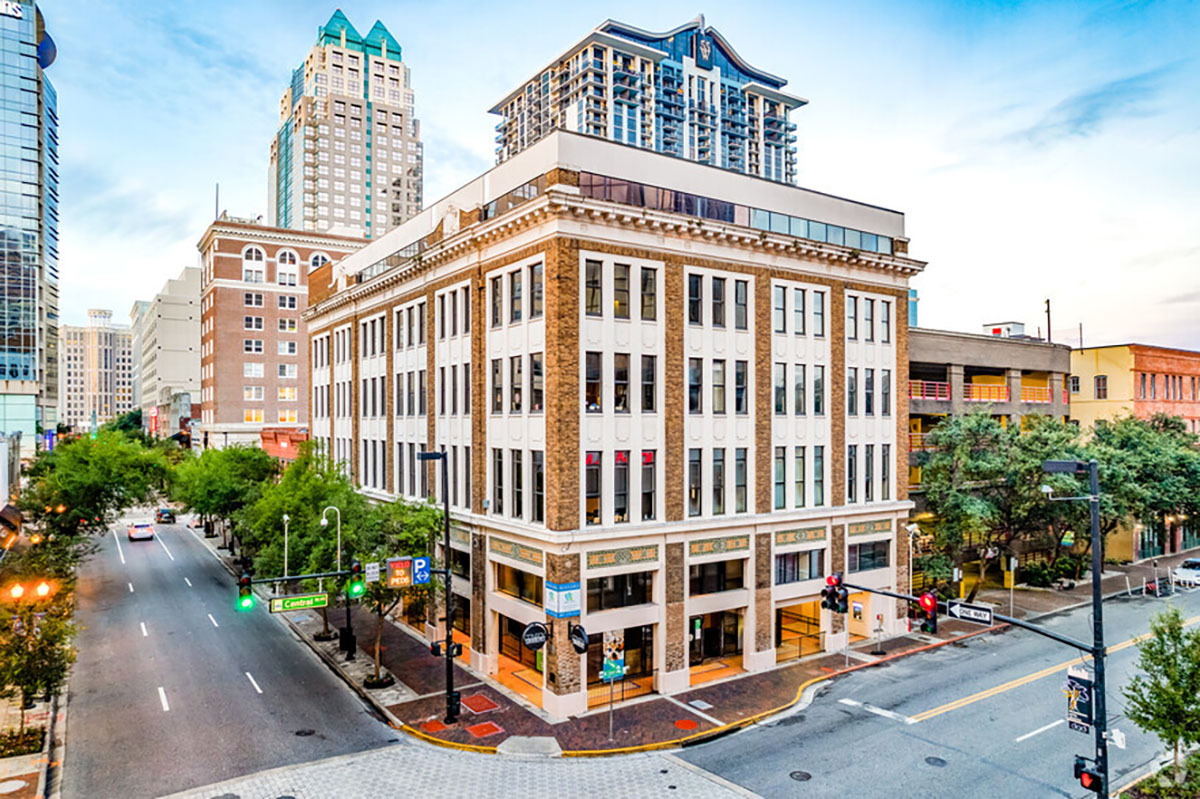







Orlando’s historic core is concentrated around Lake Eola Heights and Downtown Orlando, where early-20th-century masonry and terra cotta commercial buildings, Craftsman-era bungalows, and the railroad-era brick buildings clustered near Church Street Station represent some of Central Florida’s most significant surviving architecture. These buildings face relentless subtropical stress: near-daily summer thunderstorms, intense UV exposure, and Central Florida’s persistent humidity, which drives moisture into aging masonry and wood-frame structures far more aggressively than in drier climates. The lime mortars, soft brick, heart-pine framing, and original stucco these buildings were built with were never designed to sit behind modern sealed envelopes, and sealing them the wrong way traps moisture and accelerates decay rather than preventing it.
Presto Restoration has direct experience working on historic landmark properties throughout the United States, and we approach every historic project in Orlando with the tuckpointing precision, moisture-management judgment, and material knowledge these buildings demand. Our work typically follows the National Park Service’s Preservation Briefs, the most widely-referenced technical guidance for historic preservation work in the country, adapted to the architectural character, material specifications, and regulatory context of each individual property. We use period-appropriate materials and techniques, lime-based mortars matched to original formulations, gentle cleaning methods that don’t damage soft historic substrates, and in-kind material replacement where possible, to preserve architectural integrity while addressing structural, moisture, and mold-risk concerns unique to Orlando’s climate. Whether your building carries a local historic designation, sits within a review-board district, or is listed on the National Register, we deliver restoration work that meets the elevated standard historic properties require, including coordination with Orlando’s Historic Preservation Board and Appearance Review Board on exterior work.
Presto provides a comprehensive suite of historic property preservation services for landmark buildings, designated historic properties, and architecturally significant structures throughout Orlando.
Mortar failure is the most common, and most commonly mishandled, problem on Orlando’s historic masonry buildings. Early structures downtown were built with soft lime-based mortars designed to flex with the building and release moisture as vapor. When modern Portland-cement mortar goes into those joints instead, the harder material traps moisture inside the softer historic brick, accelerating spalling and causing irreversible damage. Our masons match new mortar to the original in color, strength, and composition, grind out failed joints to the correct depth without damaging surrounding masonry, and tool the new joints to match the original profile. It’s the slower, correct way to repoint a historic building, not the shortcut that ruins one.
Limestone, cast stone, and terra cotta trim define much of Orlando’s early-1900s downtown core, and the wrong cleaning approach can permanently scar these softer materials. Aggressive pressure washing or acid cleaning etches limestone, strips historic patina, and can expose the aggregate inside cast stone. We match the cleaning method, micro-abrasion, historic-safe chemical systems, or controlled low-pressure water, to the specific stone and its condition rather than defaulting to one process for every building. Where stone has spalled or cracked, we perform color- and texture-matched repairs engineered to blend with the surrounding original material. The goal is always a surface that reads as authentically preserved, not artificially polished to look new.
Original windows are among the most defining features of Orlando’s historic downtown buildings, and they’re also among the most frequently lost to well-intentioned renovations. Replacing historic windows with modern units typically damages a building’s architectural character and can jeopardize any historic designation it holds, while performing worse over time than a properly restored original. Our window restoration work preserves the original glass, frames, and hardware while fixing what’s actually failing: hardened glazing compound, deteriorated putty, corroded hardware, and gapped perimeter sealants. A properly restored historic window, maintained on a normal cycle, can easily outlast a modern replacement rated for just 15 to 25 years.
Traditional lime-based stucco is fundamentally different from modern synthetic stuccos like EIFS. Historic stucco was applied in multiple coats over wood lath or metal lath, with each layer engineered to allow moisture vapor to move through the wall system. When modern materials are used to patch historic stucco, particularly modern cement-based products or acrylic patches, the repair traps moisture inside the wall, causing rapid deterioration of the surrounding original material. We restore historic stucco using materials and techniques compatible with the original system: lime-based stucco formulations, proper lath repair where needed, and finishing techniques that match the original texture and appearance. For the Mediterranean and Craftsman-era stucco common on historic buildings around Orlando’s Lake Eola Heights, this work is essential to maintaining both performance and authenticity, and any exterior work is coordinated as needed with Orlando’s Historic Preservation Board or Appearance Review Board.
Cast iron storefront columns, wrought iron balconies, and early aluminum window frames show up throughout Orlando’s historic downtown core, and Central Florida’s humidity accelerates corrosion on all of them. We preserve character-defining patina wherever it isn’t compromising structural integrity, remove only the corrosion that actually threatens the metal, and refinish using techniques matched to each specific alloy. Stripping historic metalwork down to bare substrate is a last resort, not our default approach. The goal on every project is arresting deterioration while keeping the original character intact.
A historic building’s wall assembly was designed to breathe, letting moisture that gets in during Central Florida’s frequent afternoon storms evaporate back out through the masonry and lime mortar rather than trapping it behind an impermeable barrier. Modern waterproofing systems that work fine on new concrete construction can cause serious hidden damage to historic substrates by sealing that moisture inside the wall. Our historic facade waterproofing approach uses breathable, vapor-permeable water repellents and joint sealants compatible with lime mortar, applying fully impermeable systems only where the original design called for them.
Historic property restoration requires a more thoughtful approach than standard commercial restoration. Every Presto historic preservation project follows a five-phase process designed to identify all issues upfront, specify appropriate period-correct materials, and execute the work without damaging the irreplaceable original substrate, an approach especially critical for the early-20th-century masonry and terra cotta commercial buildings found throughout Downtown Orlando and the Lake Eola Heights historic district.
We document every deterioration area on your historic property and distinguish original materials (irreplaceable) from later additions (modifiable). Understanding the building's history comes before any intervention.
We identify the original materials in detail: specific mortar formulations, stone types, original stucco composition, window glazing, and metal alloys. Laboratory analysis recommended where uncertainty exists.
Findings translated into a detailed scope with quantified line items and period-appropriate product specifications. We coordinate with property owners, preservation consultants, architects, and approval bodies.
Trained crews execute using period-appropriate materials and traditional techniques where appropriate. Strict quality control: historic projects don't allow for rework on irreplaceable substrates.
Complete project documentation delivered: before-and-after photography, materials data sheets, warranty information, and maintenance recommendations. For designated properties, this becomes part of the preservation record.
Whether your historic property is showing signs of deterioration or you’re planning proactive preservation work, our specialists will provide a free, no-obligation historic property assessment with recommendations grounded in preservation-grade practice.
Call 1-800-785-9927 or Request A Free Quote.
Delivering elite restoration and waterproofing services to the Orlando area requires a dedicated local infrastructure. To provide our clients with the most comprehensive care possible, from major structural restoration to ongoing facility upkeep, Presto coordinates with our specialized regional networks.
For routine upkeep and localized facility services, we encourage property managers to explore our sister divisions:
Building Restoration Orlando: Dedicated to the ongoing, preventative maintenance required to keep your Central Florida property operating flawlessly.
Building Maintenance Orlando: Focused on localized structural repairs and building exterior preservation.
Building Services Orlando: Your resource for comprehensive, day-to-day commercial building support in the Orlando market.
Browse a selection of recent historic preservation and landmark restoration projects completed by Presto in Florida.
Standard building restoration focuses on returning a building to functional, watertight condition using modern materials and techniques. Historic preservation has a higher and more nuanced goal: maintaining the building’s structural and waterproofing performance while preserving its original architectural character, materials, and craftsmanship. This means using period-appropriate materials (like lime mortars instead of modern Portland cement), gentle techniques (calibrated cleaning instead of aggressive blasting), and reversible interventions where possible (so that future preservationists can undo our work if better methods emerge). Historic preservation costs more upfront, but it preserves both the building’s character and its historical designation, value that modern replacement materials destroy.
Historic masonry buildings were constructed with soft lime-based mortars that were designed to be slightly weaker than the brick or stone around them. This is intentional, when the building flexes seasonally or experiences thermal movement, the mortar absorbs the stress rather than the masonry. The mortar also allows moisture vapor to escape through the wall system. When historic buildings are repointed with modern Portland-cement mortars, the harder mortar traps moisture inside the soft historic brick, causing the brick face to spall (flake off) under freeze-thaw cycles or hydraulic pressure. The result is irreversible damage to the original substrate. Properly formulated lime mortar repointing preserves both the building’s performance and its original masonry.
Yes, and properly restored historic buildings often perform better than people expect. Original windows, when properly restored with new perimeter sealants and glazing compound, can perform comparably to modern replacements. Historic masonry walls have excellent thermal mass that moderates interior temperatures. Original waterproofing, when restored using breathable systems, often outperforms modern impermeable approaches because it prevents moisture damage. The key is restoration using appropriate materials, not replacement with modern equivalents. We focus on the exterior envelope; for interior energy efficiency improvements, building owners typically work with specialized historic-rated mechanical and insulation contractors.
Historic preservation projects move more slowly than standard restoration work because the materials, techniques, and quality control standards are more demanding. A facade restoration on a small historic commercial building might take 2-4 months. A comprehensive preservation project on a larger landmark property can take 6-12 months or longer. Project timelines also depend on regulatory approvals required for designated historic properties, which can add weeks or months before any work begins. We provide detailed timelines during project scoping so property owners can plan accordingly.
We’ve worked on landmark properties of various designation levels. Each project’s requirements vary based on the specific designation, local historic district, state historic register, National Register listing, or National Historic Landmark, and on what work requires regulatory approval versus what doesn’t. We can discuss the specifics of your property’s designation status during the initial assessment and outline what coordination will be required for the proposed scope of work.
For designated historic properties in Orlando, the regulatory approval process is usually managed by the property owner working with a preservation architect or consultant, often in coordination with Orlando’s Historic Preservation Board or Appearance Review Board for exterior restoration work. Our role is to provide accurate scope, materials specifications, and project documentation that meets preservation-grade standards. We coordinate closely with the property owner’s preservation team throughout the project to ensure our work supports any required submissions or approvals. We comply with all applicable local and state requirements on every project.
Yes. Presto’s historic preservation work typically follows the National Park Service’s Preservation Briefs, the most widely-referenced technical guidance series for historic restoration in the United States. The Preservation Briefs cover specific technical topics like masonry cleaning, mortar formulation, historic window restoration, stucco repair, and many other preservation-relevant subjects. Depending on the building’s historical designation, architectural character, and any project-specific material specifications, we may also follow additional preservation standards or guidelines as appropriate. Property owners working with preservation architects can review our proposed scope against the relevant Preservation Briefs to ensure our approach meets the technical requirements for their specific project.
Historic buildings can’t be replaced, and they can’t be properly restored using modern materials and shortcuts. A free historic property assessment from Presto Restoration identifies what your building actually needs to maintain its character, performance, and value for generations to come.
Call 1-800-785-9927 or Request A Historic Property Assessment online.