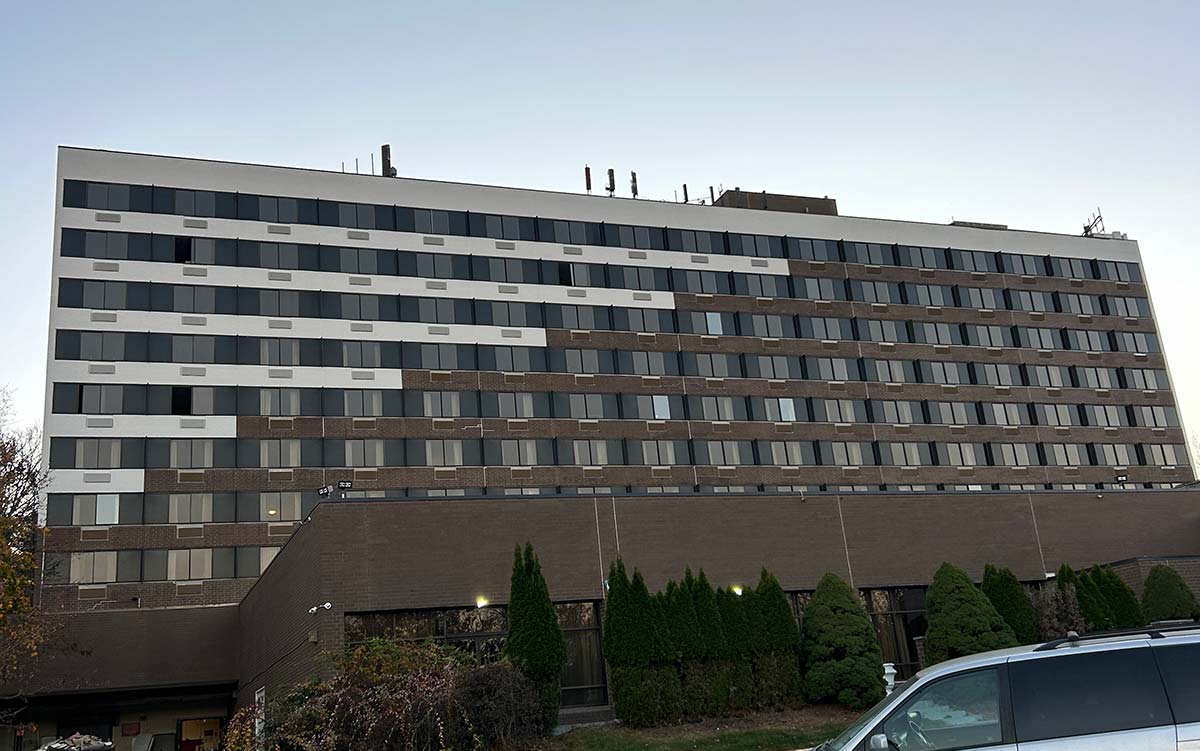
Hartford’s historic building stock was cut from Portland brownstone, laid up in Victorian brick, and framed by the heavy industrial masonry of the Colt Armory. Downtown storefronts, the rowhouses of Asylum Hill and Frog Hollow, the institutional landmarks ringing Bushnell Park — these buildings hold the city’s record in their walls. They also stand in the Connecticut River valley, where the freeze-thaw cycle runs through the whole winter. Water finds a joint or a pore, freezes, expands, and opens the gap a little further each time. Brownstone takes that hardest of all. It is a soft, bedded sandstone, and where a unit was set face-bedded, its natural layers run parallel to the wall face instead of into it. Water works between those layers, freezes, and lifts the face away in sheets and scales. The stone delaminates; it does not simply wear down. Once a face has gone, the surface behind it drinks more water than the one it replaced, so each winter takes more than the one before.
Before any of that gets repaired, someone has to establish who reviews the work. Hartford runs two separate bodies, and owners regularly assume the wrong one. The Historic Properties Commission takes up work on properties inside a local historic district. The Historic Preservation Commission takes up properties listed as state or national historic resources. Which one you answer to depends on how your building is designated, not on where it stands or how old it looks. For exterior alterations inside a Connecticut local historic district, the governing document is a Certificate of Appropriateness under CGS §7-147, and the commission has 65 days to act on an application before it is deemed approved. Read that clock as scheduling information. On a designated building, a real share of the project calendar belongs to review rather than to construction, and the quality of the scope you submit decides how smoothly that share goes.
Presto Restoration works on landmark and designated buildings across the country, and every historic assignment follows the same materials-first sequence. Our scopes generally track the National Park Service’s Preservation Briefs, the field’s most widely respected technical reference. We then fit that guidance to the material in front of us and to the commission that has say over it. In Hartford that means mortar mixed softer than the stone it beds against, so a joint gives way before a brownstone face does. It means cleaning calibrated for sandstone that has already lost part of its skin. It means weighing Dutchman repair and patching against full unit replacement one stone at a time. Whether your building sits inside a local historic district, is listed as a state or national historic resource, or falls under both, the work has to survive a harder standard than ordinary commercial repair.
Presto handles the full range of preservation work on Hartford’s designated landmarks, local historic district properties, and buildings of architectural record across the Capitol Region.

Repointing is the repair that most often finishes off a Hartford historic building. Nineteenth-century walls here were bedded in soft lime mortar, and that softness was the point. The joint was meant to be the weakest part of the wall, so movement and freezing damage would concentrate in a line of mortar a mason can replace rather than in stone nobody can. Repoint the same wall in a hard portland-cement mix and you invert the design. The joint becomes stronger than the units around it, moisture that used to leave through the joint is driven out through the stone face instead, and a Connecticut winter then takes that face off in scales. The damage usually shows two or three seasons after the work, which is why it gets blamed on the weather rather than on the mortar. Our masons match the replacement mix to the original in strength, color and composition, keep it softer than the unit beside it, cut failed joints out without biting into the arris, and tool the new joint back to the profile it had. On the Victorian brick of Asylum Hill and Frog Hollow the same logic holds at a different hardness.
Once a brownstone face has started to come away, the question is no longer whether to repair it but how far to go on each individual stone. A color- and texture-matched patch suits a unit that has lost a shallow layer and still has sound material behind it. A Dutchman repair, cutting out the failed portion and letting in a new piece of stone, suits a unit where the loss runs deeper but the surrounding masonry is worth keeping. Full replacement is the last option, and on a designated building it is also the one most likely to need commission review before anyone lifts a chisel. We make that call stone by stone and put the reasoning in writing, because an application that says “repair as required” comes back with questions. Cleaning gets the same treatment. Sandstone that has already lost part of its skin will not take aggressive pressure or a strong chemical, and a soot-darkened Hartford elevation tempts people into both. We test on a sample panel, use the gentlest method that actually works, and stop well short of stripping the age off a building that is supposed to look its age.


Historic windows are usually the first thing an owner proposes to replace and the first thing a commission pushes back on. Inside a Hartford local historic district, swapping original sash for modern units is an exterior alteration, so it needs a Certificate of Appropriateness first, and a proposal to remove original fabric is always a slower conversation than a proposal to repair it. The engineering argument tends to land on the same side. Wood sash and steel casements in Hartford’s Victorian and Colt-era buildings rarely fail as windows. They fail at hardened glazing compound, at corroded steel muntins, at seized hardware, and at perimeter sealant that opened up over a few winters and now lets meltwater in behind the frame. All of that is repairable. We keep the original glass, frames and hardware, fix what is genuinely failing, and where an owner wants better thermal numbers, storm units carry that load without the sash being thrown away. A restored window that gets maintained will outlast the replacement that was meant to save it.
Hartford’s commercial blocks and institutional buildings carry a great deal of ornament: terra-cotta sills, bands and window surrounds, pressed-metal and brownstone cornices, carved trim over entrances. Ornament is where water goes first. Every projecting course is a horizontal surface in a climate that puts snow on it, melts it, and refreezes it at the edge. Glazed terra-cotta fails when the glaze crazes and lets water into the softer body behind it, which then freezes and pushes the glaze off in flakes, while the iron anchors set into the wall rust and swell at the same time. Cornices fail at their joints and at the flashing above them. We repair terra-cotta units in place wherever the body is sound, replace anchors that have expanded, and reproduce units only where they are genuinely past saving. On brownstone trim the mortar rule still governs: whatever goes into the joint stays softer than the piece it carries. Ornament is also the part of an elevation a commission studies hardest, so we record profiles and dimensions before anything comes off the wall.


Cast-iron storefront columns, bronze entrance surrounds, copper cornices and ornamental ironwork run right through Hartford’s historic inventory, from downtown commercial blocks to the Colt Armory complex. The corrosion driver here is de-icing salt and standing meltwater. Salt tracked onto sidewalks and entrance steps splashes onto the base of a column or a railing, and that lower few feet corrodes years ahead of the metal above it. Water sitting in a horizontal seam through a freeze does the rest. We remove active corrosion where it is doing structural damage, treat and prime the substrate, and stop there. The patina on bronze and copper is part of what makes the metal historically legible, so stripping it back to bare substrate is a last resort rather than a default setting. Where a piece has to come off for shop work, we record its position and its fixings first, because on a designated building the reinstallation is looked at as closely as the repair.
Waterproofing a historic wall is a different problem from waterproofing a new curtain wall, and the difference is vapor. Lime-bedded brownstone and brick were built to let moisture that gets in during a storm evaporate back out through the wall. Seal that wall with a modern impermeable coating and the moisture has nowhere to go, so it moves to the coldest surface available, freezes there, and works on the stone from behind while the elevation still looks freshly treated from the street. On Hartford’s historic elevations we use vapor-permeable water repellents and joint sealants compatible with lime-based construction, and reserve fully impermeable systems for the specific details the original design used them on. Everything in this scope sits above grade: wall faces, mortar joints, parapets, copings, and the details around every opening.

A designated Hartford property gets worked in a different order than an ordinary commercial building. Review comes before construction, and the 65-day clock on a Certificate of Appropriateness only starts once a commission has an application it can actually act on. Every Presto historic project therefore runs through five phases: settle jurisdiction first, specify period-correct materials second, and carry out the work without harming fabric that can never be replaced.


We document every area of deterioration on your historic property and separate original fabric (irreplaceable) from later, non-original additions (modifiable). We don't touch anything until we understand the building's history.
We identify what is actually in the wall: whether the stone is original Portland brownstone or a later replacement, which way the bedding runs, the mortar mix, brick hardness, and metal alloys. Where a material is uncertain we recommend lab analysis rather than a guess.
Findings become a quantified scope with period-appropriate product specifications, written to be legible to a commission as well as to a mason. We coordinate with owners, preservation consultants and architects on what the application actually needs to say.
Trained crews carry out the approved scope using the specified materials and traditional technique where it is called for. Quality control stays strict throughout, because a soft historic substrate gives you no second attempt and rework is not an option on original fabric.
We hand over complete documentation: before-and-after photography, material data sheets, warranty terms and maintenance guidance. On a designated Hartford property that record is what supports the next commission submission years down the line.
Seeing open joints, brownstone lifting off in scales, or water tracking down a wall inside a Hartford historic elevation? Send us photographs of the elevation and we will tell you what the repair is likely to involve and what the commission will want to see in the application.
Call 1-800-785-9927 or Request A Quote.
Covering Hartford’s historic districts and the wider Capitol Region at a consistent standard takes a coordinated set of specialist divisions rather than one crew stretched across every trade. Presto runs that network so clients get continuous coverage, from major historic envelope restoration down to routine facility upkeep.
For day-to-day and preventative facility needs, we encourage property managers to reach out to our sister divisions directly:
Building Restoration Hartford: Focused on targeted structural repairs and exterior envelope preservation.
Building Maintenance Hartford: Dedicated to the ongoing, preventative maintenance that keeps Hartford properties performing through every season.
Building Services Hartford: The routine building tasks that come up between historic projects, handled on one contract.
Explore recent historic preservation and landmark restoration projects Presto has completed across Connecticut.
It depends on how the property is designated, not on how old it looks. The Historic Properties Commission reviews work on properties inside a local historic district. The Historic Preservation Commission reviews properties listed as state or national historic resources. Some buildings answer to one, some to the other, and owners regularly arrive assuming the wrong one. Establishing that is the first thing we do on a Hartford historic project, because the answer decides what has to be submitted, what the drawings need to show, and how much time belongs in the schedule before a mason ever reaches the wall.
In Connecticut, a Certificate of Appropriateness is the approval required before exterior alterations to a property in a local historic district. The authority is CGS §7-147, which gives the commission a 65-day window to respond before the application is deemed approved by default. Build that window into the project calendar rather than treating it as an afterthought. In practice the timeline turns less on the statute than on the quality of the submission. An application carrying specified mortar mixes, sample panels and clear elevations moves through. One that says “repair as required” comes back for more information, and the clock effectively starts over.
All three are legitimate, and the right answer changes stone by stone. Where a unit has lost only a shallow layer and sound material remains behind it, a color- and texture-matched patch is the least invasive option. Where the loss runs deeper but the unit is otherwise worth keeping, a Dutchman repair — cutting out the failed portion and letting in a new piece of stone — keeps most of the original in the wall. Full unit replacement is the last resort and the option most likely to draw commission questions, because it removes original fabric. We record the reasoning for each stone so the application can defend it. What we will not do is skim an elevation in a hard cementitious coating, which hides the problem for a few seasons and leaves the stone behind it worse.
Because something in a wall has to be the sacrificial part, and it should be the part you can replace. Soft lime mortar lets a wall move and lets trapped moisture leave through the joint. A hard portland-cement joint does neither. It ends up stronger than the brownstone around it, so movement and freezing stress transfer into the stone face, and moisture that used to escape through the joint is driven out through the stone instead. On soft, bedded sandstone that shows up as scaling within a few winters. On a Hartford historic building the mortar mix is not a detail; it decides whether repointing protects the wall or quietly ruins it.
Historic work runs slower than standard restoration because the materials, hand techniques and quality-control standards are more demanding. A facade scope on a smaller historic commercial building might run two to four months of construction. A full preservation scope on a larger landmark can run six to twelve months or more. Then add review. On a designated property the 65-day statutory window, plus the time needed to assemble a submission the commission can actually act on, often means the calendar begins months before scaffolding goes up. Winter matters too, since mortars and coatings have temperature limits, so parts of a scope get planned around the season rather than pushed into it. We set out both halves of the timeline during scoping.
On a designated property the approval is usually driven by the owner working alongside a preservation architect or consultant who knows what the commission expects. Our job is to supply what that process actually runs on: an accurate scope, period-appropriate material specifications, sample panels where they settle an argument, and photographic documentation that holds up to scrutiny. We stay in contact with the owner’s preservation team throughout the project so the work that gets built matches the work that was approved, and we comply with the applicable local and state requirements on every job.
Yes. Our historic scopes typically track the National Park Service’s Preservation Briefs, the most widely used technical reference for preservation work in the country. Several of them bear directly on Hartford’s building stock: masonry cleaning, mortar formulation for historic buildings, the repair of historic sandstone and brick, and historic window restoration. Depending on a property’s designation and architectural style we may layer additional standards on top. Owners working with a preservation architect are welcome to check our proposed scope against the relevant Briefs before anything starts.

A Hartford landmark cannot be rebuilt once it is lost, and modern materials applied the modern way will not put one back. Show us the building and we will set out what it takes to hold its character, its performance and its value into the next generation.
Call 1-800-785-9927 or Request A Quote online.