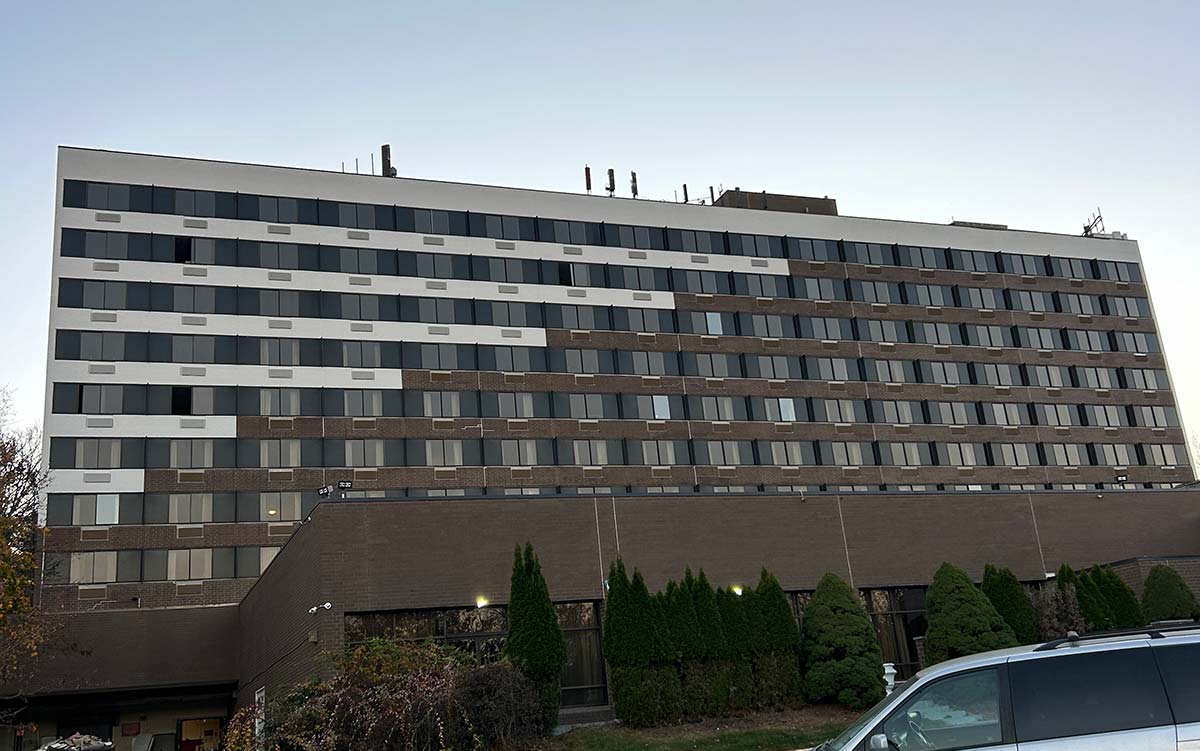
Presto Building Facade Restoration & Waterproofing
Building Facade Waterproofing & Restoration Services 1-800-785-9927

Hartford is an inland market, not a coastal one, and the Connecticut River valley sets the schedule its building envelopes fail on. The signature material here is brownstone, quarried at Portland, Connecticut, a few miles downriver from the city. That quarry site is now a National Historic Landmark, and its stone faced landmark buildings in Hartford, New Haven, New York, Boston, Chicago, Philadelphia, Baltimore and Washington. Brownstone is a soft, bedded sandstone. It carries natural layers, much the way a plank carries grain. Set with those beds running perpendicular to the wall face, it weathers slowly and predictably for a century and a half. Set face-bedded, with the layers lying parallel to the face, it does something else entirely: water works in between the layers, freezes, and lifts the outer skin away in sheets and scales. That is delamination, not erosion, and the difference decides the repair. Worse, the fresh surface behind a spalled face drinks water faster than the original ever did, so every winter takes more stone than the one before it.
Presto Restoration runs a facade, caulking and coating program built around that behavior. Crews work from swing stage and rope access on Victorian brick in Asylum Hill and Frog Hollow, on cast stone and terra cotta trim, and on the architectural metal and curtain wall of the downtown insurance towers. Sealant joints go first on all of it. We cut out spent sealant, apply flexible elastomeric membranes above grade, refinish corroded metal, and repoint with mortar deliberately softer than the stone beside it, so the joint sacrifices itself and the brownstone face survives. For more than 25 years Presto has protected commercial property nationwide, and what gets specified for your building is specified for a Connecticut winter.

Deteriorated sealant is the most common leak path we find on a Hartford building, and cold is what wears it out. A joint opens as the assembly contracts in January. Water stands in the opening, freezes, and levers it a little wider every time the temperature crosses freezing, which in this valley happens over and over through the winter. Nor’easter winds then push rain into joints ordinary rainfall never reaches. By spring the sealant has lost its recovery, split at the bond line, and handed water a direct route into the wall. Presto’s high-rise technicians cut out the spent material, prepare and prime each joint, set correctly sized backer rod, and install industrial silicone or polyurethane rated for the movement a New England annual temperature swing actually produces. Window perimeters, expansion joints, panel joints, penetrations and control joints are all handled in one coordinated pass across the elevation.
Hartford’s insurance towers put large areas of aluminum, ACM panel (Alucobond), mullion and architectural trim on permanent display: Travelers Tower, Goodwin Square, CityPlace I, and the mid-century curtain wall at Constitution Plaza. Winter is what dulls them here. De-icing salt carried up off street and plaza level, months of freeze-thaw at the panel joints, and grime that stays locked to a surface which never fully dries through a humid river-valley summer all combine to pit finishes and flatten factory color. Before anyone budgets for wholesale panel replacement, let our metal restoration team try to recover what is already on the building. Controlled micro-abrasion lifts oxidation, corrosion and embedded contamination, and refinishing brings back the original color and luster. Owners get like-new metal at a fraction of replacement cost, with far less disruption to a working building. (Restored metal is typically sealed with a protective clear coating afterward: see our Commercial Waterproofing services, which pair naturally with this work.)


Glass on a Hartford tower picks up damage no cleaning contract can reverse. Alkaline runoff from the concrete, cast stone and masonry above it etches the surface permanently. Winter road treatment gets thrown up onto lower-level glazing and leaves a haze that comes straight back the next time the plows run. Irrigation overspray and summer rain runoff bake mineral deposits in on top of that. Our chemical glass restoration process dissolves the staining, lifts mineral contamination and removes fine surface damage without touching the glass itself, so the curtain wall gets its real optical clarity back rather than a temporary shine. (To hold that clarity through the next winter, ask about our proprietary Glass Defender treatment, covered on the commercial waterproofing page. Most Hartford clients bundle the two.)
Stucco, EIFS, precast concrete and masonry share one weakness in the Connecticut River valley: they are porous, and a porous material in a freeze-thaw climate takes itself apart from the inside. Water absorbed during a November rain is still in the wall in January. It freezes, expands about nine percent, and pushes the surface apart from behind. Repeat that through a full winter and the result is map cracking, spalled faces and corroding reinforcement. Presto installs elastomeric coating systems that cure to a flexible, breathable membrane. The membrane moves with the structure across a wide annual temperature swing and bridges hairline cracks up to 1/16 inch. It stops bulk water at the surface while still letting trapped vapor out, which matters here, because heavy summer air in the valley means a wall wets faster than it dries. Systems come in a full palette of factory colors and finishes, so the waterproofing doubles as a facade facelift.


Brownstone is what makes stonework in Hartford its own discipline. The stone came out of Portland, Connecticut, just downriver, and it is soft and bedded, layered the way a plank is grained. Where a mason set a block with its beds running perpendicular to the wall face, the stone has held for a century and a half. Where a block went in face-bedded, with the layers parallel to the face, water finds the seams between those layers, freezes, and pops the outer skin off in flat sheets and scales. The stone delaminates. It does not wear back evenly, and treating it as though it does is how sound stone gets destroyed. There is a second problem underneath the first: the surface a spall exposes is more absorbent than the weathered face it replaced, so the following winter drives more water in than the last one did and the loss accelerates rather than holding steady. Our stone work therefore starts by reading the block itself, bedding orientation, sound material versus friable, and how deep the loss actually goes. Cleaning follows at the gentlest pressure and chemistry that will do the job. Then consolidation, color-matched patching keyed to the original in strength and porosity, and breathable penetrating sealers. Everything specified has to let vapor out, because stone that cannot dry is stone that will scale again. Cast stone and terra cotta trim on the same elevations get the same reading.
Mortar is supposed to be the weak part of a brick wall. That is the design, not a defect. The joint takes the movement and the moisture and gives up first, because a joint is cheap to cut out and replace and a masonry face is not.
The Victorian brick of Asylum Hill and Frog Hollow is well past the point where that sacrifice has been spent. Once a joint has weathered back behind the face of the units, freeze-thaw has somewhere to work: water stands in the recess, freezes, and takes a little more every cycle until it reaches the back-up wall and then the interior. Our masons cut the eroded joints to proper depth, install replacement mortar matched to the original in color, compressive strength, permeability and composition, and tool the finish to the profile the wall was built with.
That strength match is not a finishing detail, it is the whole job. Repoint a soft nineteenth-century wall, or brownstone, with a hard portland-cement mortar and every bit of moisture in that wall now has to leave through the masonry face instead of through the joint. The face is what spalls. So we specify lime-based blends that stay deliberately softer than the units around them.

Facade work in Hartford gets planned around the weather as much as the scope, so every project runs through the same five phases: find the defects first, price from what was actually found, execute safely around a building that stays occupied, and close out with documentation an owner can hold a warranty against.


We document the full envelope from grade, by drone, and at arm’s length from suspended access. Sealant, metal, glass, brownstone, coatings and brick are photographed and logged, so every defect is mapped before a number goes on the job.
Where a leak or concealed deterioration is suspected we run controlled water testing, infrared thermography and moisture readings. Timing matters in Hartford: a path opened by freeze-thaw may only run during a thaw, so we test when the building will actually show us the source.
Findings turn into a line-item scope with quantities, specified products and a phased schedule built around the Connecticut construction season. Your project manager handles access logistics, occupant communication, and permitting through the City of Hartford’s Department of Development Services.
Certified rope-access and swing-stage crews carry out the work to manufacturer specification. Field supervisors enforce quality control, verify substrate and ambient temperature before any coating or mortar goes on, and document progress daily.
At turnover you get the whole record: warranty documents, product data sheets, before-and-after imagery, and a maintenance plan sized to how quickly a Connecticut winter works on the envelope we just repaired.
Covering downtown Hartford and the wider Capitol Region properly takes more than a crew that turns up once a season. Presto coordinates a network of specialist divisions so clients get continuous coverage, from major envelope restoration down to routine facility care.
Property managers who need day-to-day and preventative support can approach these divisions on their own:
Building Restoration Hartford: Envelope and masonry repair scoped one building at a time.
Building Maintenance Hartford: Ongoing preventative maintenance that keeps a property performing through a full freeze-thaw season.
Building Services Hartford: Comprehensive day-to-day commercial building support.
For more than 25 years Presto Restoration has protected commercial property nationwide. What that record buys a Hartford owner is judgment about compatibility. A sandstone that sheds its face in layers will not tolerate a repair harder than itself, so the mortar, the patch and the coating each have to be chosen to stay softer and more permeable than the material they sit against. Get that wrong and the repair accelerates the very failure it was meant to arrest. We also know the review path. Exterior alterations in a Connecticut local historic district require a Certificate of Appropriateness before work starts, and the commission has 65 days to act, so that filing is scoped into the program at the outset rather than discovered halfway through it. Explore our full range of Hartford building restoration services.
Seeing brownstone scaling off in sheets, sealant joints standing open, or a stain spreading on an interior wall? Send us a photograph and a short description, and we will tell you whether you are looking at a sealant problem or a stone problem.
Call 1-800-785-9927 or Request A Free Quote.
Freeze-thaw cycling sets the interval here, not a fixed calendar. As a general guide: a full envelope inspection every 3-5 years, sealant replacement every 8-12 years, elastomeric coating renewal every 10-15 years, and repointing every 20-35 years. Brownstone elevations sit outside that guide. Once a face-bedded block has started to scale, the exposed surface behind the loss absorbs more water than the original face did, so the rate of damage climbs each winter instead of holding steady, and those elevations need looking at far more often.
On brownstone, look for the face lifting away in thin flat sheets or scales, and for sound-looking stone that has gone sugary and crumbles under a thumbnail. On brick, look for joints weathered back behind the face of the units and white efflorescence blooming after a thaw. Elsewhere: sealant that has split, shrunk or debonded from one side of a joint; rust streaks bleeding from lintels and fasteners; spalled concrete at balconies and window heads; glass that stays hazy after cleaning; and interior stains or a musty smell along an exterior wall. Any of those is worth a call before the next freeze.
Yes. Most of our Hartford work is on occupied office, institutional and multifamily buildings. Rope access removes the footprint and the noise of full scaffolding, loud operations get scheduled away from peak hours where the building allows it, and the work is phased so lobbies, entrances and parking stay usable throughout. Property managers and boards get progress updates for the duration.
Scope and height drive the schedule, and so does the calendar. A focused sealant replacement on a mid-rise runs 2-4 weeks. A full program covering caulking, coatings, masonry and metal on a downtown tower typically runs 3-6 months. Coatings and mortar both have minimum application temperatures, so wet trades are planned into the spring-through-fall window and we say so up front rather than promising a February start we cannot keep.
Warranty terms follow the specific coating systems, sealants and repair methods used on your building. We walk owners through exactly what is covered during scoping, before any contract is signed, and hand over the complete warranty documentation at closeout.
Yes. Our project managers file permit applications through the City of Hartford’s Department of Development Services. Where a property sits in a local historic district, or is listed as a state or national historic resource, exterior alterations also need a Certificate of Appropriateness under CGS §7-147 before work begins. The reviewing commission has 65 days to act, so that filing goes in early rather than late. Across the rest of the Capitol Region, West Hartford, Bloomfield, Wethersfield, Windsor, Newington and the other towns each run their own building department, and we file with each of them directly. Presto carries nationwide general liability and workers’ compensation coverage.

By the time a leak shows on the inside, the facade has already failed and winter has been working on it for a season or two. Get ahead of it. Describe the elevation and we will tell you what stage the deterioration has reached.
Call us today at 1-800-785-9927 or click Request A Quote.