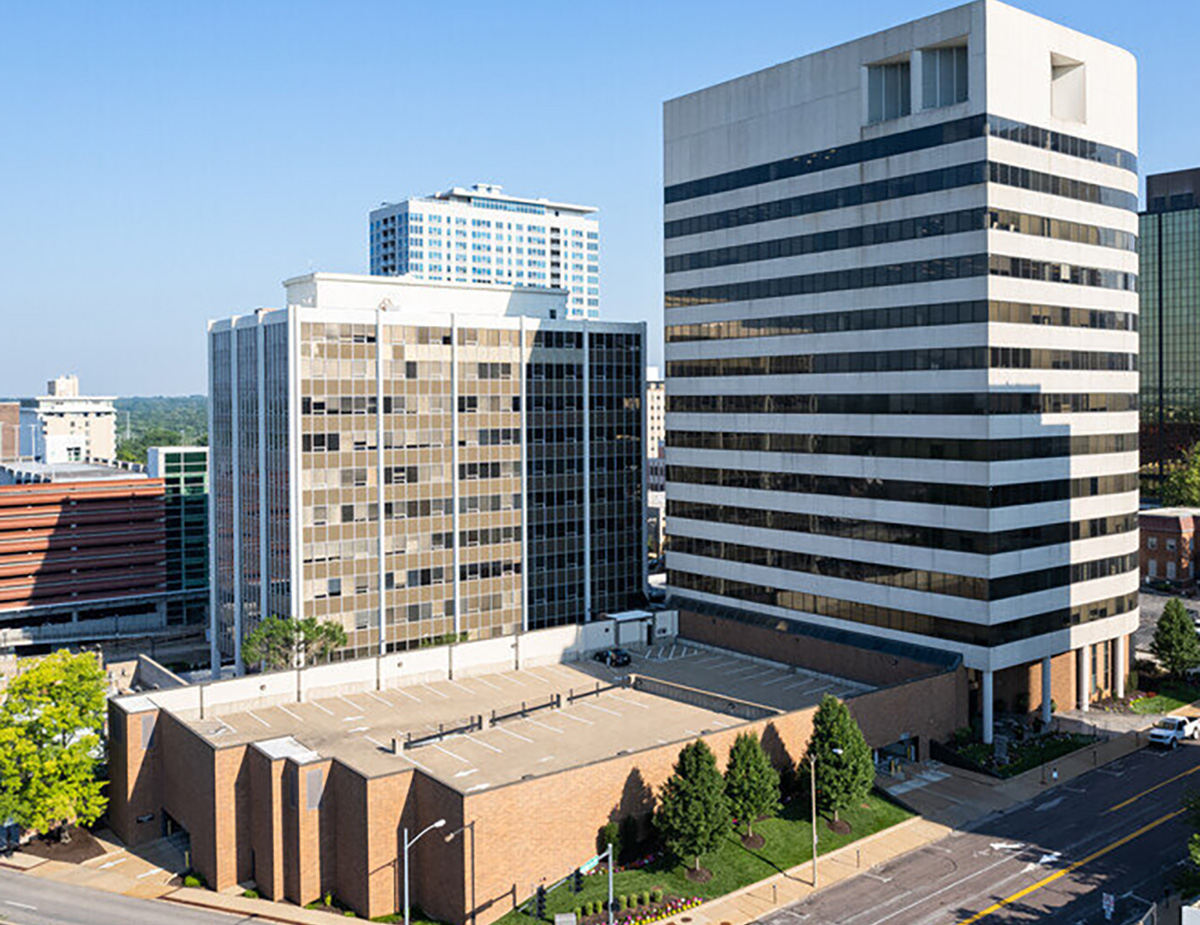






Waterproofing a building in Kansas City is really a problem of movement and temperature. Everything on the outside of a wall expands in July and contracts in January, and the joints between those materials have to absorb the whole of that range without opening up. Water that does get into a joint here does not simply sit in it either; it freezes, and freezing water is a wedge. The failures that follow are familiar to anyone who manages property in this city: damp interior walls after a thaw, efflorescence tracking down from a joint, coating blistering off a parapet, staining below a coping nobody has looked at in a decade.
Presto Restoration provides above-grade commercial waterproofing across Kansas City and the Missouri side of the metro, from downtown office towers and Crossroads mixed-use blocks to Country Club Plaza retail and suburban office space in Jackson, Clay and Platte counties. What we do differently is restore before we seal. Caulking over a contaminated or spalling substrate buys a season; cleaning and repairing it first is what makes the sealant last. The scope covers breathable masonry repellents, silicone and elastomeric coating systems, expansion joint and crack sealing, and wet glazing and glass sealing supported by our proprietary products such as Glass Defender. We also handle narrower problems such as Leach Stop Protection for precast concrete. We work exclusively above grade, not on foundations or below-grade waterproofing; that boundary is deliberate, and staying inside it is the reason the work we do take on holds.
From joint sealants to full coating systems, our above-grade waterproofing work in Kansas City splits into two groups: the core systems that keep an envelope watertight through a freeze-thaw season, and the specialized restoration-waterproofing services that clean and repair a substrate before protecting it.
Buildings in this climate move a long way over a year, and all of that movement has to be taken up somewhere. It is taken up at expansion joints, control joints and whatever cracks the structure has already developed, which is precisely why those are the first places a waterproofing system fails. Once a joint sealant has hardened or lost adhesion on one face, meltwater runs into the wall and then freezes inside it, so the joint that failed keeps getting wider on its own. We reseal with high-movement silicone and polyurethane systems rated for the local temperature range and installed to the correct joint width and depth, because a sealant asked to stretch past its rated capability will tear no matter how good the product is. On most Kansas City buildings this is the single highest-value waterproofing repair available.
Glass on a Kansas City building is under steady chemical attack from above and from the street. Mineral-rich runoff off concrete, cast stone and mortar deposits onto the glass below it; winter road spray carries de-icing chemicals onto the lower lights; and hard water from irrigation dries in place rather than running off. Left alone, all of it etches. Our proprietary Glass Defender treatment bonds a hydrophobic barrier to the glass so minerals have nothing to key into, water sheets off instead of drying on the surface, and the cleaning cycle gets easier and less frequent. Treated glazing keeps its clarity through the seasons that actually do the damage here, which are the wet ones either side of winter.
Ledges, parapets, copings, balcony edges and every other near-flat detail are where water stops moving, and standing water is a very different problem from running water once the temperature drops through freezing. Conventional coatings surrender at those locations first. For them we install high-performance silicone systems: seamless monolithic membranes bonded directly to the substrate, without the laps and terminations that ordinary products fail at. Silicone tolerates ponding, holds up under UV, and stays serviceable across a wide thermal range, which is exactly the combination a horizontal detail on a Kansas City building needs.
On a commercial tower the sealant joint between the glass and its frame is usually the first waterproofing component to go. Once that perimeter seal has hardened, split or released, water gets into the wall cavity and can travel two or three floors from the breach before anyone sees a stain, which is why the reported location of a leak is such a poor guide to its cause. Wet glazing fixes it at the source. We cut out the spent sealant and install new high-performance silicone that re-establishes a watertight bond between the glass unit and the frame. We reglaze storefront, curtain wall, ribbon and punched window systems, and the work is documented and warrantied elevation by elevation across a whole Kansas City building rather than sold as spot repairs.
Stucco, EIFS and concrete walls all develop hairline cracking eventually, and in this climate each of those cracks is a place for water to get in and then freeze. Elastomeric coatings answer that by staying flexible for the life of the film: applied at roughly ten times the thickness of ordinary paint, they stretch across a small crack instead of splitting along with it. The elasticity is the whole point on a wall that swings through a very wide temperature range between summer and winter. Our systems are breathable so interior vapor can still escape, stable under UV, and available in a full palette of factory colors and texture profiles.
Porous masonry – block, precast, cast stone, terra cotta – takes water in rather than shedding it, and in a freezing climate a saturated wall is a wall being taken apart from the inside. What shows on the outside is efflorescence, staining, spalled faces and damp interior finishes. We apply clear, breathable penetrating repellents built on silane and siloxane chemistry that soak into the substrate and make it hydrophobic without changing how it looks. After treatment the wall reads exactly as it did before, but rain beads and runs off instead of soaking in, so there is far less water in the wall when the temperature drops. These sealers are invisible once cured and stable under UV.
What sets Presto apart is the order of operations: we clean and restore a surface before we seal it. Two steps instead of one produces waterproofing that looks better, performs better and lasts longer than sealing over a substrate that was already failing. The services in this second group exist for specific problems a general waterproofing contractor is not equipped to solve.
Precast concrete carries water-soluble minerals, and any moisture moving through a panel brings them to the surface and deposits them on whatever sits below – windows, metal trim, sills, the next panel down. The result looks permanent, resists cleaning, and returns within weeks, because cleaning treats the stain and never the source. In a market with a long wet-and-freezing shoulder season there is plenty of moisture moving through precast to keep it going. Our Leach Stop Protection service treats the source instead. We clean the existing staining and then treat the precast to block further mineral migration, so a building that has been re-cleaning the same windows for years can stop.
Architectural metal panels, curtain wall framing, mullions and Alucobond composite panels take punishment from two directions in Kansas City: de-icing chemicals splashed and tracked up the lower elevations through winter, and hail impact in the storm season. Both attack the coating before they attack the metal, and once the coating is compromised the substrate follows. Rather than pushing an owner toward panel replacement, we apply protective clear coating systems that seal the metal and leave the original factory finish visible. The clear coats bond directly to the existing surface and hold moisture and chlorides off the substrate, which adds real service life to material already on the building. In most cases that takes a replacement project out of the capital plan and lowers the long-term maintenance cost with it.
Every waterproofing project runs through the same five phases: diagnose the actual failure, specify systems that suit the substrate and the temperature range, install them to the manufacturer’s written requirements, and hand over a record of what was done and where.
We survey every above-grade waterproofing system on the building - joints, coatings, exposed decks, copings, parapets, masonry walls - and log each failure point with photographs and notes tied to an elevation and a floor.
A leak almost never starts where it shows. Controlled water testing, moisture readings and visual tracing separate the actual entry point from the place the water finally came out, and the two are often several floors apart.
We name the products for your substrates - silicones, elastomeric systems, traffic membranes - as quantified line items rather than an allowance, and the project manager handles permitting and tenant coordination.
Crews work from rope access, swing stage or lifts, whichever the building actually suits. Everything goes in to the manufacturer's written specification, including its ambient and substrate temperature limits, with quality checks recorded as the work proceeds.
You get the complete file: warranty information, product data sheets, before-and-after photography by elevation, and a maintenance schedule written around the seasons that will test the work.
Seeing water inside, sealant that has let go, or coating lifting off a parapet? Describe what you have and where it shows up, and our team will tell you what is most likely behind it and what the sensible order of repair looks like.
Call 1-800-785-9927 or Request A Free Quote.
Presto Restoration has been restoring and protecting commercial buildings nationwide for more than 25 years. What that record means for a Kansas City owner is that we already know how these systems fail in a freezing climate: what joint dimension a sealant needs to survive the annual range, why a coating that performed well in a mild market blisters off a parapet here, and how far chloride exposure has usually traveled by the time the concrete starts to look wrong.
A waterproofing program is a project; keeping a building dry is a habit. To cover both, from major envelope restoration down to the routine upkeep in between, Presto coordinates with specialized divisions working the Kansas City market.
For routine upkeep and site-level facility work, property managers are welcome to approach our sister divisions directly:
Building Restoration Kansas City: Focused on the structural repairs and exterior preservation work that come up between waterproofing cycles.
Building Maintenance Kansas City: Dedicated to the preventative maintenance that gets drains, copings and joints clear before the first hard freeze.
Building Services Kansas City: Your resource for the ordinary weekly building care that keeps a waterproofing system working.
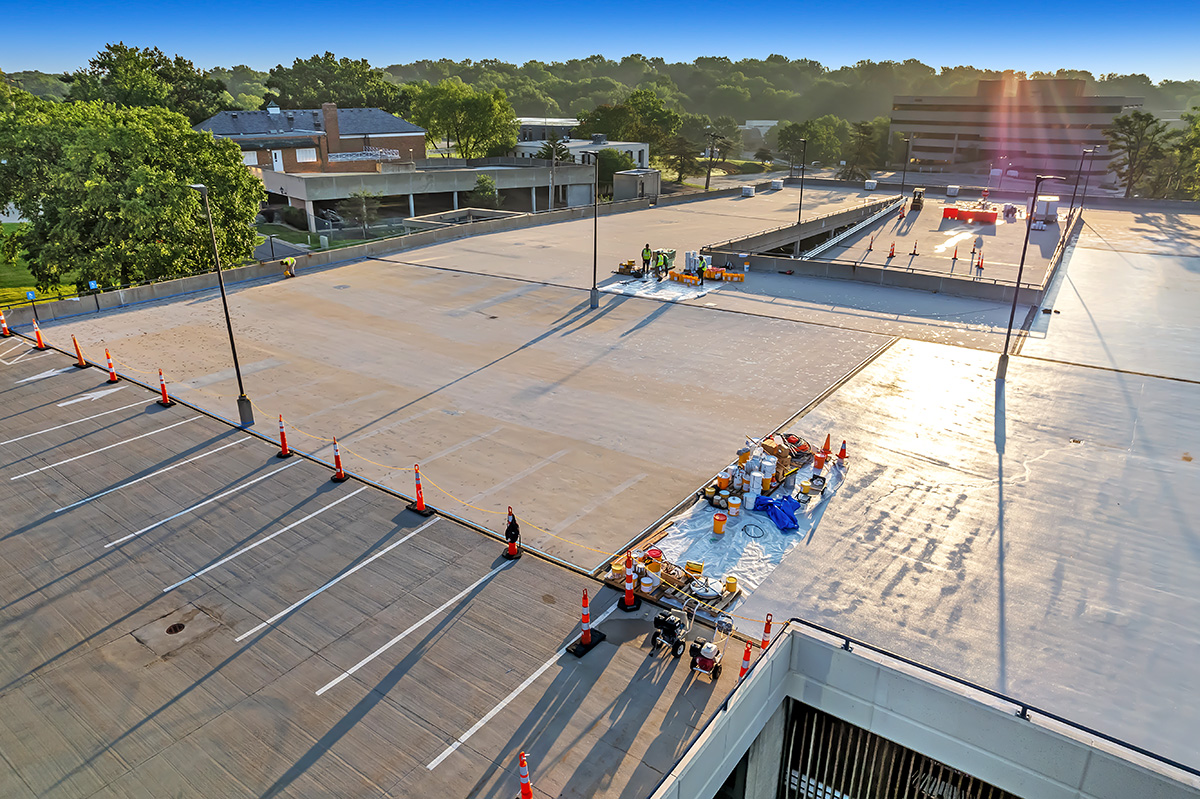
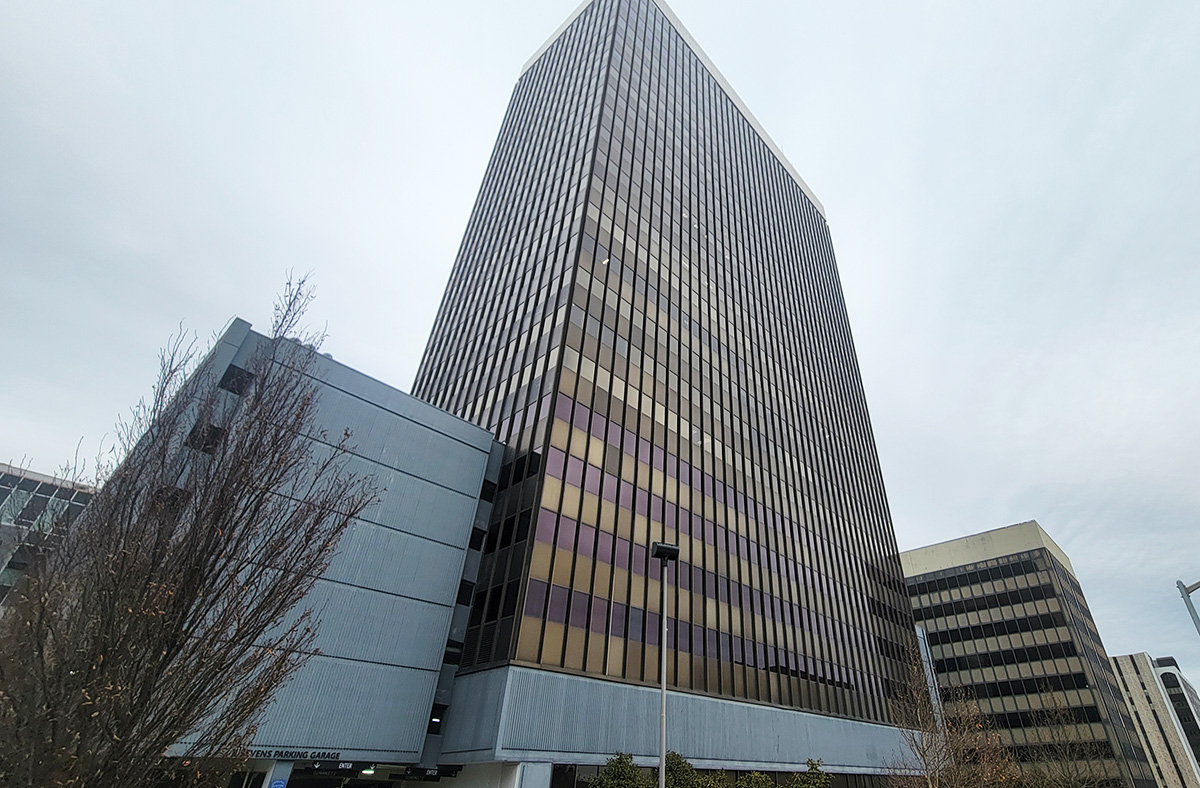
Take a look at a sample of recent commercial waterproofing, caulking, and coating projects Presto has completed across Missouri.

Manufacturer ratings assume a gentler service life than this climate provides. A product rated for 15-25 years will often show real failure at 10-15 on an exposed elevation here, because the joint is being cycled through its full movement range every year while the material itself stiffens with age. South and west elevations go first, then copings and anything sitting above a horizontal surface. An envelope inspection every 5 years is the cheapest way to find that before it becomes interior damage.
No. They sit at opposite ends of the same problem. Waterproofing is preventative work on the outside of the building: sealants, coatings and membranes installed so water never gets in. Water damage restoration is what happens after it already did, which is drying, replacing finishes and dealing with whatever grew. Presto works on the preventative side, on the exterior systems that keep water out of the envelope, and over any reasonable timeframe that costs far less than repairing the inside again.
Occupied, yes, and almost all of it is: office towers, hotels, hospitals, residential buildings. We use rope access rather than scaffolding wherever the building allows it, put the noisy operations outside peak hours, keep tenants informed, and phase the sequence so common areas and parking stay in use. Winter is the harder question. Most sealants and coatings carry a minimum application temperature and will not cure properly below it, so cold-season work either gets a heated enclosure or gets scheduled for spring, and we say which of the two applies before anything is signed.
Paint is a finish. It gives you color and a little weather resistance, and it does not stretch, so when the wall moves the paint cracks exactly where the wall cracks. An elastomeric coating is a waterproofing system that also happens to look good: far thicker film, flexible with the substrate, and able to bridge hairline cracking so water cannot get through it. On a wall that runs through a wide annual temperature range and holds water that then freezes, that difference decides whether the wall is protected or merely painted.
Some signs mean now. Joint sealant that has split or pulled away from one face. Dark streaking down a wall below a failed joint. Efflorescence on masonry or concrete. Damp patches or lifting paint on an interior wall, particularly after a thaw. Coating that is chalking, peeling or cracked along a movement line. Any visible spalled concrete or exposed reinforcement. Waiting on those does not hold the cost steady, because every winter that water sits in the wall makes the repair larger. Call 1-800-785-9927 or use the Request A Quote form and tell us what you are seeing.
Yes. Our project managers file permit applications directly, along with any association or design-review submission the property needs. Applications go through the City Planning and Development Department, and on a Kansas City Register property the Historic Preservation Commission reviews the work for a Certificate of Appropriateness before an exterior permit issues, which affects the schedule as well as the choice of mortar and sealant. Presto carries nationwide general liability and workers’ compensation insurance and complies with local and state requirements on every project.
A joint that has just let go is a small repair. The same joint after two winters of water standing in the wall behind it is not. Tell us what you are seeing and our team will tell you where on that curve your building sits.
Call us today at 1-800-785-9927 or click Request A Quote.